



Takeaways from Denver's Driverless Shuttle Deployment
The project goal is to assess the reliability and availability of an AV shuttle service and its applicability to a transit application.

Started in January of 2019, the shuttle has been running on weekdays from 10 a.m. to 6 p.m.
Photos courtesy RTD
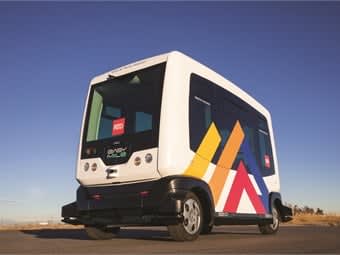
Started in January of 2019, the shuttle has been running on weekdays from 10 a.m. to 6 p.m.
Photos courtesy RTD
The Regional Transportation District (RTD) launched a first-of-its-kind pilot project in Colorado: a first-, last-mile connection to a rail station using a driverless shuttle. As described on the RTD’s website, this project is a partnership between various stakeholders that introduces EasyMile’s autonomous vehicle (AV) demonstration on a public roadway. The project goal is to assess the reliability and availability of an AV shuttle service and its applicability to a transit application. Specifically, the project objectives are as follows:
Introduce AV technology safely on a public roadway in the Denver metro area.
Provide additional connectivity between station and businesses and residential areas.
Explore first-, last-mile solutions for future growth throughout the district.
Test AV technology in a transit setting.
Started in January of 2019, the shuttle has been running on weekdays from 10 a.m. to 6 p.m. While ridership is not one of the goals of the project, many passengers and residents have come by to take a ride. Due to the novelty, this project took many months to plan and coordinate and, since deployment, the EasyMile and RTD project team leads reflected on its many lessons learned; these are outlined below.
1. Stakeholder Alignment is Key
Similar to most autonomous shuttle projects, this project involved many stakeholders:
RTD in partnership with Transdev (operator of the service).
EasyMile (the provider of the autonomous vehicle and driverless technology).
Colorado’s Autonomous Mobility Task Force (Colorado Department of Transportation, Colorado State Patrol, and Colorado Department of Revenue/DMV).
City and County of Denver (Public Works and Denver International Airport).
Panasonic and Fulenwider (the developers of Peña Station NEXT).
Since many of these project stakeholders did not have a history of working together, it was extremely helpful to have bi-weekly, in-person meetings, which were increased to weekly meetings as the kick-off got closer. As a group, representatives from each organization spent time understanding the project and the driverless technology, and then, confirmed each organization’s goals and project roles.
Lesson learned: Involve all of the potential stakeholders from the very beginning; provide a detailed introduction to the EasyMile AV shuttle technology and deployment process; and have detailed discussions around each organization’s goals, champions, critics, and concerns. These all support a project running smoothly.
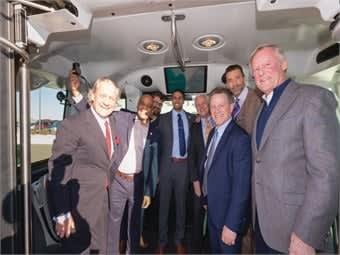
Denver RTD CEO/GM Dave Genova (third from right) is joined by stakeholders during the January 2019 launch of the agency's driverless shuttle pilot program.
2. Regulatory Processes Take Time
Since EasyMile’s driverless shuttles do not have steering wheels, rearview mirrors, and such, they do not comply with current Federal Motor Vehicle Safety Standards. EasyMile’s shuttles require a federal exemption and they are subject to state and local regulations. While EasyMile has navigated these processes for over 30 deployments in the U.S., these regulatory processes are constantly evolving.
Moreover, many state and local jurisdictions don’t have autonomous vehicle regulations and licensing processes in place, so an autonomous shuttle project requires educating policy writers and decision-makers which can prove to be time consuming.
For the 61AV project, there were many regulatory considerations:
Federal: The federal exemption process was slowed due to the government shutdown that happened toward the end of December 2018.
State: At the state level, Colorado passed Senate Bill 17-213 in mid-2017, which authorizes the use of autonomous driving systems in Colorado under certain conditions. This law designated an “Autonomous Mobility Task Force,” comprised of representatives from the Colorado State Patrol, Colorado Department of Transportation, and the Colorado Department of Revenue, to review potential autonomous deployment requests. The process was highly effective, but it was lengthy since the 61AV project was the first to undergo this process.
Local: As the owners of portions of the route, the City and County of Denver and Denver International Airport, were involved. The City and County of Denver, ultimately, required that signage was added along the route.
Lesson learned: Involve the regulatory partners early in the project and confirm the key steps from the onset. Many of the steps were necessary, and a full understanding of the regulatory processes and steps required from the beginning is key to keep to the schedule.
3. Proactive Marketing and Communications are Vital
Due to the newness of any autonomous shuttle project and the technology involved, the marketing and communications around the deployment generally define the way the project is perceived and, ultimately, the success of the project. Marketing and communications can be challenging as it requires alignment amongst all of the stakeholders. There’s generally a minimal budget allocated toward these activities, and it is often an afterthought.
To correct some of these issues, the 61AV project team established a marketing and communications sub-committee that included representatives from all of the organizations. This group met weekly for the three months leading up to the ribbon cutting event and shuttle launch. Some of the activities this group was focused on included:
Ribbon-cutting event logistics and planning.
Website page and FAQs.
Media engagement, including a press release and photo opportunities.
Social media strategy.
Although the budget for marketing and communications activities was limited, most organizations contributed with staff time and other non-cash resources.
Lesson learned: A dedicated marketing and communications steering committee with appropriate representation helps identify ideas, key dates, and needs. Meetings should start early enough so that all stakeholders are well aware of the project and the autonomous shuttle technology. Communication between this committee and the Project Team is key to ensure all activities are aligned.
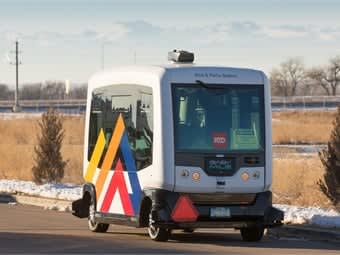
Transdev will operate the EasyMile autonomous shuttle for the RTD in a new route called 61AV. The project’s main goal is to assess the viability of autonomous services in providing first- and last-mile connections to and from transit.
4. Budget for the Project Appropriately
Autonomous shuttle projects have more costs to consider than just the vehicle and associated technology. The following outlines some of the cost considerations:
Safety operators / Customer service ambassadors.
Bus stop infrastructure.
Signage (both for other road users and for vehicle localization).
Vehicle storage and charging location.
Marketing and communications.
For the 61AV project, each stakeholder was contributing to different aspects of the overall budget. The clear identification of each contribution is necessary to build a comprehensive budget and spare any surprises.
Lesson learned: Account and identify all project costs at the onset of the project.
5. Identify Metrics that Address Each Stakeholder’s Goals
To ensure such a large project is deemed successful by all stakeholders, goals and metrics must be established from the onset. As with most autonomous shuttle projects, this project had many stakeholders with varying goals. For example, RTD is interested in vehicle reliability and on-time performance. The City and County of Denver is interested in road safety, and EasyMile is interested in disengagements. Obviously, there are overlapping goals, but the key is to compile all of the metrics needed to measure each stakeholder’s goals.
Lesson learned: Establish key metrics that encompass goals of every stakeholder in order to objectively assess the project’s success.
The 61AV project is a first-of-its-kind transit project in Denver/Colorado that has brought many forward-thinking stakeholders together to learn and further advance autonomous vehicle technology. With the introduction of a shared, electric, and autonomous vehicle in a transit operation, RTD is leveraging the latest in technology. This pilot project is planning to run until the end of July, and we will keep on learning more every day as the shuttle operates.
Bruce Abel currently serves as RTD’s Director of Special Projects and led RTD’s efforts to implement the 61AV driverless shuttle project. Lauren Isaac is the Director of Business Initiatives for the North American operation of EasyMile.
More New Mobility

From Hardware to Digital Partner: Luminator Charts Its Next Chapter
CEO Magnus Friberg discusses Luminator’s shift toward becoming a digital partner, the growing importance of software and interoperability, and how AI can help agencies improve operations and passenger experience.
Read More →
Biz Briefs: Alstom Lands Canadian Contract, LYT to Supply California TSP, and More
In METRO's latest installment, we take a look at recent news from Complete Coach Works, Beep, FlixBus, and more partnerships making headlines across the transportation sector.
Read More →
CharterUP’s Armir Harris on Technology, AI, and the Future of Group Mobility
In a recent episode of METROspectives, CharterUP Founder/CEO Armir Harris discussed the company’s evolution from an online charter bus marketplace into a technology platform supporting public- and private-sector mobility and much more.
Read More →
Jacksonville’s NAVI Project Charts a New Course for Autonomous Public Transportation
Through its NAVI program, JTA is showing how autonomous vehicles, intelligent infrastructure, and coordinated operations can work together to deliver everyday public transportation.
Read More →
Biz Briefs: Luminator Marks Milestone and More
From manufacturers and suppliers to transit agencies and motorcoach operators, these updates offer a snapshot of the projects, partnerships and business moves driving the industry forward.
Read More →
New Tricks for Old Bureaucracies: Joshua Schank on Making Transit Innovation Stick
Former LA Metro Chief Innovation Officer Joshua Schank discusses why good ideas aren't enough, how transit agencies can overcome resistance to change, and why today's challenges demand more innovation.
Read More →
How DART's GoPass Is Redefining Regional Mobility
Serving 14 transit agencies, GoPass simplifies multimodal travel by allowing riders to plan, pay for, and manage an entire trip through one app.
Read More →
Biz Briefs: OCTA Taps Clean Energy for Hydrogen Station, Stadler to Supply Via Rail Vehicles, and More
From manufacturers and suppliers to transit agencies and motorcoach operators, these updates offer a snapshot of the projects, partnerships and business moves driving the industry forward.
Read More →CharterUP Expands Into New Mobility and Autonomous Transportation
Vice President of New Mobility Stephen Joos discusses how CharterUP is leveraging its nationwide transportation network, technology platform, and autonomous vehicle partnerships to expand into workforce mobility, campus shuttles, and transit solutions.
Read More →
METRO Magazine Announces 2026 Innovative Solutions Awards Winners
Projects Recognized for Advancing Mobility Through Technology, Accessibility, Workforce Innovation, and Operational Excellence
Read More →