



Taking Buses Beyond ADA Compliance with ‘Smart’ Air Management Systems
Computer-controlled air management and ride control systems have been evolving over the last two decades and are now more effective and versatile than ever before, helping to smooth out the ride of buses operating on even the worst of roads.
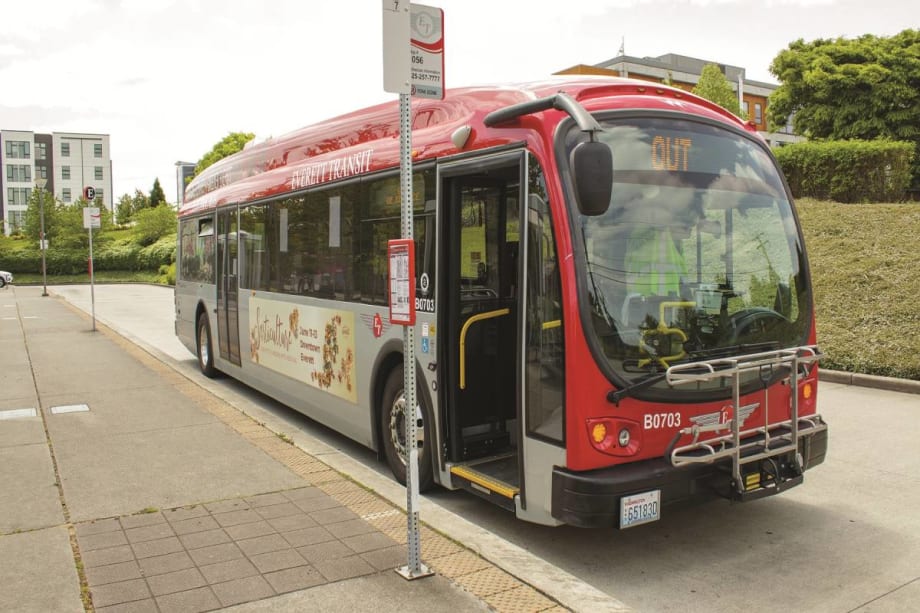
Most air suspension systems use a mechanical valve and lever system that toggles as the vehicle’s wheels and suspension moves up and down in relation to the chassis.
Photo: Everett Transit
When Tom Hingson took a position as a part-time driver for King County Metro in Washington State in 1983, the Americans with Disabilities Act (ADA) would not be signed into law for another seven years. However, even in ’83, some buses were equipped with kneeling capabilities, but the technology was designed simply as a convenience, not compliance. Those early air suspension systems allowed transit buses to lower their boarding threshold for easier entry, but they were noisy and slow to respond.
While “The air escaping from the air bags when you manually triggered the kneeling feature was loud,” says Hingson, now transportation services and transit director for Everett Transit in Everett, Wash., “After the passengers boarded, it would take a good deal of time for the air suspension to reinflate to normal ride height so we could depart — you could hear and feel the air system labor at the task.”
The inflation time lapse meant that Hingson had to wait until the suspension was fully at ride height before proceeding. The whole process took a bit of time and added another friction point whenever the kneeling feature was used, but Hingson’s early air suspension system still beat the alternative.
Better than the alternative
Back in the day, most buses were riding on steel spring suspensions, and some continue to do today. The springs are factory adjusted to provide the optimal ride when a bus is full of passengers and become progressively more reactive the fewer passengers there are. Steel springs simply cannot isolate a chassis and everything and everyone riding upon it, from uneven road surfaces — and they certainly cannot kneel.
Over the years, Hingson has watched air suspensions and air management technology advance. Today’s air suspension and ride control systems make the bus ride experience much smoother, more comfortable, accessible, and convenient for everyone involved.
Not only have transit bus air suspensions become far more sophisticated, but they are also being called upon to do a lot more. Many systems offer front and whole-side kneeling and can be manually or automatically adjusted above ride height, if necessary, to accommodate platform entry. Some systems even offer a tilt feature for basic maintenance access.
Why electromechanical ride control is important
Most air suspension systems use a mechanical valve and lever system that toggles as the vehicle’s wheels and suspension moves up and down in relation to the chassis. As the lever moves, it either opens or closes ports that likewise inflate or exhaust air from the system’s air bags, also known as bellows, mounted on both sides of the suspension.
While they provide a generally comfortable ride over a variety of surfaces, mechanical valves can overreact to more dramatic surface inputs, like a large pothole. A temporary imbalance can occur while the mechanical system recalibrates itself after a concussion, resulting in increased fuel use to support longer and more frequent compressor run times.
Like most other technologies, air suspensions have progressed over time. Computer-controlled air management and ride control systems have been evolving over the last two decades and are now more effective and versatile than ever before. Using controllers with sophisticated algorithms, the systems make precise corrections to air bag inflation in milliseconds, smoothing out the ride of buses operating on even the worst of roads.
“When everything is working properly, you get an exceptionally smooth ride,” says Hingson, referring to the Proterra Catalyst buses and other similarly equipped vehicles currently serving the Everett Transit fleet.
But ride control and air management systems aren’t only about ride quality, they provide so much more. Not only are driver and passenger comfort and safety enhanced by superior ride characteristics, but the ability also to manually and automatically control and manage onboard air systems means buses can more safely and effectively serve a broader segment of the riding public.
Compassion, convenience, and compliance
Though ADA mandates were originally enacted to assure accessibility for those coping with disabilities, many of the innovations developed to meet those requirements, particularly within the field of mass transit, offer wide-ranging benefits to passengers and drivers alike.
The speed and recovery of bus kneeling is a good example of the advancements in air management technology that have resulted in greater convenience for the broader ridership. Gone are the days when kneeling a bus challenged both schedules and patience.
Buses now quickly lower to kneeling height and return to ride height within as little as three seconds after the doors are closed. The swift kneeling and recovery cycles remove friction from the system and allow the feature to be used more liberally.
“Our customers come in all shapes and sizes, ages, and physical capabilities,” says Hingson. “So, anything that we can do to make it easier to ride the buses on our system we will do.”
Hingson explains that Everett Transit has trained all its drivers to kneel their buses close to the curb. They are also instructed to offer ramps, even to persons who are merely walking slowly.
Everett serves routes where passengers exclusively board at curb height and do not have to contend with platform loading and unloading. The buses generally make stops every two to three blocks and the drivers manually control the kneeling feature.
According to Hingson, the county has a larger transit system and that system overlays Everett’s. The county’s system does serve passengers who board via platforms and dealing with this variability is where air management has made some of its greatest strides.
Smarter Air Management Systems
Digitally-driven air management systems, like Link Manufacturing’s Smart Air Management System (SAMS), now bring the promise of greater safety, increased operational efficiency, superior ADA compliance, and far more sophisticated levels of automation.
Link is the maker of the SmartValve, a patented, integrated height control system that can take the place of mechanical height control valves and offers automated and manual ride adjustment features. The company incorporated SmartValve as an integral component in its SAMS technology.
With SAMS, precise kneeling, elevation, and wheelchair ramp operation performance is possible, allowing drivers to accommodate passengers boarding from curbside — to platform height — and anything in between. Buses can lower and raise to enable zero-angle and flat ramp access where necessary, and drivers can even control individual air bags when desired.
Paratransit buses can benefit from SAMS technology. Depending on passenger placement, when these vehicles begin forward movement, there is often significant pressure placed on the rear suspension, which can cause the front suspension to elevate as the rear drops. Many paratransit bus bodies are tapered in the rear to compensate for this, and to avoid potential contact with the pavement. With SAMS, the system actively monitors the vehicle’s load in real time. As a SAMS-equipped bus moves forward, it can sense any imbalance and can elevate the rear suspension override height, leveling-out as the bus reaches speed, all while maintaining equilibrium.
Depending on route and boarding characteristics, and on what levels of automation a transit authority wants to achieve, buses can also be outfitted with geotagging technology to maintain exact and repeatable ride heights that require little, if any, human operation by drivers.
Say for instance that during a certain portion of its route, a bus is making frequent stops at several platforms with a uniform height. A smart system can allow the bus to stay at that pre-programmed ride height between stops, without further inflation or exhaustion. By minimizing the inflation and deflation cycles on specific routes, a smart air management system can reduce wear-and-tear on air suspension components.
Conversely, geotagged routes consisting of mixed passenger loading heights can be individually tagged for optimal bus arrival heights. Under these circumstances, a bus will automatically adjust its ride height as it approaches its stop, saving time and reducing the need for manual operation or adjustment once the bus arrives.
SAMS offers transit fleets total air management capabilities with diagnostic monitoring, LED indicator, touchscreen interface, and USB connectivity. With the SAMS user interface, drivers can also override a vehicle’s set ride height to raise and lower its chassis at low speeds, when desired.
The automation-rich capabilities of SAMS technology also set the table for enhanced pneumatic operation in future semi-autonomous, and ultimately, autonomous vehicles. These modes of transportation will rely even more heavily on intelligent support systems to keep them up and running safely and smoothly with little or no human intervention.
Oil-based Solutions
In the last few years, silicone oil-based hydraulic systems have also been introduced. However, their more complex suspension architecture and high cost of entry can make them prohibitive to many transit fleets. Their reputation within the transit industry for exorbitant maintenance, repair, and replacement costs can also make hydraulic systems less attractive in the long run.
Unlike air management systems like SmartValve and SAMS, which have five decades of heavy-duty commercial suspension application experience behind them, hydraulic suspension systems have only recently migrated from the automotive sector and are not truly rated for commercial use. Even the use of hydraulic oil is counter to the lower carbon direction that much of the transit industry is moving.
Going Oil-Free
It is no secret that U.S. transit fleets are migrating away from oil- and carbon-based vehicles. Following the macro-trend toward zero-emission vehicles (ZEVs), forward thinking fleets are purchasing hydrogen, natural gas, and electric buses in record numbers.
Decarbonization is happening and it is happening fast. The trend will put additional pressure on bus manufacturers to move away from hydraulics and traditional air suspensions with mechanical valves, because they use more compressed air to operate, and thus, more energy than electronically-controlled systems.
“We purchased our first Proterra Catalyst electric buses 30 months ago,” says Hingson. “Our nine buses have a projected lifespan of 12 years each, so we’re still in the early stages, but we plan to be operating an almost all electric fleet by 2024.”
Link’s SAMS system has significant experience with ZEVs, including Everett’s Proterra Catalyst buses. SAMS has the capabilities to provide broad and sophisticated performance with low power consumption overhead.
Using smart air management systems like SAMS, transit fleets using ZEVs can achieve enhanced driver and passenger safety, while increasing power savings and operational efficiencies, including reduced compressor run times. In short, as we move into the future, ZEVs will perform better and travel longer distances between charges with smart air management.
“So far, just our small number of electric buses have reduced our fleet’s carbon footprint by about 626 tons of carbon dioxide,” says Hingson. “And if things go as planned, our majority electric fleet will reduce our carbon dioxide output by 6,628 tons over the next 15 years — we won’t be alone in this shift to reduce carbon pollution.”
More Technology

From Hardware to Digital Partner: Luminator Charts Its Next Chapter
CEO Magnus Friberg discusses Luminator’s shift toward becoming a digital partner, the growing importance of software and interoperability, and how AI can help agencies improve operations and passenger experience.
Read More →
Beyond the Checklist: A Structured Approach to Transit Maintenance
Reliability-Centered Maintenance helps transit agencies move beyond routine checklists to focus limited resources on the assets and failures that have the greatest impact on safety, reliability, and service.
Read More →
NJ TRANSIT Advances Bus Technology Upgrades Across Statewide Fleet
More than 1,500 buses now feature upgraded technology designed to improve arrival predictions and provide free Wi-Fi, with deployment expected to reach nearly 2,000 buses by the end of 2026.
Read More →

Building a Flexible Path to Transit Electrification
John Hroncich discusses BAE Systems’ modular and scalable approach, lessons learned from decades of real-world operations, and how agencies can identify electrification strategies that fit their fleets.
Read More →
Biz Briefs: Alstom Lands Canadian Contract, LYT to Supply California TSP, and More
In METRO's latest installment, we take a look at recent news from Complete Coach Works, Beep, FlixBus, and more partnerships making headlines across the transportation sector.
Read More →
From Legacy Silos to Conversational Intelligence
What if transit leaders could ask any operational question and get a trusted answer in seconds? Conversational AI is transforming how agencies use their data.
Read More →
USDOT Announces Rail Vehicle Replacement Grants, Chattanooga AV Shuttle Funding
More than $191 million in federal funding will help three transit agencies replace aging rail vehicles and support a new autonomous shuttle service in Chattanooga.
Read More →
Bus Tech Talk: Keeping Transit Technicians Ahead of the Technology Curve
LA Metro’s Obed Mejia discusses technician training, evolving maintenance technology, fleet replacement, and strategies for getting the most out of today’s transit fleets.
Read More →
Biz Briefs: RIPTA Unveils New Frontrunners, Clevland RTA Adds New Siemens, and More
In METRO's latest installment, we take a look at recent news from Siemens, Prevost, Dodge, and more partnerships making headlines across the transportation sector.
Read More →
Why Simulating Pedestrian Movement Has Become Essential for Modern Rail Stations
Pedestrian microsimulation is helping rail planners identify bottlenecks, test station designs, and prepare complex transit hubs for growing passenger volumes.
Read More →