



The World Cup Stress Test: Are U.S. Cities Ready for Potential Gridlock?
The 2026 FIFA World Cup promises to be one of the most significant public events in North American history, with the tournament expanding from 32 to 48 teams and matches scheduled across 16 cities.

To best manage stress on the system during the World Cup, agencies must adopt a data-driven, multiphase, and cyclical planning approach, implemented ahead of events, during real-time operations, and after the events, to apply lessons learned to the next matchday.
Photo: METRO
- The 2026 FIFA World Cup in North America is set to expand to 48 teams from the previous 32.
- Matches will be played across 16 different cities, increasing logistical and infrastructure demands.
- U.S. cities are being evaluated for their readiness to handle potential gridlock during the event.
*Summarized by AI
The 2026 FIFA World Cup promises to be one of the most significant public events in North American history, with the tournament expanding from 32 to 48 teams and matches scheduled across 16 cities.
Unlike typical sporting events at these venues, 67% of these matches will take place on weekdays, placing extraordinary pressure on city streets, transit systems, and commuter routines. Millions of fans unfamiliar with local transportation systems will converge on stadiums and fan zones, competing for the same space as daily commuters.
For transportation agencies, this poses stress of unprecedented scale on the mobility ecosystem. While private vehicles often dominate discussions about traffic, public transit is a key factor in mitigating congestion during any significant-scale event. Well-coordinated bus, rail, and shuttle networks can efficiently transport large numbers of fans, thereby reducing the burden on city streets.
To best manage stress on the system, agencies must adopt a data-driven, multiphase, and cyclical planning approach, implemented ahead of events, during real-time operations, and after the events, to apply lessons learned to the next matchday.
Planning Phase: Lessons from Past Events
The World Cup has consistently presented transportation and logistics challenges in host countries. The greatest fan and resident experiences have often come when transportation agencies have prepared well in advance with infrastructure and technology solutions to support the onslaught of visitors.
The expansion in teams and matches this year poses an additional level of risk, with more fans visiting from more countries, as well as an increase in the number of matches.
For local jurisdictions, it may seem logical to compare these matches to other sporting events that typically happen in these NFL stadiums.
However, previous experience shows that large weekday matches can create unexpected patterns of congestion. Analysis of past large-scale events in U.S. cities, like other regional soccer tournaments or Monday Night Football, reveals that traffic peaks are rarely uniform.
Some corridors may become heavily congested while others remain relatively smooth, depending on where fans are traveling from and the routes they choose (which can vary depending on whether fans are local or visiting).
For transit systems, creating a baseline for ridership is the first step toward effective planning.
Agencies must identify which streets, intersections, and transit corridors are likely to experience high demand around stadiums, fan zones, and key commuter routes. This enables a more effective allocation of buses, light rail, and shuttle services to accommodate the increased passenger load. Dynamic routing strategies, such as temporary express shuttles or modified service patterns, can keep transit moving even when adjacent roadways are congested.
Additionally, observed data from these events across all modes (cars, micromobility, and transit) presents the complete picture of trip patterns. This data enables agencies to understand the impact on congestion and ridership, allowing them to better plan for increased demand and influence mode shift.
With these considerations in mind, agencies can take a structured approach to address key operational challenges, from street closures to real-time service adjustments:
- Quantifying the impact of street closures: Street closures around venues are inevitable for pedestrian safety, security, and event logistics. But these closures can have ripple effects on parking, curbside access, and feeder services. Transit planners must evaluate how detours will impact bus stops, drop-off zones, and park-and-ride locations. Establishing alternative pick-up and drop-off points and communicating them clearly to riders can prevent bottlenecks and improve the overall flow of people to and from the event.
- Understanding how fans travel: Knowing how fans arrive at stadiums informs transit decisions. Many will use rideshares, public buses, light rail, or personal vehicles, often in combination. Analyzing travel patterns from previous large-scale events allows agencies to anticipate peak demand times and routes and adjust service frequency accordingly. Planning for multimodal transfers — where riders switch from one type of transit to another—ensures smoother operations and reduces delays that could cascade across the system.
Operations Phase: Real-Time Management and Adaptation
For an event to be successful, a detailed plan is a prerequisite. The accurate measure of operational efficiency lies in the operations phase, where real-time monitoring and adaptive management are paramount. This will be particularly true for the World Cup matches, where a sudden surge in demand can lead to significant bottlenecks and a poor user experience can become an international story.
The ability to monitor ridership, travel time, and incident metrics in real time allows for a proactive approach to managing unforeseen challenges.
By analyzing this live data in a shared environment with partners such as first responders and city and state transportation agencies, operations managers can make rapid, informed decisions. This dynamic approach transforms a static plan into a flexible, responsive system, ensuring the safety and satisfaction of all attendees.
Based on these objectives, agencies can address key operational challenges by leveraging the following strategies:
- Real-time monitoring and action: Even with careful planning, unexpected events will occur. Construction, accidents, or sudden surges in fan arrivals can disrupt schedules. Transit agencies should maintain live visibility into traffic and transit conditions, enabling rapid response. Centralized operations centers can monitor road and transit networks, allowing agencies to adjust service frequency, reassign buses, or implement temporary detours.
- Coordinating across services: Shared mobility (rideshares, e-scooters, and bike-share programs) plays a growing role in how fans access stadiums. Transit agencies must dynamically coordinate with these services to manage curbside operations, reduce double-parking, and ensure compliance with local regulations. Data-driven coordination enables agencies to prioritize high-demand corridors and offer safe, efficient options for first- and last-mile connectivity.
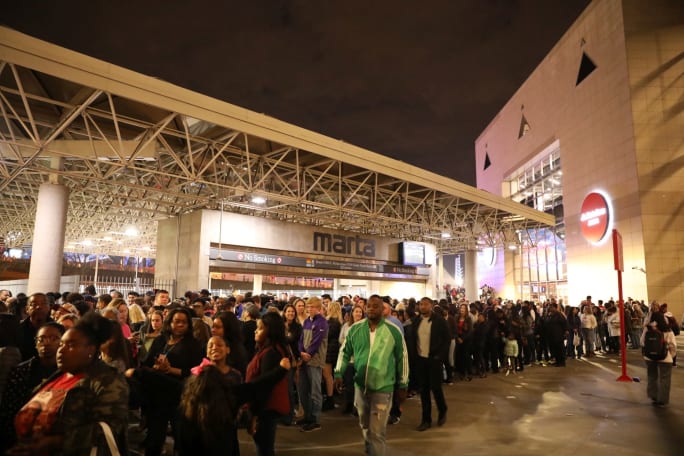
For local jurisdictions, it may seem logical to compare these matches to other sporting events that typically happen in these NFL stadiums. However, previous experience shows that large weekday matches can create unexpected patterns of congestion.
Photo: MARTA
After Action Phase: Learning from Each Event
Preparation for the World Cup doesn’t end when the opening whistle blows. All cities hosting the 2026 World Cup will be hosting multiple matches, many of which will have only three or four days between them, so post-event analysis is critical for refining strategies for the next match day.
Transit agencies can assess which routes experienced the highest delays, evaluate the effectiveness of signal timing or rerouting strategies, and identify emerging travel patterns.
Each match offers lessons that can be applied to subsequent matches or other large-scale events, creating a feedback loop that continuously improves the city’s transportation resilience.
Looking Ahead
U.S. cities face a high-stakes challenge in 2026. The World Cup will test the ability of transit systems to operate under extreme, unpredictable conditions.
Agencies that proactively analyze likely congestion points, anticipate the impact of street closures, understand multimodal travel behavior, and deploy adaptive operations will be best positioned to maintain mobility and ensure safety.
For transit planners, the message is clear: the World Cup is a stress test for cities’ entire mobility networks. Investing in planning, real-time management, and multimodal coordination today can prevent chaos tomorrow and deliver a smoother experience for both event attendees and everyday riders.
About the Author: Ahmed Darrat is a trained Transportation Engineer with over 20 years of experience in the fields of transportation policy, operations, and technology.
Quick Answers
The 2026 FIFA World Cup will be one of the most significant public events in North American history because it will expand from 32 to 48 teams, with matches scheduled across 16 cities.
*Summarized by AI
More Technology

From Hardware to Digital Partner: Luminator Charts Its Next Chapter
CEO Magnus Friberg discusses Luminator’s shift toward becoming a digital partner, the growing importance of software and interoperability, and how AI can help agencies improve operations and passenger experience.
Read More →
Beyond the Checklist: A Structured Approach to Transit Maintenance
Reliability-Centered Maintenance helps transit agencies move beyond routine checklists to focus limited resources on the assets and failures that have the greatest impact on safety, reliability, and service.
Read More →
NJ TRANSIT Advances Bus Technology Upgrades Across Statewide Fleet
More than 1,500 buses now feature upgraded technology designed to improve arrival predictions and provide free Wi-Fi, with deployment expected to reach nearly 2,000 buses by the end of 2026.
Read More →

Building a Flexible Path to Transit Electrification
John Hroncich discusses BAE Systems’ modular and scalable approach, lessons learned from decades of real-world operations, and how agencies can identify electrification strategies that fit their fleets.
Read More →
Biz Briefs: Alstom Lands Canadian Contract, LYT to Supply California TSP, and More
In METRO's latest installment, we take a look at recent news from Complete Coach Works, Beep, FlixBus, and more partnerships making headlines across the transportation sector.
Read More →
From Legacy Silos to Conversational Intelligence
What if transit leaders could ask any operational question and get a trusted answer in seconds? Conversational AI is transforming how agencies use their data.
Read More →
USDOT Announces Rail Vehicle Replacement Grants, Chattanooga AV Shuttle Funding
More than $191 million in federal funding will help three transit agencies replace aging rail vehicles and support a new autonomous shuttle service in Chattanooga.
Read More →
Bus Tech Talk: Keeping Transit Technicians Ahead of the Technology Curve
LA Metro’s Obed Mejia discusses technician training, evolving maintenance technology, fleet replacement, and strategies for getting the most out of today’s transit fleets.
Read More →
Biz Briefs: RIPTA Unveils New Frontrunners, Clevland RTA Adds New Siemens, and More
In METRO's latest installment, we take a look at recent news from Siemens, Prevost, Dodge, and more partnerships making headlines across the transportation sector.
Read More →
Why Simulating Pedestrian Movement Has Become Essential for Modern Rail Stations
Pedestrian microsimulation is helping rail planners identify bottlenecks, test station designs, and prepare complex transit hubs for growing passenger volumes.
Read More →