



Tracking Results: Enhanced Tamping in SoCal Light Rail Project
San Diego’s Mid-Coast Corridor Transit project hits record speed and efficiency with new rail tamping technology designed to provide more accurate track measurements.
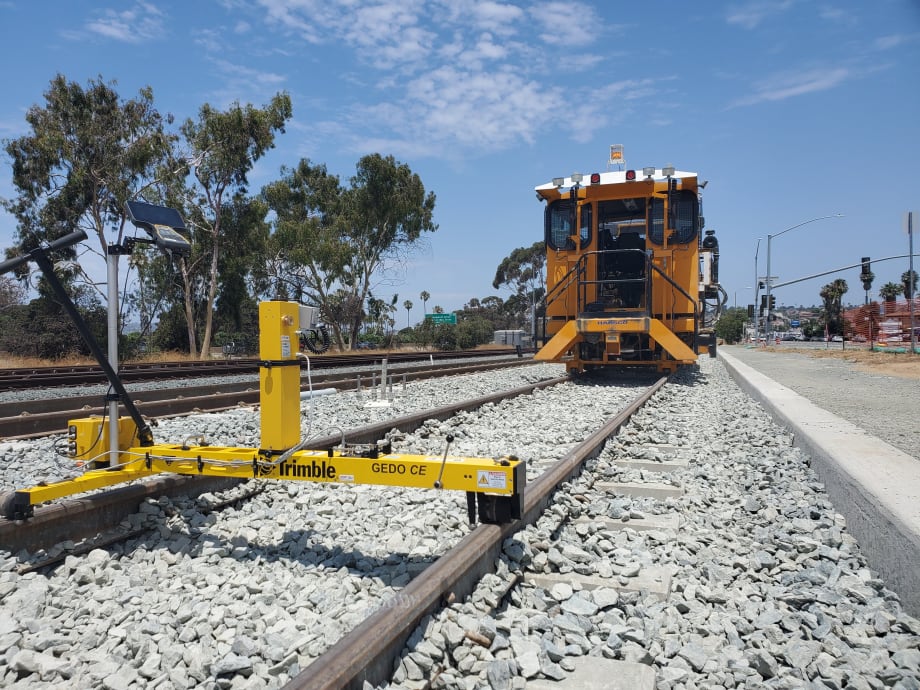
San Diego’s Mid-Coast Corridor Transit project is hitting record speed and efficiency with Trimble's new rail tamping technology designed to provide accurate track measurements.
CL Surveying and Mapping
For years, the freeways and arterials in San Diego’s Mid-Coast corridor have been getting more congested, with traffic projected to increase exponentially as the region grows. By 2030, studies show the population in the corridor will increase by nearly 20% as it evolves into a high-density residential neighborhood, much like Downtown San Diego.
The area has also developed as a major employment area, with employment expected to increase by 12%. The new Mid-Coast Trolley extension will provide an alternative to increasingly crowded freeways and roadways for employees and travelers. It will improve public transit options by adding 9 new stations and connecting the corridor with areas served by the existing Trolley system.
CL Surveying and Mapping is one of the contractors working on the $2.1 billion extension of San Diego’s regional rail service. The firm is using a new technology designed to enhance tamping — the process in which railway track is adjusted to meet design requirements. In this procedure, a specialized railcar called a “tamper” lifts and shifts the track and repositions the rock ballast that supports the sleepers; the track then settles into its new position. The new technology is from Trimble and called GEDO.
To be effective, a tamping machine needs precise measurements comparing the existing track to the design. After each pass by the tamping machine, the tracks are remeasured. On new track construction, two or three passes (or “lifts”) are used to gradually bring the track up to the design position. This technique results in fast, high-accuracy measurement, and when put to work on the Mid-Coast Transit Corridor project, CL Rail Survey Manager Josh Draper says the new solution is a “night-and-day” improvement.
Tamper operators have traditionally relied on stakes set by a surveyor using a total station. Typically set at 25-foot intervals, the stakes provide height and position correction information for the tamping process. Then came the GEDO Vorsys, which eliminated the need for conventional staking at 25-foot intervals.
The GEDO Vorsys system uses a pair of track-mounted trolleys. One trolley is equipped with a total station while a second trolley carries a prism and other sensors to provide accurate measurements of the track. A companion technology to Vorsys —Trimble GEDO IMS— provides an alternative method for efficient track measurement.
Mounted on a single trolley, Trimble GEDO IMS combines inertial measurement technology with onboard sensors to produce precise data on track alignment, elevation, gauge, and cant (superelevation). Digitally transferred to the tamping machine, the data provides immediate, error-free information for the tamping operator.
Draper has used the GEDO IMS on more than 20 miles of tamping work.
“It’s amazing the difference as far as how fast we can get things done,” Draper said. “There’s just a single trolley and one person. You measure the first control point, move the trolley on the track to the next control point and get all the core data on the track.”
With control points located on catenary foundations roughly 250 feet apart, Draper can closely follow the tamping machine.
“I’m right behind them,” Draper said. “As soon as they are a few feet past a control point, I’ve got the data read and can tell how the track looks.”
Draper sees the system becoming the standard for rail construction and maintenance.
CL President Dan Calvillo estimates that his team can support about six miles of track tamping per day with the GEDO IMS system. In addition to the new system, the company also uses a 3D laser scanner mounted on the GEDO trolley to precisely capture track and surrounding features for clearance analysis, asset documentation, and other client-relevant purposes. Calvillo noted that the one-person operation of the solution not only speeds up track measurement, it also reduces labor costs or frees up technicians for other tasks.
“GEDO is rail’s answer to meeting specs, schedules, and requirements on modern rail projects,” Calvillo said. “We have the equipment and expertise to handle large projects, including high-speed, on ballasted, direct-fixated, and slab track.”
The last of 45 new Trolley cars has arrived and the city is still on track to take riders this September. For San Diego, it’s the completion of one of the largest infrastructure projects in the city. For riders, it’s relief from freeways and congestion as another new option for local transit opens up.
John Stenmark is a writer and consultant working in the geospatial, AEC, and associated industries. He has more than 25 years of experience in applying advanced technology to surveying and related disciplines.
More Rail

New York MTA Advances Final Contract for Second Avenue Subway Expansion
Contract Four is the largest in the Second Avenue Subway Phase 2 project and includes construction of station infrastructure, tracks, and signals for the subway expansion, MTA officials said. Work on Contract Four will begin in 2027.
Read More →
San Diego MTS Breaks Monthly Trolley Ridership Record
Agency officials said July’s ridership indicates MTS’s continued recovery from the pandemic.
Read More →
Report Examines NJ TRANSIT Reliability, Funding Challenges
The Garden State Initiative analysis examines the roles of Amtrak infrastructure, fleet management, and agency operations while recommending a more performance-based approach to improving reliability.
Read More →
Stadler, CapMetro Sign Long-Term Rail Fleet Support Agreement
Beginning in 2027, Stadler will provide on-site technical expertise, spare parts support, training, and obsolescence management to help extend the reliability and longevity of CapMetro’s GTW fleet.
Read More →
Biz Briefs: Alstom Lands Canadian Contract, LYT to Supply California TSP, and More
In METRO's latest installment, we take a look at recent news from Complete Coach Works, Beep, FlixBus, and more partnerships making headlines across the transportation sector.
Read More →
CATS Gold Line Marks 5 Years of Service, 2.8M Passenger Trips
With a six-mile expansion planned, the Charlotte streetcar is positioned to connect more neighborhoods and major transit hubs across the region.
Read More →
Why Simulating Pedestrian Movement Has Become Essential for Modern Rail Stations
Pedestrian microsimulation is helping rail planners identify bottlenecks, test station designs, and prepare complex transit hubs for growing passenger volumes.
Read More →
Amtrak Begins Major Construction at New York’s Sunnyside Yard
The new maintenance facility will support Amtrak’s Airo trainsets while improving maintenance efficiency and turnaround times in New York.
Read More →
Chicago Leaders Unveil Plans for O’Hare Airport Express Train
The privately developed project would offer a 15-minute trip between downtown and O’Hare’s Terminal 2, with trains operating every 15 minutes on a dedicated track. The service would use battery-electric trains and three existing freight rail rights-of-way.
Read More →
OCTA Maps Out 30-Year Strategy to Protect Coastal Rail Corridor
The draft feasibility report identifies strategies to protect the coastal rail line for decades as the agency continues near-term stabilization and sand placement efforts.
Read More →