



'Transformative' IIJA Bill Could Help Transit Build Far Into the Future
The public transportation industry and its large supplier base are about to receive their largest financial boost in history. The boost will then become even larger and more sustained if other pending legislative actions remain on track.

The infusion of cash will help transit agencies meet their goals of electrifying bus fleets, especially in California.
SFMTA
The public transportation industry and its large supplier base are about to receive their largest boost in history, according to several analyses of the recent legislation that was signed into law. This boost will then become even larger and more sustained if other pending legislative actions remain on track.
Although President Biden signed the bipartisan Infrastructure Investment and Jobs Act (IIJA) into law in November, for transportation programs it represented a reauthorization bill, meaning that most of the transit provisions are dependent on passage of the usual annual appropriation bill before the money begins to be distributed. As APTA President Paul Skoutelas points out, the new law is by far the largest federal investment in the history of public transportation. Over the next five years, $91.2 billion for public transit and $66 billion for Amtrak, and high-speed and higher-speed intercity rail was authorized by the IIJA. Add another $351 billion for highway programs, $11.8 billion for highway safety, and another $19 billion for various multimodal discretionary transportation programs, the $539.2 billion total authorized for the next half-decade for all modes of surface transportation is a truly historic number.
Federal public transportation programs will receive a 29% increase in funding overall authorized by IIJA, but some programs will receive an even larger boost. No better example is the Low and No Emissions portion of the Major Capital Investment Grants program, which is expected to increase by ten-fold, to more than a billion dollars per year over the next five years of the IIJA reauthorization. A program to fund redesign and retrofits of rail legacy systems’ stations to be accessible to wheelchair users and meet the requirements of the Americans with Disabilities Act will result in $1.75 billion in new funding for these rail systems, channeling most of it for work in New York, Chicago, Boston, and New Jersey.
IIJA a massive job creator
“Yet, this long sought and hard-won legislative victory is about much more than the sum of its numbers,” APTA’s Skoutelas adds. “It represents a historic, seminal chapter in public transportation’s future. Our expanded role includes modeling sustainability to fight climate change, advancing racial and social equity, and providing greater access to convenient, reliable mobility options.” To his point, new program language directs federal agencies to grant these monies with eligibility criteria that emphasize equity and combating climate change in their decision making.
Since three-fourths of federal investments flow to the private sector through contracts and direct grants to contractors, manufacturers, and professional service firms, the new law is expected to generate new jobs or sustain existing ones well beyond the local government agencies that build, operate, or oversee public transport projects and services. Indeed, using recent APTA studies, economic impacts of public transportation investments calculated that 49,700 jobs are supported or created per every billion dollars invested in public transportation. the following estimates represent the huge impact that IIJA’s $91 billion, five-year transit investments alone will have on the economy:
More than 4.5 million direct and indirectly generated jobs, roughly two-thirds of which employed or supported by the private sector, either through hiring or indirectly generated by spending less on commutes, time wasted, and parking
$455 billion in economic return/impact.
$264.48 billion in retail and wholesale sales over the next five years.
$34.8 billion in local, state, and federal tax revenues over same timeframe.
Moreover, when the $66 billion in investments for passenger and freight rail over the next five years is added, as well as the synergies with some of safety, electrification, and other infrastructure investments are also calculated, the economic impact could easily double. Again, it’s important to note that these numbers exclude the transportation-related investments that come with the Build Back Better Act.
It’s also important to note that many of these private sector firms are also involved in many other markets in which the IIJA also invests, and significantly so. Although these programs have synergistic effects, by helping the vehicle programs with chargers and electric grid modernization investments, for example, they have not been fully quantified.
Here are some examples of these programs funded by IIJA that leverage additional opportunities for manufacturers and professional services firms:
$25 billion authorized for airport investment programs, including a new terminal access program, some of which could potentially result in more spending for public transportation (because ground transportation access is a typical part of those ground-access investments).
$65 billion for grid investments, including money for grid reliability and resiliency and investments in critical minerals and supply chains for clean energy technology and energy demonstration projects.
$16.6 billion for ports and waterway infrastructure.
A good example of this unmeasured by clear synergistic effects will likely occur in California. The Golden State will receive $384 million over the next five years to expand the network of charging stations available for electric vehicles. This cash infusion will help large California cities such as Los Angeles and San Francisco, as well as smaller cities such as Stockton and Monterey meet their goals of electrifying their bus fleets in compliance with the state’s mandate to electrify all heavy-duty transit buses by 2040. In all, the new legislation provides an estimated $15 billion in funding for the electrification of transportation and non-transit transportation infrastructure in the state.
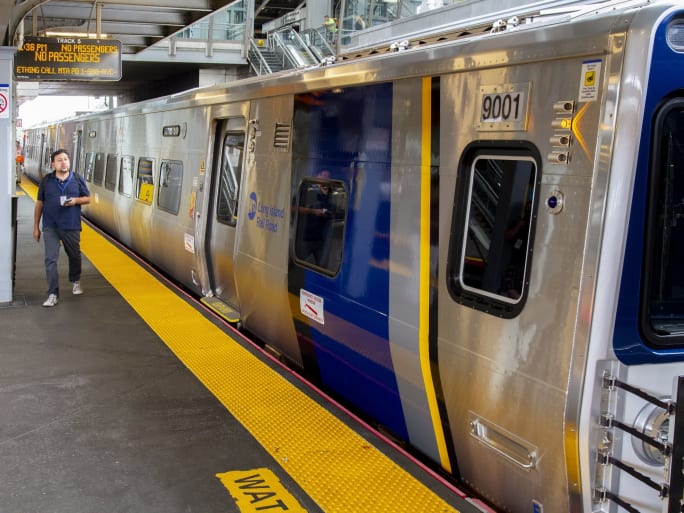
When the $66 billion in investments for passenger and freight rail over the next five years is added, as well as the synergies with some of safety, electrification, and other infrastructure investments are also calculated, the economic impact could easily double.
LIRR
A Green New Deal After All
Most observers expect the Fiscal Year 2022 appropriations bill for transportation will be enacted in January 2022, ahead of when current funding expires in February. Many advocating for a much larger “Green New Deal” of investments have expressed disappointment at only half a trillion dollars of truly new investments beyond baseline spending. Accordingly, these advocates and their supporters in Congress are seeking to add more investments in a package of tax credits, spending, and taxes targeted at addressing climate change, social justice, and economic inequality, known as the Build Back Better Act. Because this package has never garnered the bipartisan support that led to the IIJA’s enactment, congressional leaders are seeking to enact the legislation through a process known as reconciliation, which required only a majority vote and cannot be filibustered. Although envisioned as a budgetary tool when it was created in the mid-1970s, reconciliation has been a process used by both Republicans and Democrats alike for major legislative initiatives when either side has the majority of both houses. However, two Democratic Senators continue to have concerns about some of the measure’s provisions, most notably its size in the wake of two multitrillion-dollar laws enacted in 2021, including the IIJA and COVID-19 pandemic relief.
In January, a federal court agreed that while local governments that received the COVID assistance could use unspent funds for capital and operating programs, the court ruled that it could not be used for debt relief or tax refunds. The decision is expected to further increase transit agencies’ capital investments and service expansions.
Meanwhile, provisions in the IIJA are designed to ensure the jobs created by the bill employ U.S. workers. Buy America requirements for procurements using public transportation and other federal grants have been toughened, and for any projects receiving direct federal assistance — such as the law’s Department of Energy and postal service vehicle purchases, for example — the earlier, Depression-era Buy American law was expanded by IIJA to cover construction materials — but it still exempts cement and cement components. To toughen enforcement, IIJA creates a new “Made in America Office” oversight office within the Office of Management and Budget at the White House, which will assume all the current Buy America enforcement at the FTA and elsewhere in the federal government. And the current ban on procurements of rolling stock owned or controlled by Chinese companies was extended another five years by IIJA.
At press time, the leadership in both legislative chambers insist that concerns about Build Back Better can be addressed to the two senatorial holdouts’ satisfaction, and thereby passed at a price tag between $1.5 trillion and $1.8 trillion. But even if it fails, the year 2021 will go down in history as a seminal one for public transportation and related programs. The IIJA’s program investments, loan programs, and tax incentives, combined with the ability of transit agencies to invest unspent pandemic relief dollars, ensure that the next years, and likely beyond, will see a dramatic expansion of public transport services, technologies, and jobs. It’s the green new deal by another name.
More Management

LIT Marks 10-Year Milestone at Annual Summit
Hosted by the COTA from September 10 to 13, the Summit carried the theme “Celebrating 10 Years of Excellence, Leadership, and Impact,” with every part of the program honoring the people, agencies, and partners who built LIT over its first decade.
Read More →
People Movement: Dan Dipert Coaches Adds Third-Generation Leader, Keolis Names New Valley Metro VP/GM, and More
In this edition, we also cover recent appointments and announcements at the Wabtec, SilverRide, HNTB, and more, showcasing the individuals helping to shape the future of transportation.
Read More →
METRO Opens Submissions for 2026 Motorcoach Awards
Nominations are now being accepted for METRO Magazine’s Operator of the Year and Innovative Operator of the Year awards.
Read More →

New York MTA Advances Final Contract for Second Avenue Subway Expansion
Contract Four is the largest in the Second Avenue Subway Phase 2 project and includes construction of station infrastructure, tracks, and signals for the subway expansion, MTA officials said. Work on Contract Four will begin in 2027.
Read More →
Transit Agencies Highlight Safety Gains at National Summit
Leaders from 15 major transit systems shared crime-reduction results and safety initiatives while discussing the role of continued federal support.
Read More →
NITA Names New Leadership, Expands Reduced-Fare Program at First Board Meeting
The new regional transit authority appointed its first board chair and interim executive director while extending reduced fares across CTA, Metra, and Pace for eligible riders.
Read More →
Beyond the Checklist: A Structured Approach to Transit Maintenance
Reliability-Centered Maintenance helps transit agencies move beyond routine checklists to focus limited resources on the assets and failures that have the greatest impact on safety, reliability, and service.
Read More →
APTA 2026 Nominating Committee Selects Leadership Slate, Names Chair and Vice Chair Nominees
Leadership changes will help shape the association’s priorities and its representation of the transportation industry during the 2026–2027 term.
Read More →
DART Launches Major Security, Fare Enforcement Initiative
The 90-day demonstration will deploy coordinated security teams at five light rail stations while testing controlled access and gathering data to guide future investments.
Read More →
Advancing Fare Collection Through Technology and Innovation
Learn about delivering 1300 gates at 91 stations while managing fare evasion. Explore the large scale deployment, solution customization and real-world results that affect the region. Prepare for deployment in your region now.
Read More →