



UMA Expo attendees urged to cultivate individuality to grow business
Show coverage of the 2004 United Motorcoach Association's annual conference in Atlanta.

The purpose of any business is to profitably create an experience that is so compelling to customers that their loyalty is assured, said keynote speaker Scott McKain during the United Motorcoach Association’s (UMA) 2004 Expo held in Atlanta in February. “It‘s no longer about customer satisfaction. The bar has been raised.” How [operators] do things differently is what makes people keep coming back, he said. “That is what transcends price.“ Other opening-day events included a state-of-the-industry panel moderated by UMA President Victor Parra and International Motor Coach Group President Steve Klika. Panelists discussed the past, present and future of the industry, such as the need to market more aggressively and the importance of embracing new technology to create new business. Other key business strategies included hiring an outside trainer for the sales force and seeking new opportunities and alliances. “Good competition makes you a better company,” said panelist Jeff Polzein of Red Carpet Charters in Tulsa, Okla. “Don’t fear competition.” Another session speaker, Federal Motor Carrier Safety Administration (FMCSA) Administrator Annette Sandberg, cited reduced congestion and increased mobility as key initiatives. Removing uninsured motorcoach operators from the road was another important FMCSA agenda. She also commended the industry for “being kept out of the hours-of-service rule because of its good safety record.” Attendees of the various seminars were educated on improving utilization rates, the importance of business diversification and how to secure contract work. “Utilization doesn’t mean anything unless you balance costs and profits,” said Ed Gallagher of Leprechaun Lines in Newburgh, N.Y. During his marketing session on business survival tactics, speaker Chip Eichelberger touted the benefits of optimism, innovation and leadership. “The formula for success is practicing a few simple disciplines and repeating them every single day.” Nearly 1,400 attendees, including more than 750 exhibitors, graced the show floor of the Georgia World Congress Center during UMA’s three-day event. In addition to numerous product offerings, the prevailing trend on the show floor included wrapping coaches in elaborate graphics to garner attention. DaimlerChrysler Commercial Buses (DCCB), one of the vehicle exhibitors, introduced the CL300, its new mid-size luxury coach. This vehicle, built on the Freightliner Business Class M2 chassis, features a Mercedes-Benz 906 engine and a fully multiplexed electrical network with on-board diagnostics. NASCAR racing legend Richard Petty was on hand for photos and to sign autographs to inaugurate the latest addition to DCCB’s coach line. Motor Coach Industries (MCI) showcased its E4500 and J4500, equipped with new power train options. MCI also celebrated the delivery of the 2,500th coach, to Lakefront Lines of Brook Park, Ohio. Another exhibitor, Prevost Car touted its removable wheelchair lift system, now available on XLII or H-series coaches. Blue Bird Corp. also made news by announcing the consolidation of its coach, luxury motor home and commercial bus divisions to form Blue Bird Coachworks. Day two of the show featured UMA’s 5th Annual Vision Awards ceremony, where Steve Busskohl of Arrow Stage Lines in Norfolk, Neb., was winner of the Vision Award. Other award winners of the evening included Alex Guariento of Greyhound, Dave Bolen of New World Tours in Lorton, Va., UMA Board Member Mitch Guralnick and Joseph Cyr of Cyr Bus Lines in Old Town, Maine.
More Management

NITA Proposes $5B Operating Budget, $9.7B Capital Program for 2027
The proposed budget includes funding for expanded transit service, safety initiatives, fleet upgrades, and infrastructure improvements across CTA, Metra, and Pace.
Read More →
Financing, Fleet Replacement Requires a More Strategic Approach
Executives from ABC Companies and MCI discuss how rising costs, changing market conditions, and post-pandemic challenges are prompting motorcoach operators to rethink financing strategies, fleet replacement cycles, and long-term planning.
Read More →
Bringing Austin’s First Light Rail System to Life
Austin Transit Partnership CEO Greg Canally discusses the city's nearly 10-mile light rail project, its collaborative approach to project delivery, the importance of community engagement, and the milestones ahead as construction approaches in 2027.
Read More →
ETA CEO John Maglio on Transit Technology, Innovation, and Building Agency Trust
ETA founder and CEO John Maglio explores the evolution of transit technology, the importance of reliable systems, and how stronger partnerships can help agencies improve operations and the passenger experience.
Read More →
Metra Draft Plan Outlines Costs, Service Improvements for Regional Rail
The Systemwide Network Plan identifies infrastructure needs and potential investments to expand all-day, bidirectional rail service across the Chicago region.
Read More →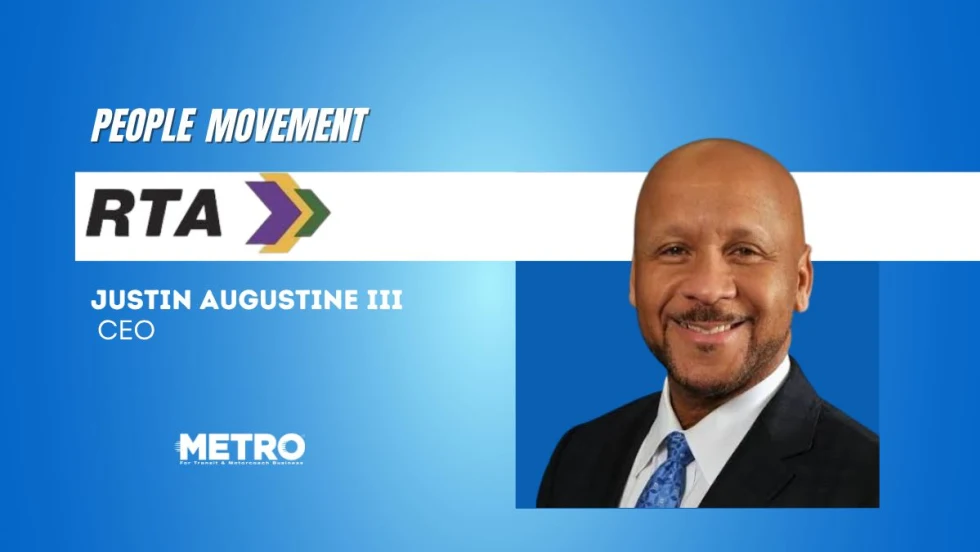
New Orleans RTA Names Augustine III as New CEO
In this edition, we also spotlight recent personnel moves at HDR, PATH, STV, and more, highlighting the people taking on new roles across the transportation industry.
Read More →
How Transit Agencies Are Using Free Rides to Improve Voting Access
Transit agencies are using fare-free service, trip-planning tools, and targeted rides to improve voting access. See what other agencies can learn from these efforts.
Read More →
Caltrain’s Electrification Drives a New Era of Ridership Growth
The railroad’s shift to electric service has brought more frequent trains, stronger customer satisfaction, and increased ridership, earning it APTA’s Outstanding Public Transportation System award.
Read More →
Chicago, Charlotte Transit Agencies Expand Rider Support Programs
CTA launched crisis intervention teams as CATS prepares to deploy fare ambassadors, expanding customer assistance and security efforts across both systems.
Read More →
New York MTA Launches Historic $1.9B Signal, Track Modernization Project
Funded in part by congestion pricing revenue, the project will replace nearly century-old signals along the A and C lines in Brooklyn and Queens.
Read More →