



Urban Challenge taps into transit for adventure
I was not sure what I’d be in store for when my editor volunteered me to take part in the Urban Challenge, a newly created event that combines trivia, technology and public transportation.
Attracting non-transit-dependent riders is never an easy task, but the Urban Challenge may help transit agencies attract a whole new segment, including magazine editors. I was not sure what I’d be in store for when my editor volunteered me to take part in the Urban Challenge, a newly created event that combines trivia, technology and public transportation. I was looking forward to getting a better feel for Los Angeles’ sprawling transit system, but definitely wasn’t prepared for the tasks that lay ahead. After completing a 30-question trivia quiz, the 150 participants (broken up into two-person teams) were ranked based on how many answers they got correct. The more correct answers, the earlier you started the race. While I’ll admit I wasn’t in one of the starting groups, by the time my group was called, my teammate and I were prepared to head out and solve the clues for 12 checkpoints. At each of the checkpoints, we needed to ask a stranger to take our picture at the destination for proof that we’d been there. Much of the five hours we roamed the city was spent on the phone trying to get friends to help with the clues, running to catch the next bus and trying to figure out the fastest bus route to get to where we needed. We spent more time walking/limping around the city than anything else until we realized the merits of the bus systems, specifically L.A.’s MetroRapid bus rapid transit system. (The event lends itself to a lot of bus and rail hopping.) Dragging ourselves back to the starting point after hitting such spread out landmarks as Canter’s Deli, the Hollywood Walk of Fame and Little Tokyo, we were greeted with some much-welcomed water, and the realization that the winner of the race was done in two hours and 45 minutes. And, while my teammate was ready to go again, I was just looking forward to sitting at my computer and writing about it. Kevin McCarthy, creator of this urban adventure race, began the event last year after designing a similar adventure for his daughter’s birthday party. The first Urban Challenge took place with a practice race in Phoenix in February. The first official race was the Los Angeles challenge and 21 races were held this year, with a final event culminating in Las Vegas in November. All teams finishing in the top 10 of the other races qualify for the Vegas event. When McCarthy created the race, he centered it around using public transportation to get to the various destinations. “Transit brings so much strategy to the race,” he said. “I never conceived doing it without [transit] … it would be just a marathon. It’s an equalizer that gives everyone a shot.” The races involve the more popular lines of transit systems in such major cities as Chicago, Boston, Miami and Philadelphia. McCarthy uses public transit and city maps to design the course, of which no more than seven to 10 miles need to be completed by foot. In fact, many of the race cities were selected based on the quality of their public transportation systems. “I can’t think of a better way to get people to try public transportation than the Urban Challenge,” McCarthy said. “They have to use it.” In its first year, the Urban Challenge did not partner with transit agencies and is still developing a marketing strategy. “In the 2003 season we are anticipating some partnerships,” McCarthy said. “We’re hoping to one day become self-supporting.” To participate in the event, challengers pay an entry fee that ranges from $65 for early registration to $100 on race day. For more information on this event, go to www.urbanchallenge.com.
More Management
People Movement: Connectpoint Expands Leadership Team, Stadler Names New Group CEO, and More
In this edition, we also spotlight recent personnel moves at Burns, UZURV, and more, highlighting the people taking on new roles across the transportation industry.
Read More →
More Than a Summer Job: Building the Next Generation of Transit Talent
The Delaware River Port Authority and PATCO have transformed their internship program into a hands-on professional development experience that introduces students to the breadth of transportation careers — and creates a pipeline for future employees.
Read More →
LA Metro Board Awards 220 Battery-Electric Bus Contract to ENC
The contract, which is the largest base award of battery-electric buses by a U.S. transit agency, will be built in Southern California, sustaining good jobs as LA prepares to welcome the world in 2028
Read More →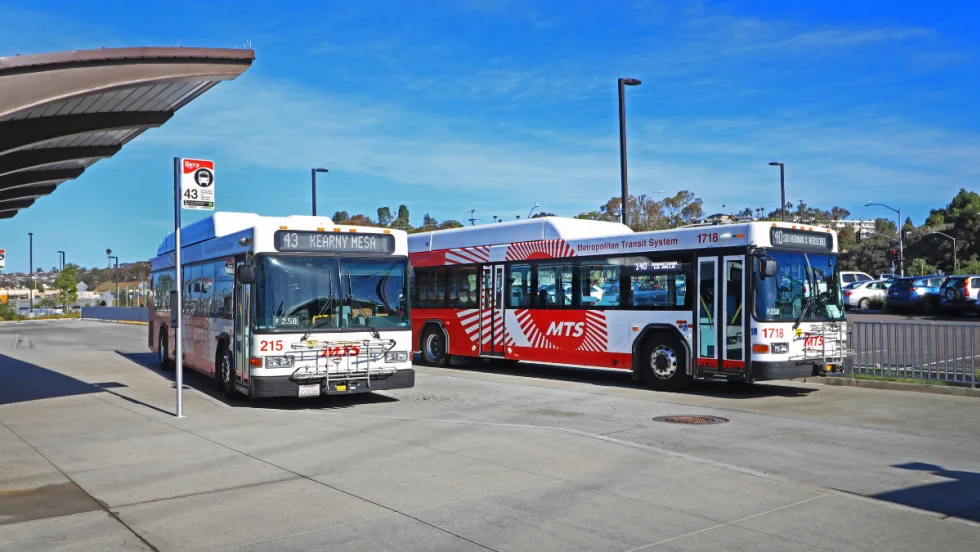
What’s Behind San Diego MTS’s Award-Winning Transit Strategy
Named one of APTA’s 2026 Outstanding Public Transportation Systems with 50 million or more annual passenger trips, California’s San Diego Metropolitan Transit System points to gains in ridership, safety, technology, and reliability as foundations of its success.
Read More →
Public Transit Conference Returning to GFX in 2027, Call for Papers Now Open
The Call for Papers is now open, allowing transit agency professionals and industry experts to help shape the PTC educational program by submitting session ideas for consideration.
Read More →
Indian River Transit’s Community-Focused Approach Earns National Recognition
Named APTA’s 2026 Outstanding Public Transportation System in its size category, Florida’s Indian River County transit system continues to grow ridership through fare-free service and a focus on evolving community needs.
Read More →
ENC Lands MATA Contract and More in Biz Briefs
In this edition of Biz Briefs, we spotlight the latest developments shaping the future of mobility.
Read More →
From Surviving to Thriving: Building Stronger Transportation Organizations
Bus Business Consultants founder Brian Dickson shares lessons on leadership, organizational health, and creating options for long-term success in a changing transportation industry.
Read More →
Everett Transit, Community Transit Outline Consolidation Agreement
The proposed agreement calls for a 50% increase in bus service in Everett, a new microtransit zone, continued paratransit service, and the transfer of Everett Transit operations to Community Transit.
Read More →
Strada360’s Steve Lassey on Turning Transit Data Into Better Decisions
From breaking down data silos to preparing for AI, Strada360 CEO Steve Lassey discusses how transit agencies can use technology to improve operations, customer information, and long-term decision-making.
Read More →