Mid-Atlantic Division President & National Transit/Rail Market Sector Leader
HNTB Corp.
Washington, D.C.


 MENU
MENU SEARCH
With a master’s degree in urban planning from University of Pennsylvania, Diana Mendes was initially interested in natural resource preservation and urban environments.
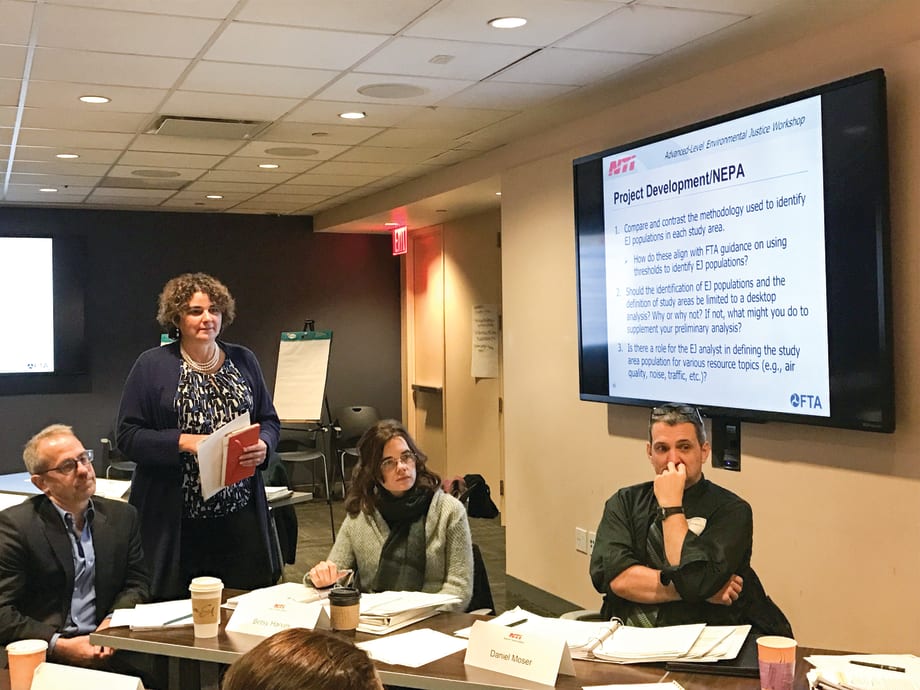
Mendes (standing) is committed to ehancing professional development.
Mendes (standing) is committed to ehancing professional development.
With a master’s degree in urban planning from University of Pennsylvania, Diana Mendes was initially interested in natural resource preservation and urban environments. Early on in her career, Mendes worked on a number of large-scale, comprehensive land-use plans for municipalities, counties, and states. This included planning for the expansion of Washington Metropolitan Area Transit Authority’s Metrorail system and one of the first plans in Maryland to save the Chesapeake Bay.
“It was in these early experiences when I had my first ‘transit moment,’” says Mendes. “I really saw how important transit was in impacting the built-in environment and protecting resources.”
Another poignant moment in Mendes’ career was in the aftermath of the September 11 attacks. She was part of a team contracted by the Federal Transit Administration to help rebuild the transit service in lower Manhattan. It was a chance to help the region restore a sense of normalcy.
“That was the first time where I felt like all my work experience over the years was being put to a very important use beyond that which I could do in a normal career,” says Mendes. “Being able to contribute and leave things better than people had hoped for was extremely meaningful.”
ROLE FOCUS. Mendes joined HNTB a little over a year ago. She is focused on managing all of the firm’s Mid-Atlantic transportation business, from Pennsylvania to South Carolina to West Virginia, and everything in between.
“One of the things I get excited about the most is helping people achieve their visions of success,” says Mendes. “We get to work with clients to solve some of their most important and complex problems.”
KEY PROJECT. She is currently engaged in construction management for the extension of the LYNX Blue Line in Charlotte, N.C. The new line is gearing up to open next year — Mendes and her team ensure that the project remains on budget and on time.
“It’s an amazing experience to deliver large-scale transit improvements and help communities be successful from investment in public transportation,” says Mendes. “All while contributing to the betterment of how we live and use our environment.”
INVOLVEMENT. For the last 17 years, Mendes has also been working as an instructor for the National Transit Institute (NTI). NTI is funded by the Federal Transit Administration and is housed at Rutgers University in New Jersey. While NTI offers an array of different courses for affiliates of the transit field, Mendes co-teaches an advanced course in environmental justice.
“It’s an important topic in the times we live in now,” says Mendes. “It’s very gratifying to work with professionals throughout the country to help them think about new ways to address equity during the planning, development, and operation of transit systems.”
Whether it is for clients or other industry professionals, Mendes is committed to enhancing the state of professional development in general. According to Mendes, the biggest problem any manager or leader will face today is attracting and retaining talent as well as promoting workforce development. She views professional development training, such as courses through NTI, as an opportunity to inspire people in the field.
MOTIVATION. Part of Mendes’ industry success can be attributed to her altruistic approach, as she describes her commitment to helping others excel as a motivating principle.
“It helps me do extra research and take on that extra technical training to learn more about the circumstances that our clients are addressing as they try to do a good job serving their communities,” says Mendes.
On her days off, one could find Mendes in a barn. She is a long-time equestrian who started out exchanging farm work for riding lessons at the age of 10. She also enjoys kayaking and is especially partial to trips along the Chesapeake Bay.

Nominations are now being accepted for METRO Magazine’s Operator of the Year and Innovative Operator of the Year awards.
Read More →
Contract Four is the largest in the Second Avenue Subway Phase 2 project and includes construction of station infrastructure, tracks, and signals for the subway expansion, MTA officials said. Work on Contract Four will begin in 2027.
Read More →
Leaders from 15 major transit systems shared crime-reduction results and safety initiatives while discussing the role of continued federal support.
Read More →
The new regional transit authority appointed its first board chair and interim executive director while extending reduced fares across CTA, Metra, and Pace for eligible riders.
Read More →
Reliability-Centered Maintenance helps transit agencies move beyond routine checklists to focus limited resources on the assets and failures that have the greatest impact on safety, reliability, and service.
Read More →
Leadership changes will help shape the association’s priorities and its representation of the transportation industry during the 2026–2027 term.
Read More →
The 90-day demonstration will deploy coordinated security teams at five light rail stations while testing controlled access and gathering data to guide future investments.
Read More →
Learn about delivering 1300 gates at 91 stations while managing fare evasion. Explore the large scale deployment, solution customization and real-world results that affect the region. Prepare for deployment in your region now.
Read More →
Between packed transit stations and team motorcoaches, see how agencies and operators across North America tackled the transportation demands of the 2026 FIFA World Cup.
Read More →
The stopgap keeps federal transportation programs moving, but missing advance funding could complicate the transit and rail projects agencies are planning next.
Read More →