



Workshop broadens transit emergency response awareness
Created specifically for communicators, APTA's Marketing and Communications Workshop Crisis Communications session, held in Miami in February, walked attendees through a scenario consisting of three incidents.

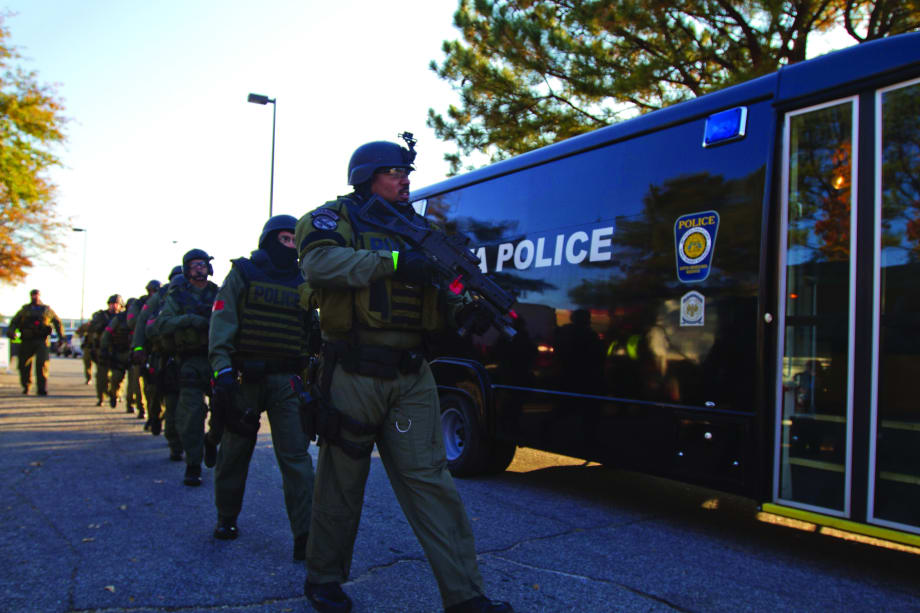
Metropolitan Atlanta Rapid Transit Authority participated in a drill exercise that walked attendees through a terrorist attack scenario at APTA’s Marketing and Communications Workshop Crisis Communications session. The agency routinely conducts its own emergency exercises.

Created specifically for communicators, the American Public Transportation Association’s (APTA) Marketing and Communications Workshop Crisis Communications session, held in Miami in February, walked attendees through a scenario consisting of
three incidents: two explosions in a Metropolitan Atlanta Rapid Transit Authority (MARTA) bus station, one explosion in a Bay Area Rapid Transit District (BART) station and white powder found on a South Florida Regional Transportation Authority bus.
Panelists included officials from the Department of Homeland Security (DHS), Transportation Security Administration (TSA), Federal Transit Administration (FTA) and communications staff members from each transit agency.
It was the first time that a security communications drill about attacks on public transportation was offered, Virginia Miller, senior manager, media relations, APTA, says.
“Everyone in the room was in the communications department for transit systems,” she explains. “While individual transit systems have gone through different exercises with local police, firemen and their Mayor’s offices, they had never before sat in a room with their colleagues and just focused on public transportation.”
The session opened with Miller discussing ISACs, national and critical infrastructures to build and maintain information sharing and analysis centers. The public transportation sector has its own ISAC, which APTA manages. It collects and analyzes threat information from government and open sources and is available on a 24/7 basis.
“All APTA members have access to the ISAC,” Miller says. “If something was to ever happen, ISAC would have information out to public transit systems stating what has happened and what the facts are at that moment.”
The three federal panelists spoke about their respective agencies’ roles, what would be going on in the government if something were to happen on U.S. transit systems, and about transit agencies reaching out to federal and local stakeholders to share information. Panelist Lisa Farbstein, public affairs specialist and spokesperson, office of strategic communications & public affairs, TSA, says each federal panelist also explained how they work together and with transit agencies in the event of an incident.
Panelists also covered how communicators need to be in that loop and ask questions, find out about what his or her agency is doing, and communicate that to passengers. “You put out word, ‘Something happened in city X and we are monitoring that situation and taking the following proactive steps.’ You want your public to know that,” Farbstein says.
Additionally, transit agencies should all share the same message and ensure they are communicating shared messages among each other.
Drill exercise
The drill scenario presented a day of terrorist attacks on the East Coast and the West Coast and reviewed procedures both at public transit systems and in the government. First there was an explosion in the morning during rush hour at the Five Points MARTA bus station and another explosion at the same station 14 minutes later.
Also in the exercise, Miller explains, after the two bombings at MARTA, the DHS at different points in the day held a National Incident Communications Conference Line (NICCL) call for federal and transit agencies. NICCL is used to coordinate public information efforts with federal partners during a threat or an incident, Chad Wood, risk communications specialist, office of public affairs, DHS, says.
[PAGEBREAK]

Cara Hodgson, manager of communications, MARTA, discussed how she and her colleagues would respond to such an incident.
“Our police department would close down the system [and employ] our explosive detection team,” she explains. “We would also work with the TSA in Atlanta as well as the City of Atlanta and Cobb County Police Departments to evacuate the area, ensuring that no other incidents occurred.”
Hodgson adds that MARTA communications staff would immediately notify customers and employees by reaching out to media and posting information on the agency’s social media sites. Additionally, MARTA has a phone line available just for employees to call.
“If there was an emergency we would update that and the phone system for customers so we could get the message out that we were having an emergency and having to evacuate the system and provide any additional information,” Hodgson says.
The second incident presented in the drill was an explosion at BART. Luna Salaver, communications officer, BART, and public information officer, Capital Corridor Joint Powers Authority, discussed what would happen, whether or not they would shut down services, and how that would be communicated.
“By the time the situation the West Coast, it was at our Embarcadero station at about 9:00 a.m.,” Salaver says of the drill. “I told the attendees that when the situation started on the East Coast, our folks would have already been on alert. That’s what happened on 9/11. Before the second plane hit the World Trade Center our folks were already looking at the downtown stations and deploying our canine units.”
Salaver added that the station would be shut down and treated as a crime scene. BART would also shut down other nearby areas and stations.
BART’s first priorities would be to get the word out the passengers who are on the system and explain to all customers why the station was shut down, utilizing PA announcements, messages on digital signage, alerts posted on its website, employ its media voice mail line and advise its media partners.
Attendee feedback
Many attendees walked away from the drill with awareness that they had some homework to do, Miller says. For example, several attendees didn’t know about ISAC, let alone who gets the ISAC alerts at their transit systems.
Gerry Carpenter, Utah Transit Authority spokesperson, says that the most valuable part of the drill for him was realizing that all transit agencies are potential terrorism targets and learning how to prepare a communications plan.
“When we talk homeland security and terrorism, I always thought big cities: New York City, Washington, D.C., Los Angeles. [Being in] Salt Lake City, I never thought I would have to worry about it. But, one thing that really came out bluntly to me [is] that everywhere is a potential target and it doesn’t matter what size your city is. Oklahoma City [was used as an] example,” he explains. “One of the greatest concerns is domestic acts of terrorism, [which] certainly can happen anywhere. I need to think about developing the plans for how I, as a PIO would [handle] any sort of a threat of this kind affecting my system. As a PIO I had never really considered how it could potentially affect me. It was really an eye-opening experience.”
Attendee Joan Strazewski, public relations manager, GRTC Transit System agrees.
“Richmond, [Va.] is a small market. On the other hand, we should all be on extra alert when we see that somebody in our business has been attacked,” she says. “Honestly, I hadn’t thought in terms of us going to alert status to watch the progress of what’s happening at another place and enacting initial steps here because of activities at other sites. I really had my eyes opened about the impact to all of us when this happens to one of us.”
Hodgson says she heard several attendees agree that having tabletop exercises and drills throughout the year is very important to ensure that an agency’s communications are in place.
More Bus
Finding the ‘Happy Medium’: Optimizing Maintenance Without Sacrificing Reliability
The key to maintenance optimization isn’t doing less work—it’s doing the right work at the right time on the right assets.
Read More →
LA Metro, City of West Hollywood, and Partners Advance Smarter Bus Lane Enforcement
The award-winning partnership combines AI-powered detection with human oversight to improve bus reliability, accessibility, and enforcement efficiency.
Read More →
PSTA Modernizes Workforce Management with Digital Bidding System
The award-winning Workforce Transit Modernization project replaced paper bidding with a transparent digital platform, cutting administrative effort while improving access for operators.
Read More →
Washington's Community Transit Sets Six-Year Roadmap for Growth, Expansion
Approved TDP targets more bus service, new mobility options, Swift BRT expansion, and a potential Everett Transit annexation.
Read More →
DART Customer Satisfaction Reaches Six-Year High
Overall satisfaction rose to 74.9%, while the agency’s Net Promoter Score reached a record 33.7.
Read More →
How DART's GoPass Is Redefining Regional Mobility
Serving 14 transit agencies, GoPass simplifies multimodal travel by allowing riders to plan, pay for, and manage an entire trip through one app.
Read More →
Biz Briefs: OCTA Taps Clean Energy for Hydrogen Station, Stadler to Supply Via Rail Vehicles, and More
From manufacturers and suppliers to transit agencies and motorcoach operators, these updates offer a snapshot of the projects, partnerships and business moves driving the industry forward.
Read More →
METRO Magazine Announces 2026 Innovative Solutions Awards Winners
Projects Recognized for Advancing Mobility Through Technology, Accessibility, Workforce Innovation, and Operational Excellence
Read More →
Biz Briefs: STV teams with Amtrak, Motorcoach Operators Boost Fleet and Land Contracts, and More
From manufacturers and suppliers to transit agencies and motorcoach operators, these updates offer a snapshot of the projects, partnerships and business moves driving the industry forward.
Read More →
LA Metro Marks Banner Year, Sets Ambitious Goals for New Fiscal Year
Incoming LA Metro Board Chair and Los Angeles Mayor Karen Bass joined outgoing Board Chair Fernando Dutra and LA Metro CEO Stephanie Wiggins to review accomplishments from fiscal year 2026, which included the opening of new rail extensions, advancement of major transit projects, expanded safety programs, and new rider amenities.
Read More →