



Caution When Passing Other Buses In 'The Zone'
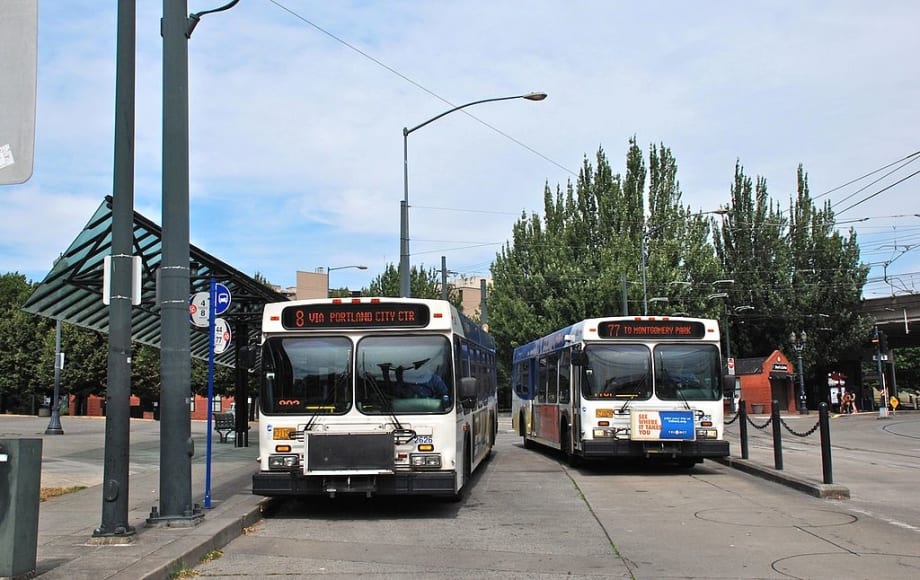
I recently had the opportunity to view a video that captured what could have been a fatal pedestrian knockdown if contact had occurred. A bus overtaking another bus positioned in the bus stop zone occurs routinely and usually without incident, but if not performed correctly, this type of situation can end with catastrophic results.

Steve Morgan
Steve Morgan
I recently had the opportunity to view a video that captured what could have been a fatal pedestrian knockdown if contact had occurred. A bus overtaking another bus positioned in the bus stop zone occurs routinely and usually without incident, but if not performed correctly, this type of situation can end with catastrophic results.
Let me set the table:
Bus curbed (and stationary) in bus stop zone.
Passenger exits bus utilizing front doors.
Passenger steps from curb directly in front of bus.
Passenger begins to attempt to cross the street.
Bus operator conducting the pass is moving in second lane, left of curbed bus, when the person appears from left front corner of curbed bus.
The actions (described above) taken by the discharged passenger who (in a rush) steps out to cross the street directly in front of a curbed bus happens daily in many cities. What does your agency require your operators to do? More specifically, under what circumstances are your operators permitted to pass and how are they taught to conduct the pass?
It requires coordination between the operator in the curbed bus and the operator of the bus doing the passing. It might be a good time to review your Standard Operating Procedures on this subject to understand how your operators should handle this type of situation.
How many of the following recommended actions, involving both operators, are currently in place at your agency? Perhaps you have other useful actions in place that you can mention and share in the comments section below.
Let's begin with the operator that "will be doing the passing."
First and foremost, an operator must ask the question just as you do when attempting to pass another vehicle while driving your personal vehicle, "Is the pass necessary?" and “what's to gain from it?”
Early positioning of the bus a minimum of four feet alongside the curbed bus must be established early on to create a cushion. This cushion will add needed space and time for a startled person to react favorably by moving away from the rapidly approaching bus.
As the operator of the bus conducting the pass approaches the rear left corner of the curbed bus, the operator must remove their foot from the accelerator and place it over the brake to reduce bus speed in anticipation of a person stepping out from in front of the curbed vehicle.
In every instance of a bus overtaking another bus, the operator of the bus conducting the pass must assume that someone will step out. Simply sounding the horn is not enough and unless I've been under the ether, I don't know of any buses that automatically slow down or stop by simply sounding the horn.
Much of the burden of a safe pass is obviously on the operator doing the passing, but there is something that the operator of the curbed bus can do. Bus operators are not in the business of directing pedestrians when to proceed. This is a huge no-no. No operator wants to direct someone to cross the street only to have that person struck by another motorist. However, having an active and alert operator in the curbed bus who witnesses someone preparing to step out in front of the bus — while another bus is beginning to overtake them — and then be able to communicate that danger to the operator of the passing bus without sounding the horn — the horn may cause the person to react by moving forward into the path of the moving bus rather then back to the sidewalk — may prevent contact from occurring.
In closing, generally speaking, passing another bus in a bus stop zone should only be permitted:
When only one route is being serviced by that bus stop and the operator of the overtaking bus can ensure that no one is alighting or no one in the bus zone desires to board their bus.
When the curbed bus is a "headway" behind schedule, operating on the schedule of the following bus.
Here’s a quick example:
Curbed bus:
Schedule departure time of 8:47 am
Actual arrival time of 8:53 am
Bus overtaking:
Arriving on time with a schedule departure time of 8:53 am
Passing should not be permitted when a member of supervision is visibly on post in the bus zone area. Operators must enter the zone and stop. This is called "showing respect!"
Louie is the former director of training for the New York City Transit Dept. of Buses Safety & Training Division and 2003 NTI Fellow. Currently, he is sr. consultant/SME in transit training & bus simulation at L-3 D.P. Associates and independent consultant at "Bus Talk" Surface Transit Solutions.
In case you missed it...
Read our previous blog, "Simple, Effective Measures to Reduce Bus Collisions at Your Agency"
More Blog Posts
Improving Transit Accessibility by Offering Assistive Listening
Did you know that there are literally tens of millions of people worldwide with hearing loss, many of whom will use some form of public transit at some point?
Read More →
35 Years of the ADA, Making Travel Easier for Seniors
Thirty-five years after the passage of the Americans with Disabilities Act of 1990 (ADA), the impact of this landmark piece of civil rights legislation cannot be overstated.
Read More →
Driving Performance with Purpose: How I Lead One of Greyhound’s Top Teams
Safety, on-time performance, and customer experience are critical elements in intercity bus operations. But getting them right doesn’t come down to plans or protocols alone. It comes down to execution. How well your team performs on the ground, in real time, is what defines success.
Read More →
Navigating Emerging Privacy Laws: A Call to Action for Service Providers in Mass Transit
With Data Privacy Day Jan. 28, I want to spotlight a critical challenge faced by service providers in the mass transit sector: managing personal information responsibly in an era of rapidly evolving privacy regulations.
Read More →
Human Trafficking Awareness: What Public Transportation Can Do?
January is National Slavery and Human Trafficking Prevention Month in the U.S., and January 11 is National Human Trafficking Awareness Day.
Read More →
Want to Improve Transit Safety and Operations? Break Down the Silos
Retrieving and reviewing data and video can be a cumbersome process for fleet managers. Each system or tool provides a piece of the puzzle, but seeing the complete picture requires tedious manual synchronization.
Read More →
Ensuring Public Transit Cybersecurity Through Robust Protective Measures
In today’s highly connected world, cybersecurity is of utmost importance, particularly for transportation agencies overseeing transit bus systems that rely increasingly on sophisticated technologies, including the use of data analytics in traffic signal networks, to manage and operate their systems.
Read More →
How Advances in Thermal Management Revolutionize Urban Mobility
In the daily hustle and bustle of city life, transit buses serve as the backbone of urban transportation, allowing millions of city dwellers to get from point A to point B each day reliably.
Read More →
The Evolution of Bus Design
Thirty years ago, drivers not only had to drive the bus and navigate heavy traffic, but they were also responsible for tasks like supervising passenger loading and unloading, selling tickets, and providing passengers with various kinds of information, all while sitting in an often ill-fitting workstation.
Read More →
What 'Transit Safety 101' Really Means
Safety, Safety, Safety. This word is used repeatedly, and in many contexts, without most people understanding what it actually means.
Read More →