




How Bus Operators Can Improve Focus, Concentration with Food Choices
How Effective Scanning Helps Bus Operators See Potential Driving Hazards
The world is a very busy place. We rely on our eyes to provide us with information that will keep us from harm as we operate our vehicles. It is difficult to over-emphasize the importance of effective scanning in order to recognize potential hazards early enough so appropriate action can be taken to avoid conflict. As a result, we spend a lot of time advising operators how often they should scan their mirrors, where to look for hazards, and how to bring objects into view that may be temporarily obstructed, and so on.
November 11, 2015
4 min to read

The world is a very busy place. We rely on our eyes to provide us with information that will keep us from harm as we operate our vehicles. It is difficult to over-emphasize the importance of effective scanning in order to recognize potential hazards early enough so appropriate action can be taken to avoid conflict. As a result, we spend a lot of time advising operators how often they should scan their mirrors, where to look for hazards, and how to bring objects into view that may be temporarily obstructed, and so on.
All of this makes much more sense to me after pausing to take a closer look at how our eyes actually work during the visual discovery of objects. I don’t consider myself to be an expert on human sight, but I have learned a few things that are worth sharing. Much of what I have learned helps to explain why phrases such as “look ahead," “get the big picture,” “keep your eyes moving,” etc., are so important for instilling the daily discipline needed to promote safe bus operation.
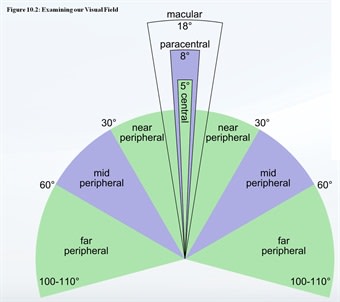
First of all, our eyesight is comprised of several component visual fields that work together to provide us with practical vision. In short, each field is responsible for contributing a specific portion of visual data that is needed to complete “the big picture” that we know as human sight.
If we look at the diagrams provided (left), we can see how our full visual field breaks down into the various components.
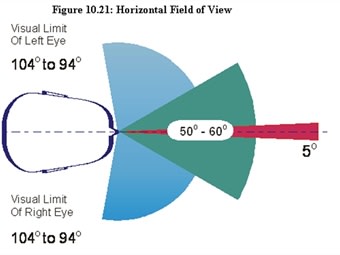
Our most accurate field of vision is known as our central vision (or central cone of vision) and is represented by the red area in Figure 10.21 and the smallest sliver shaded in light green of Figure 10.2.
Our most accurate vision, which we use for reading and to consider fine detail, is confined to a very small percentage of our overall vision. Data suggests that our central vision covers an area somewhere between three to five degrees.
The further away from our central cone, the less accurate and reliable our vision becomes.
Quickly, if our eyes could speak, this is what we might hear:
Central Vision — I see a woman moving slowly from right to left wearing a Detroit Lions jersey with a number 12 pasted front and back with sunglasses propped on top of her head and a dazzling silver backpack slung over her right shoulder. Lots of detail.
Immediate Peripheral Vision (includes near- and mid-peripheral fields) — I see a woman wearing a blue outfit walking slowly. Some detail.
Far Peripheral — Something moved. Very little detail.
Essentially, our peripheral vision serves as an early detection system that causes us to direct our attention (and central vision) towards objects that merit a closer look. This might be anything that has the potential to become a hazard without us taking appropriate action. Detection happens in a split second, but once our focus has shifted to the detected object, much of our mental resources are then dedicated toward calculating the objects speed, bearing and relationship to our vehicle. This represents the critical information that we need in order to decide whether to proceed, cover our brake, slow down, stop or make a steering correction.
One thing I learned is that our early detection system (peripheral vision) closes down if we don’t keep our eyes moving. In fact, our peripheral field can close down in a matter of seconds. Therefore, to maintain our safety net by keeping our peripheral field open and active, we must keep our eyes moving by looking left-right-left, scanning our mirrors at appropriate intervals and by maintaining the discipline needed to help our eyes collect the information we need to make decisions.
Please take a brief moment to review the video to appreciate how quickly this can happen:
If you fix your stare at the green dot positioned in the center of the grid, you may notice that the yellow dots seem to disappear from the screen. As soon as you start looking for them, the yellow dots reappear. This short video illustrates why it is so important to “keep your eyes moving.”
Each time we operate a motor vehicle we must use our near- and far-peripheral fields to funnel pertinent information to our macular vision or central cone, so we can make the critical decisions needed to avoid hazardous situations. This requires lots of head movement and extreme concentration and explains why even the slightest distractions can prove costly.
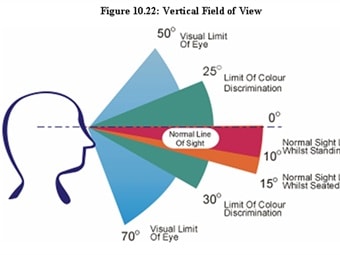
One final note… In Figure 10.22, you may notice that our visual field is biased in a way that allows us to see more below our normal sight line than above. This helps describe the natural tendency we have to look down and why it takes practiced discipline to “aim high in steering”.
Hopefully, understanding how your eyes work, even at the most basic level will help you use your vision to your best advantage.
Thanks to Allen Morgan of TriMet for sharing the video and bringing this information to my attention. The photos can be referenced by visiting the following links:
https://en.wikipedia.org/wiki/Peripheral_vision#/media/File:Peripheral_vision.svghttp://www.epd.gov.hk/eia/register/report/eiareport/eia_1402007/For%20HTML%20version/Figure/Figure%2010.21&10.22.png
Steve Mentzer is manager, transit simulations, training & courseware, L-3 D.P. Associates.
In case you missed it...
Read our previous blog, "Recognizing a Job Well Done at Your Bus Operation."
Subscribe to Our Newsletter
More Blog Posts
Improving Transit Accessibility by Offering Assistive Listening
Did you know that there are literally tens of millions of people worldwide with hearing loss, many of whom will use some form of public transit at some point?
Read More →
35 Years of the ADA, Making Travel Easier for Seniors
Thirty-five years after the passage of the Americans with Disabilities Act of 1990 (ADA), the impact of this landmark piece of civil rights legislation cannot be overstated.
Read More →
Driving Performance with Purpose: How I Lead One of Greyhound’s Top Teams
Safety, on-time performance, and customer experience are critical elements in intercity bus operations. But getting them right doesn’t come down to plans or protocols alone. It comes down to execution. How well your team performs on the ground, in real time, is what defines success.
Read More →
Navigating Emerging Privacy Laws: A Call to Action for Service Providers in Mass Transit
With Data Privacy Day Jan. 28, I want to spotlight a critical challenge faced by service providers in the mass transit sector: managing personal information responsibly in an era of rapidly evolving privacy regulations.
Read More →
Human Trafficking Awareness: What Public Transportation Can Do?
January is National Slavery and Human Trafficking Prevention Month in the U.S., and January 11 is National Human Trafficking Awareness Day.
Read More →
Want to Improve Transit Safety and Operations? Break Down the Silos
Retrieving and reviewing data and video can be a cumbersome process for fleet managers. Each system or tool provides a piece of the puzzle, but seeing the complete picture requires tedious manual synchronization.
Read More →
Ensuring Public Transit Cybersecurity Through Robust Protective Measures
In today’s highly connected world, cybersecurity is of utmost importance, particularly for transportation agencies overseeing transit bus systems that rely increasingly on sophisticated technologies, including the use of data analytics in traffic signal networks, to manage and operate their systems.
Read More →
How Advances in Thermal Management Revolutionize Urban Mobility
In the daily hustle and bustle of city life, transit buses serve as the backbone of urban transportation, allowing millions of city dwellers to get from point A to point B each day reliably.
Read More →
The Evolution of Bus Design
Thirty years ago, drivers not only had to drive the bus and navigate heavy traffic, but they were also responsible for tasks like supervising passenger loading and unloading, selling tickets, and providing passengers with various kinds of information, all while sitting in an often ill-fitting workstation.
Read More →
What 'Transit Safety 101' Really Means
Safety, Safety, Safety. This word is used repeatedly, and in many contexts, without most people understanding what it actually means.
Read More →