



How safety programs can help transit meet budget challenges
Agencies striving to meet service demands and overcome budgetary pressures are continuing to make safety of operators and riders a priority, however, it’s not always something that can be given a huge investment. What we’ve seen, though, is that investing in safety can actually work to the benefit of agencies in terms of efficiency increases and cost reductions.

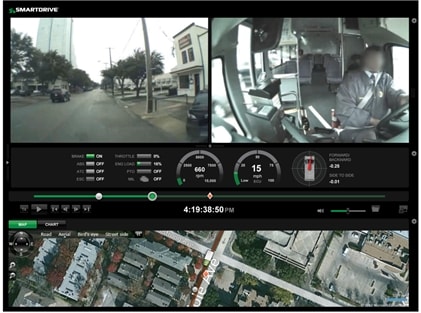
A driving event captured by SmartDrive has been scored and prioritized.
Transit agencies today face a complex set of issues: budgets are shrinking while demand for public transportation and ridership are increasing at a record pace.
Agencies striving to meet service demands and overcome budgetary pressures are continuing to make safety of operators and riders a priority, however, it’s not always something that can be given a huge investment. What we’ve seen, though, is that investing in safety can actually work to the benefit of agencies in terms of efficiency increases and cost reductions.
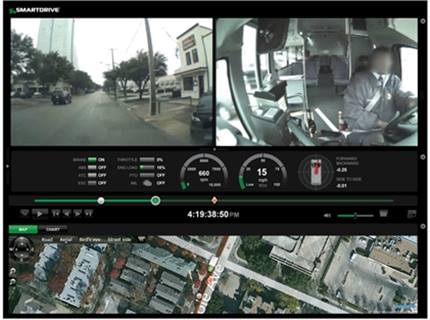
A driving event captured by SmartDrive has been scored and prioritized.
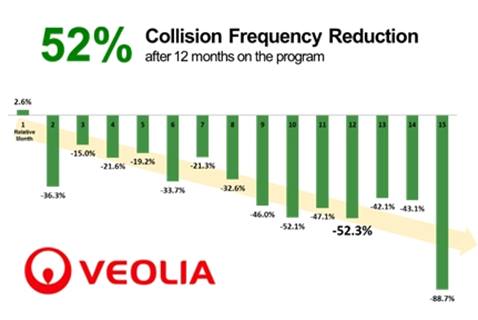
A prime example of this is with Veolia Transportation, a private sector operator of multiple modes of transit in North America. The company saw a relatively small investment in safety systems turn into big cost savings — specifically, a $5 million drop in annual claims cost.
Back in May 2011, Veolia started implementing SmartDrive’s on-board video and safety program on vehicles across the U.S. Veolia has always been an organization focused on safety. Their major safety initiative, 300:29:1, identifies and eliminates the unsafe acts that can accumulate and lead to an accident. The rationale: for every 300 unsafe acts, 29 potential collisions and one catastrophic loss will occur. They’ve coined the phrase “Prevent the 300” to keep the priority in mind.
As part of its goal to “Prevent the 300,” Veolia has long supported the use of on-board video on its vehicles. After using another system that wasn’t meeting its needs, Veolia switched to SmartDrive Safety, which combines video with a critical analysis component. The video provides a consistent and objective view of the operator, vehicle and environment, and then, SmartDrive Safety experts analyze, score and prioritize the data before sending it to Veolia. These experts identify unsafe driving maneuvers, highlight good driving skills and document rider issues — giving safety managers actionable and prioritized tools to coach operators on their individual performance.
Since starting the program, Veolia has seen some amazing increases in safety including:
• Decrease in following at an unsafe distance by 79%.
• Drop in speeding by 88%.
• Reduction in collision frequency by 52%.
• 94% of unfastened seat belts now being fastened.
Importantly, Veolia made their investment back — and then some — with the $5 million drop in annual claims cost.
In the end, safety programs can be a key component in helping transit agencies overcome today’s operational and budgetary pressures by increasing efficiency, saving lives and reducing costs.
To read the entire case study on how Veolia is “preventing the 300” and saving money with SmartDrive, visit http://smartdrive.net/documents/veolia-transportation-case-study.pdf.
In case you missed it...
Read our METRO blog, "San Antonio transit agency turns to advanced vehicles to protect air quality."
________________________________________
Palmer is the president of SmartDrive Systems, a leader in providing comprehensive, video-based operator performance and safety programs to help transit agencies achieve operational safety and efficiency, protect operators and the public, and lower costs overall.
More Blog Posts
Improving Transit Accessibility by Offering Assistive Listening
Did you know that there are literally tens of millions of people worldwide with hearing loss, many of whom will use some form of public transit at some point?
Read More →
35 Years of the ADA, Making Travel Easier for Seniors
Thirty-five years after the passage of the Americans with Disabilities Act of 1990 (ADA), the impact of this landmark piece of civil rights legislation cannot be overstated.
Read More →
Driving Performance with Purpose: How I Lead One of Greyhound’s Top Teams
Safety, on-time performance, and customer experience are critical elements in intercity bus operations. But getting them right doesn’t come down to plans or protocols alone. It comes down to execution. How well your team performs on the ground, in real time, is what defines success.
Read More →
Navigating Emerging Privacy Laws: A Call to Action for Service Providers in Mass Transit
With Data Privacy Day Jan. 28, I want to spotlight a critical challenge faced by service providers in the mass transit sector: managing personal information responsibly in an era of rapidly evolving privacy regulations.
Read More →
Human Trafficking Awareness: What Public Transportation Can Do?
January is National Slavery and Human Trafficking Prevention Month in the U.S., and January 11 is National Human Trafficking Awareness Day.
Read More →
Want to Improve Transit Safety and Operations? Break Down the Silos
Retrieving and reviewing data and video can be a cumbersome process for fleet managers. Each system or tool provides a piece of the puzzle, but seeing the complete picture requires tedious manual synchronization.
Read More →
Ensuring Public Transit Cybersecurity Through Robust Protective Measures
In today’s highly connected world, cybersecurity is of utmost importance, particularly for transportation agencies overseeing transit bus systems that rely increasingly on sophisticated technologies, including the use of data analytics in traffic signal networks, to manage and operate their systems.
Read More →
How Advances in Thermal Management Revolutionize Urban Mobility
In the daily hustle and bustle of city life, transit buses serve as the backbone of urban transportation, allowing millions of city dwellers to get from point A to point B each day reliably.
Read More →
The Evolution of Bus Design
Thirty years ago, drivers not only had to drive the bus and navigate heavy traffic, but they were also responsible for tasks like supervising passenger loading and unloading, selling tickets, and providing passengers with various kinds of information, all while sitting in an often ill-fitting workstation.
Read More →
What 'Transit Safety 101' Really Means
Safety, Safety, Safety. This word is used repeatedly, and in many contexts, without most people understanding what it actually means.
Read More →