



How to Maximize the Lifecycle of Trains, Infrastructure Safely, Efficiently
Reports of passenger rail accidents dot the news cycle, often citing lack of modernized infrastructure as a leading cause. Despite these facts, it is simply not realistic to expect commuter and subway systems to be overhauled overnight.

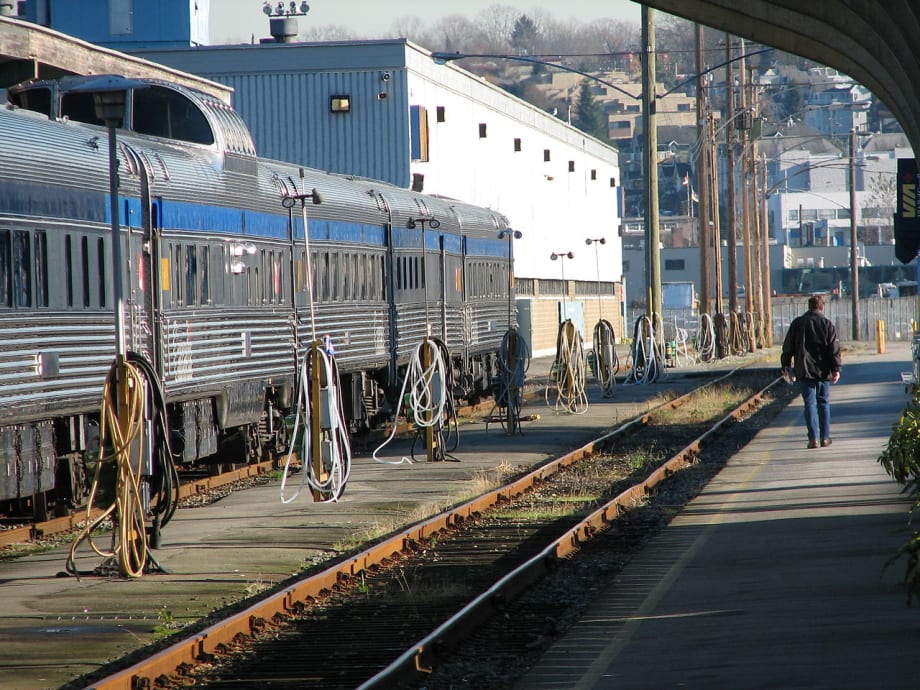
For rail, maintaining full visibility into the state of capital assets is essential to service availability, increasing passenger safety and achieving optimal lifetime value.
Lee Down
Reports of passenger rail accidents dot the news cycle, often citing lack of modernized infrastructure as a leading cause. Despite these facts, it is simply not realistic to expect commuter and subway systems to be overhauled overnight. Instead, the goal for transit operators should be to maximize the lifecycle of trains and infrastructure in a safe and efficient way — how can transit agencies maintain and repair infrastructure as it ages in the most efficient way?
One approach that’s been gaining traction lately is digitization. In the rail industry, digitization can be achieved with solutions like GPS technologies and updated rail signaling systems, but these don’t necessarily solve for deteriorating infrastructure. For that, transit agencies are turning to digitized assets, or the act of bringing life to physical objects, such that those objects can communicate directly with operations personnel to facilitate preventative and predictive maintenance, incite a higher level of asset utilization, create better asset visibility and planning, and allow for more accurate reporting.
Making Assets Smart
If an asset is able to “tell its life story” to anyone with a smartphone-based reader, then it is smart. In the world of rail management, this would mean any object that requires maintenance can dictate repair instructions, at the precise moment in time when an action needs to occur. When a railcar, for example, is able to relay real-time detail about where it is in its 30-year maintenance and repair lifecycle, along with compliance criteria that may be required, the game simply changes.
At its core, this kind of approach is a 180-degree turn from traditional means of tracking lifecycle history and actionable needs. Instead of recording notes in an analog logbook that is fundamentally de-coupled from the asset, smart assets can distribute key information — manufacturing details, part specifications, authenticity and progressive maintenance activity — on a product itself, across its entire useful life.
Making Lifecycle Information Efficient for Rail Operations
For rail, maintaining full visibility into the state of capital assets is essential to service availability, increasing passenger safety and achieving optimal lifetime value. Attaching accessible data directly on an asset improves maintenance and operations since maintenance professionals, at the point of interaction with the asset, will be fully informed about the product’s history before undertaking any maintenance procedures.
Compare that to traditional matrices of rail operation, where paper logs might get misplaced or become unreadable, while data that has been uploaded to Enterprise Asset Management (EAM) systems can erode during IT consolidation and upgrade cycles; worse yet, storing critical information in remote locations makes it nearly impossible for operators or third-party maintenance vendors to access at a moment’s notice.
Full visibility also increases safety for passengers and train operators. When parts have the ability to compute and communicate, they are able to signal to maintenance crews when there is an issue, or if a component is due for replacement. Providing maintenance professionals with the most current information possible will limit unnecessary overhauls and repairs to keep trains on the track longer, and heighten the level of safety transit agencies can provide their riders and operators.
Lessons Learned from Aerospace
When advances in inexpensive, rugged semiconductor chips made it possible to attach, or embed data within physical assets, aerospace suppliers became textbook early adopters. Airbus now ships its A350 airliners with thousands of high-memory passive RF tags. This gives them improvements in assembly operations, and provides airline operators with a lifecycle data platform so they can support improved operation and maintenance. Airbus and Boeing are moving toward tagging all serialized, repairable, replaceable and maintainable airplane parts — about 10,000 parts on a typical airframe.
Many aircraft components carry specific, periodic inspection and maintenance requirements in order to be legally airworthy. The smart asset approach improves aircraft operators’ ability to sustain maintenance and inspection records for each component. When components are sent out for repair or overhaul, the configuration and history data on the part becomes instantly available to anyone who touches it, even if the airframe is thousands of miles away.
This same digitization has the potential to transform railway asset management as well, such that rail agencies can record, store, and manipulate critical data and drive major business benefits. It is no wonder 92% of rail industry companies plan to invest in digitizing their business in the next three years, according to the 2017 Rail Supply Digitization study. The trick is getting it right.
Next-Generation Asset Lifecycle Management in Context
In summary, the next-generation of lifecycle operations will allow the entire, granular history of capital assets to easily and inexpensively become part of the equipment itself. This elegant distribution mechanism provides crews with complete origination, usage and maintenance history information, without depending on access to centralized systems, networks or paper records. The model is, in fact, analogous to what happened when computing moved from mainframe systems, to distributed PCs and finally to the mobile device ecosystem that is ubiquitous today.
When assets become imbued with their own computing power, you begin to see the potential for lower lifecycle costs and improved safety. The opportunity to fundamentally transform the asset lifecycle management process in rail is here; it is now up to stakeholders to grab hold.
About the Author: Timothy Butler is the founder and CEO ofTego, whose technology turns products, components, and systems into smart assets.
More Blog Posts

Improving Transit Accessibility by Offering Assistive Listening
Did you know that there are literally tens of millions of people worldwide with hearing loss, many of whom will use some form of public transit at some point?
Read More →
35 Years of the ADA, Making Travel Easier for Seniors
Thirty-five years after the passage of the Americans with Disabilities Act of 1990 (ADA), the impact of this landmark piece of civil rights legislation cannot be overstated.
Read More →
Driving Performance with Purpose: How I Lead One of Greyhound’s Top Teams
Safety, on-time performance, and customer experience are critical elements in intercity bus operations. But getting them right doesn’t come down to plans or protocols alone. It comes down to execution. How well your team performs on the ground, in real time, is what defines success.
Read More →
Navigating Emerging Privacy Laws: A Call to Action for Service Providers in Mass Transit
With Data Privacy Day Jan. 28, I want to spotlight a critical challenge faced by service providers in the mass transit sector: managing personal information responsibly in an era of rapidly evolving privacy regulations.
Read More →
Human Trafficking Awareness: What Public Transportation Can Do?
January is National Slavery and Human Trafficking Prevention Month in the U.S., and January 11 is National Human Trafficking Awareness Day.
Read More →
Want to Improve Transit Safety and Operations? Break Down the Silos
Retrieving and reviewing data and video can be a cumbersome process for fleet managers. Each system or tool provides a piece of the puzzle, but seeing the complete picture requires tedious manual synchronization.
Read More →
Ensuring Public Transit Cybersecurity Through Robust Protective Measures
In today’s highly connected world, cybersecurity is of utmost importance, particularly for transportation agencies overseeing transit bus systems that rely increasingly on sophisticated technologies, including the use of data analytics in traffic signal networks, to manage and operate their systems.
Read More →
How Advances in Thermal Management Revolutionize Urban Mobility
In the daily hustle and bustle of city life, transit buses serve as the backbone of urban transportation, allowing millions of city dwellers to get from point A to point B each day reliably.
Read More →
The Evolution of Bus Design
Thirty years ago, drivers not only had to drive the bus and navigate heavy traffic, but they were also responsible for tasks like supervising passenger loading and unloading, selling tickets, and providing passengers with various kinds of information, all while sitting in an often ill-fitting workstation.
Read More →
What 'Transit Safety 101' Really Means
Safety, Safety, Safety. This word is used repeatedly, and in many contexts, without most people understanding what it actually means.
Read More →