




Related: Bus Collisions and the Fully-Equipped 'Medicine Cabinet'
The Power of Collaboration to Promote Safe Bus Operations
Years ago, I was with Louie Maiello when someone walked over and asked him for some advice: “We’re having problems with people remembering to secure the bus before they leave their seat. Do you have any advice? How can we get them to remember?” Without missing a beat, Louie said “PIN it.” The advice seeker happened to be a veteran mechanic, so he understood and walked away to resume his work. I stood there for a while scratching my head. Pin it?
October 12, 2016
5 min to read
Years ago, I was with Louie Maiello when someone walked over and asked him for some advice: “We’re having problems with people remembering to secure the bus before they leave their seat. Do you have any advice? How can we get them to remember?” Without missing a beat, Louie said “PIN it.” The advice seeker happened to be a veteran mechanic, so he understood and walked away to resume his work. I stood there for a while scratching my head. Pin it?
Parking Brake—Interlock—Neutral.
Louie called each one out using his fingers for emphasis: P-I-N. Right, an acronym. Makes sense.
A spirited back-and-forth exchange ensued with each of us offering clever turns on well-known phrases such as Al Davis’ “Just PIN baby!” Ty Pennington’s “PIN-THAT-BUS!” Dale Carnegie’s “How to PIN the Bus and Influence People” and my favorite, Jonny Cochran’s “You must remain in it, until you PIN it!” With “When you PIN, we all Win” running a close second.
Although we didn’t realize it at the time, this was the first round of collaboration that eventually led to the safety poster shown below as Exhibit B. How so? A rapid succession of ideas were generated without pausing to judge for individual merit. This is otherwise known as “brainstorming" — an informal, fast, and effective way to generate ideas. And, its fun!
Chapter 2 — Time moves on, priorities change, brainstorms end, and a promising idea is left at the station.
Then, someone innocently asks, “Have you ever run across a good safety poster that can be used to promote proper bus securement?” A gleam begins to form in my eyes…
Memories of those clever phrases returned, but it occurred to me that I had never seen any of them made into a poster. So, I did some digging — Googled like mad — but I couldn’t find anything. “How soon do you need something?” A couple of weeks. Perfect. “Let me get back to you.”
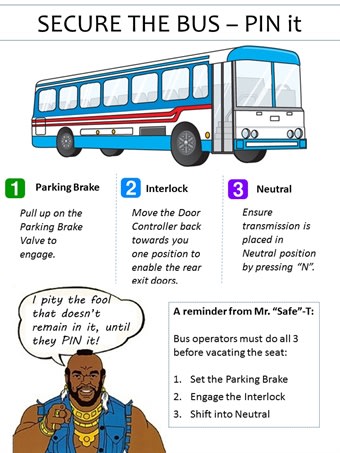
Exhibit A
Spending just enough time to check for typos, I rushed a copy off to my friend to proofread.
After waiting five excruciating minutes, I broke down and called to receive his accolades: “Wow, Steve! You must really like cartoons. Can I make a few suggestions?” I was shocked and crushed. A clear victim of self-bias.
Self-bias is the reason that collaboration is important. We have a tendency to fall madly in love with anything we create. This works great with children, not so well when it comes to advancing an idea. We are also prone to suffer from the “fluency illusion,” which describes a level of familiarity with a topic that fools us into thinking we are actually bona fide “experts” on the subject. I was suffering a little of both.
Fortunately, the suggestions for improvement arrived before I could offer an objection. They turned out to be very good. I listened carefully and then called some other people to get their input.
You will be amazed at how willing others are to offer their assistance when asked to do so. More importantly, an idea can be quickly strengthened, validated, or confirmed, corrected, or improved, sometimes even scrapped altogether — simply by asking for help. Time will be saved. Hallelujah!
Quickly, let’s walk through some of the changes that came as a direct result of collaboration:
I thought the notion of Mr. T having an alter ego that dispenses safety information to bus operators was pure genius; however, it was quickly nixed. It was suggested that most people don’t appreciate being menaced in the workplace and some may find the bubble’s text to be condescending. Goodbye, Mr. T.
The cartoon bus lacks rear passenger doors and is not representative of any specific make and model currently being operated by the authority. Lose the bus.
Lacks visuals to reinforce the text. Add visuals.
Layout needs to be clear and easy to read. A poster may only receive a passing glance. They are not commonly studied, so a message needs to be conveyed as much by image as words. Look for examples.
Incorporate color to make the “quick message” pop off of the page. Call Mike Perez.
Incorporating the changes inspired me to improve the visual quality and to provide a mix of “quick” messages — images combined with simple instructions. Most bus operators don’t require the level of detail provided, but it helps to clarify the message and discourage misconceptions.
Chapter 3 — No man is an island.
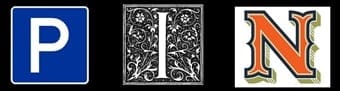
Mike Perez (San Diego MTS) is a master at creating visuals that are incredibly powerful, yet simple. Mike understands that less is more. I’m still learning. Want to see the difference? Look at my choice of letters below. Now look at the final draft (Exhibit B) using Mike’s letters. Clean & simple = Easy to read.
Seeking the input of others revealed that there is more than one way to secure a bus. The process can vary from model to model and from agency to agency. One that seemed particularly noteworthy came from my esteemed friend, Kevin Vautour (MBTA). Their policy is quite extensive, so I will summarize in order to illustrate some of the differences.
To secure a bus in Boston, operators must set the parking brake, shift to neutral, shut off the engine, close the doors, and place chock blocks against the wheels. Front wheels are turned towards the curb to account for even a slight grade. A complete procedure that describes how to properly apply the chock blocks to prevent movement of the bus is defined in a separate document. Did you notice that interlock is not mentioned? The PIN acronym will not work here.
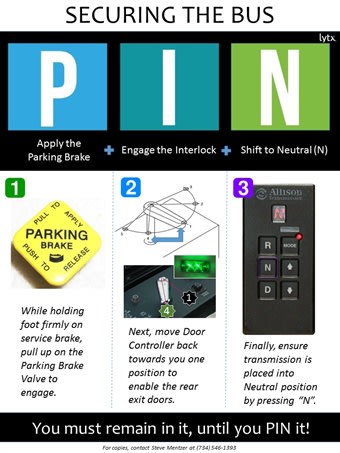
Exhibit B
So what was the sticky part? The phrase at the bottom, of course. Concepts become easier to remember if we can add a unique twist — set the message to a familiar tune, use a rhythmic cadence (think Muhammad Ali), or link with a distinct image or emotion. It takes practice.
An idea for expressing the securement process through a musical reference might play off of the Lynyrd Skynyrd song, “Gimme Three Steps,” to ensure that the PIN sequence is followed without omitting a single step.
Are you working on a safety message, campaign, or presentation that you would like to improve? If so, pick up the phone or send an email. Help is on the way!
**Special thanks to Louie, Mike, Kevin, and Stephanie Furlong (St. Louis Metro Bus) for their contributions.
Steve Mentzer is Enterprise Sales Director, Public Transit and Government Fleets, for Lytx.
Subscribe to Our Newsletter
More Blog Posts
Improving Transit Accessibility by Offering Assistive Listening
Did you know that there are literally tens of millions of people worldwide with hearing loss, many of whom will use some form of public transit at some point?
Read More →
35 Years of the ADA, Making Travel Easier for Seniors
Thirty-five years after the passage of the Americans with Disabilities Act of 1990 (ADA), the impact of this landmark piece of civil rights legislation cannot be overstated.
Read More →
Driving Performance with Purpose: How I Lead One of Greyhound’s Top Teams
Safety, on-time performance, and customer experience are critical elements in intercity bus operations. But getting them right doesn’t come down to plans or protocols alone. It comes down to execution. How well your team performs on the ground, in real time, is what defines success.
Read More →
Navigating Emerging Privacy Laws: A Call to Action for Service Providers in Mass Transit
With Data Privacy Day Jan. 28, I want to spotlight a critical challenge faced by service providers in the mass transit sector: managing personal information responsibly in an era of rapidly evolving privacy regulations.
Read More →
Human Trafficking Awareness: What Public Transportation Can Do?
January is National Slavery and Human Trafficking Prevention Month in the U.S., and January 11 is National Human Trafficking Awareness Day.
Read More →
Want to Improve Transit Safety and Operations? Break Down the Silos
Retrieving and reviewing data and video can be a cumbersome process for fleet managers. Each system or tool provides a piece of the puzzle, but seeing the complete picture requires tedious manual synchronization.
Read More →
Ensuring Public Transit Cybersecurity Through Robust Protective Measures
In today’s highly connected world, cybersecurity is of utmost importance, particularly for transportation agencies overseeing transit bus systems that rely increasingly on sophisticated technologies, including the use of data analytics in traffic signal networks, to manage and operate their systems.
Read More →
How Advances in Thermal Management Revolutionize Urban Mobility
In the daily hustle and bustle of city life, transit buses serve as the backbone of urban transportation, allowing millions of city dwellers to get from point A to point B each day reliably.
Read More →
The Evolution of Bus Design
Thirty years ago, drivers not only had to drive the bus and navigate heavy traffic, but they were also responsible for tasks like supervising passenger loading and unloading, selling tickets, and providing passengers with various kinds of information, all while sitting in an often ill-fitting workstation.
Read More →
What 'Transit Safety 101' Really Means
Safety, Safety, Safety. This word is used repeatedly, and in many contexts, without most people understanding what it actually means.
Read More →