The Federal Railroad Administration (FRA) issued a final rule establishing modern, performance-based safety standards for railroad passenger equipment. The rule reinforces FRA’s commitment to safety while representing one of the most significant enhancements to the nation’s passenger rail design standards in a century. The rule paves the way for U.S. high-speed passenger trains to safely travel as fast as 220 miles per hour.
The final rule defines a new category of high-speed rail operations and makes it possible for high-speed rail to utilize existing infrastructure, saving the expense of building new rail lines. The new “Tier III” passenger trains can operate over shared track at conventional speeds, and as fast as 220 mph in areas with exclusive rights-of-way and without grade crossings.
Ad Loading...
The final rule also establishes minimum safety standards for these trains, focusing on core, structural, and critical system design criteria. FRA estimates that the rule will improve safety because of expected improvements made by the railroads to accommodate the operation of high-speed rail equipment in shared rights-of-way.
The final rule will be a deregulatory action under Executive Order (EO) 13771, “Reducing Regulation and Controlling Regulatory Costs.” The rule is expected to save more than $475 million in net regulatory costs.
Passenger train manufacturers across the globe have utilized innovative design and testing techniques for years, incorporating features such as crash energy management. Under FRA’s previous passenger equipment regulations, U.S. rail companies have had limited procurement options or have needed to petition FRA for waivers to use these newer technologies.
The final rule continues to define Tier I as trains operating in shared rights-of-way at speeds up to 125 mph, and it also allows state-of-the-art, alternative designs for equipment operating at these conventional speeds. Tier II trains are defined as those traveling between 125 to 160 mph, an increase from the previous 150 mph limit. This supports a competitive operating environment for U.S. companies seeking to offer travelers more passenger rail options. By enabling the use of advanced equipment-safety technologies, this final rule helps eliminate the need for waivers.
The final rule was developed with the assistance of the Engineering Task Force (ETF), under the auspices of FRA’s Railroad Safety Advisory Committee (RSAC). The ETF membership included FRA technical staff and representatives from railroads, rail labor organizations, manufacturers and others. The ETF evaluated production trends against the U.S. operating environment. The ETF recommended that FRA expand its traditional speed-and-safety rating system to three categories of passenger trains.
METRO’s People Movement highlights the latest leadership changes, promotions, and personnel news across the public transit, motorcoach, and people mobility sectors.
BART began offering select parking lots to non-BART riders to generate new revenue to help address its FY27 $376M operating budget deficit brought on by remote work.
Drawing on decades of industry experience, Evans-Benson offered insights into the differences between the two, along with tips for better customer engagement and more.
The renewals include continued operations at Fort Lauderdale-Hollywood International Airport in Florida; the PRTC in Virginia; and RTC Washoe in Nevada.
The governor’s proposed auto insurance reforms could save the agency $48 million annually by limiting payouts in crashes where buses are not primarily at fault.
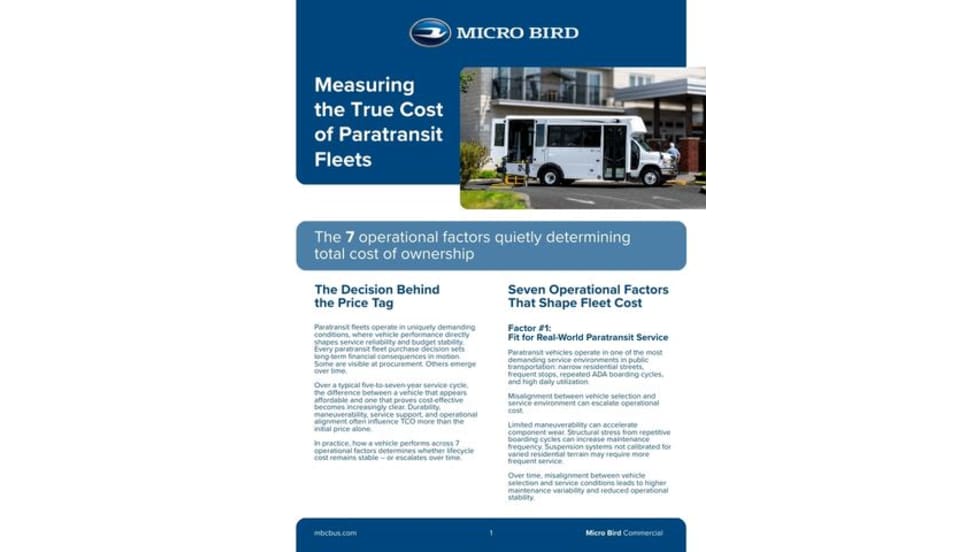
What truly drives the cost of a paratransit fleet? Beyond the purchase price, seven operational factors quietly determine maintenance frequency, downtime, and long-term service reliability. This whitepaper explores how these factors shape lifecycle cost and what agencies should evaluate when selecting paratransit vehicles.
In this conversation, TBC’s Executive Director Ed Redfern, President Corey Aldridge, and Washington Representative Joel Rubin outline the coalition’s key policy priorities, the challenges facing transit agencies, and how industry stakeholders can work together to strengthen the voice of bus transit at the federal level.
Amanda Wanke, who has worked at DART for 10 years, including the past 2½ years as CEO, will join Metro Transit as deputy chief operating officer, operations administration.