GM/CEO
Santa Clara Valley Transportation Authority
San Jose, Calif.


 MENU
MENU SEARCH
Growing up in Panama City, Panama, Nuria Fernandez’s earliest experience with transit was riding what she calls the “rather unorthodox bus system” of her hometown.
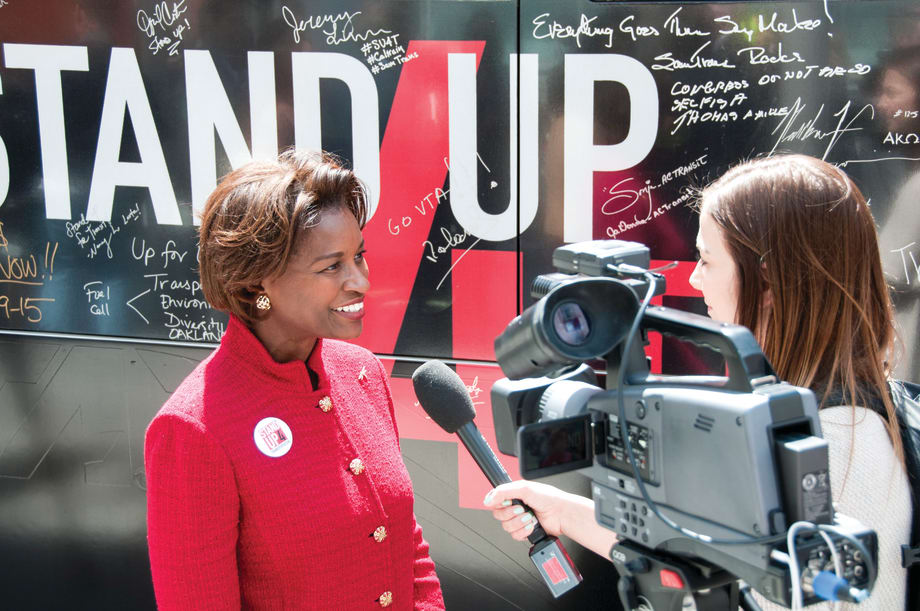
Fernandez says her agency’s location is at “ground zero for innovation.”
Growing up in Panama City, Panama, Nuria Fernandez’s earliest experience with transit was riding what she calls the “rather unorthodox bus system” of her hometown.
Fernandez says her agency’s location is at “ground zero for innovation.”
“Back then, anyone who wanted to could get a license to operate a bus, and the routes and fares were not as structured as they are in the U.S.,” says Fernandez.
CAREER PATH. When she came to the U.S. to study civil engineering, she was introduced to the American system of public transportation. This sparked her interest in pursuing transit as a career path. She then began an internship with the Panama Canal Co., where she landed her first job upon graduation. She worked in the engineering division of the Panama Canal Co.’s Gatún Locks.
“My great grandfather was involved in the construction of the Canal, so it was a legacy that I proudly took part in,” says Fernandez.
EXPERIENCE. Over the course of her robust 35-year career, Fernandez has worked many public and private sector jobs in the transportation industry. She served as chief operating officer for the New York State Metropolitan Transportation Authority. Fernandez also managed the operations of O’Hare International Airport in Chicago. And sequentially, she was the head of design and construction for the Chicago Transit Authority and the Washington Metropolitan Transit Authority.
Fernandez provided high-level policy and program expertise as deputy administrator of U.S. Department of Transportation’s Federal Transit Administration. Additionally, she has served as senior VP at two different engineering consulting firms, CH2M HILL and Earth Tech.
ROLE FOCUS. As GM/CEO of Santa Clara Valley Transportation Authority (VTA), Fernandez oversees all functions of the agency. She describes the present as an exciting time to be based in Silicon Valley.
“We are at ground zero for innovation,” says Fernandez. “I routinely interact with tech industry leaders in an effort to integrate their cutting-edge ideas into our transportation landscape so that our system can work better for everyone. This collaboration is where creativity is changing not only our region but the world — it is an exciting partnership.”
In addition to being a transit authority, VTA is also the Congestion Management Agency for Santa Clara County. Therefore, Fernandez is in charge of supervising VTA plans, designs, and even the construction of mass transit facilities and highway interchanges. This is in an effort to help regional traffic move more smoothly overall.
In taking on such a big task, Fernandez emphasizes that confidence is key. “My confidence was instilled in me by my mother,” says Fernandez. “You need a willingness to try new things and take risks.”
KEY PROJECT. Currently, the VTA is completing the largest transportation infrastructure project in Santa Clara County history — the extension of the Bay Area Rapid Transit (BART) system. The goal is to create a comprehensive public transportation network around the entire San Francisco Bay Area.
In order to make this a reality, VTA placed the 2016 Measure B on the ballot last year, which implements a 30-year half-cent countywide sales tax. The measure passed by nearly 72%, marking the highest level of support for any Santa Clara County transportation tax. The measure will help fund BART through downtown San Jose as well as dozens of other improvements.
“I am extremely proud of the work that VTA’s planning and community outreach teams did over the past two years to educate residents and listen to their needs,” says Fernandez. “It started with building a coalition of stakeholders and residents to develop a list of projects to build and maintain our transportation infrastructure network.”
Fernandez and her team are currently in the process of developing a program to allocate the projected $6 billion in sales tax revenues from Measure B.
When Fernandez is not at the office, she enjoys hiking and biking around northern California. She also knits, crochets, bakes, and spends time with her two new grandchildren.

Nominations are now being accepted for METRO Magazine’s Operator of the Year and Innovative Operator of the Year awards.
Read More →
Contract Four is the largest in the Second Avenue Subway Phase 2 project and includes construction of station infrastructure, tracks, and signals for the subway expansion, MTA officials said. Work on Contract Four will begin in 2027.
Read More →
Leaders from 15 major transit systems shared crime-reduction results and safety initiatives while discussing the role of continued federal support.
Read More →
The new regional transit authority appointed its first board chair and interim executive director while extending reduced fares across CTA, Metra, and Pace for eligible riders.
Read More →
Reliability-Centered Maintenance helps transit agencies move beyond routine checklists to focus limited resources on the assets and failures that have the greatest impact on safety, reliability, and service.
Read More →
Leadership changes will help shape the association’s priorities and its representation of the transportation industry during the 2026–2027 term.
Read More →
The 90-day demonstration will deploy coordinated security teams at five light rail stations while testing controlled access and gathering data to guide future investments.
Read More →
Learn about delivering 1300 gates at 91 stations while managing fare evasion. Explore the large scale deployment, solution customization and real-world results that affect the region. Prepare for deployment in your region now.
Read More →
Between packed transit stations and team motorcoaches, see how agencies and operators across North America tackled the transportation demands of the 2026 FIFA World Cup.
Read More →
The stopgap keeps federal transportation programs moving, but missing advance funding could complicate the transit and rail projects agencies are planning next.
Read More →