



IndyGo finalizes new strategy to charge electric buses
The organization worked with BYD to develop a solution, which will utilize wireless charging technology.

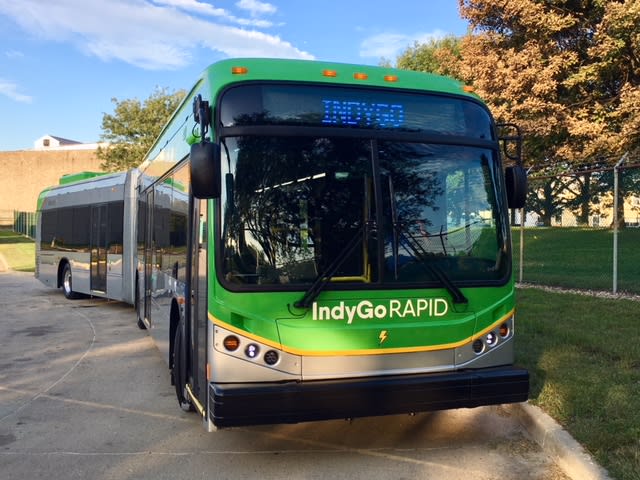
The BYD buses will periodically charge for approximately 10 to 20 minutes.
BYD
The BYD buses will periodically charge for approximately 10 to 20 minutes.
BYD
Indianapolis’ IndyGo reached an agreement with BYD, the maker of IndyGo’s new electric buses, to install and pay for wireless charging infrastructure. The deal includes wireless charging hardware for buses, and the equipment for three charging pads along battery-powered routes.
When testing began last fall, the buses achieved lower-than-expected distances on one charge. Over the course of several months of testing, IndyGo confirmed a strong correlation between vehicle range for the BYD K11 buses and outdoor temperature. The organization worked with BYD to develop a solution, which will utilize wireless charging technology.
“We anticipated that vehicle range would depend on temperature, but the contract requires a 275-mile range at zero degrees,” said Justin Stuehrenberg, IndyGo VP, capital projects and planning. “Our team identified several options to address the issue and worked closely with BYD to determine the most feasible resolution. At the same time, we made it clear to the company they must be accountable to our contract. Numerous test days this spring resulted in range performance at and above the contractually required 275 miles on a single charge. To date, the best range of any one test was 307 miles on a single charge.”
Throughout daily operations, the BYD buses will periodically charge for approximately 10 to 20 minutes at three locations near the rapid transit routes. IndyGo is currently evaluating the specific locations for the charge points. The charging system itself will use inductive technology.
“BYD has been a good partner in providing a reliable solution for what was agreed upon in our contract,” said Mike Terry, president/CEO of IndyGo. “We are excited to be the first battery-powered BRT line in the nation.”
The periodic boosts to the batteries on the BYD buses will incrementally recharge the vehicles while drivers take scheduled breaks with no passengers on board. At the end of daily operations, all electric buses operating on the city’s bus rapid transit lines will return to IndyGo headquarters, where the batteries will be fully charged overnight.
The Red Line will be the nation’s first battery-electric bus rapid transit route. IndyGo plans to operate a 100% electric bus fleet by 2035.
More Management

METRO Opens Submissions for 2026 Motorcoach Awards
Nominations are now being accepted for METRO Magazine’s Operator of the Year and Innovative Operator of the Year awards.
Read More →
New York MTA Advances Final Contract for Second Avenue Subway Expansion
Contract Four is the largest in the Second Avenue Subway Phase 2 project and includes construction of station infrastructure, tracks, and signals for the subway expansion, MTA officials said. Work on Contract Four will begin in 2027.
Read More →
Transit Agencies Highlight Safety Gains at National Summit
Leaders from 15 major transit systems shared crime-reduction results and safety initiatives while discussing the role of continued federal support.
Read More →

NITA Names New Leadership, Expands Reduced-Fare Program at First Board Meeting
The new regional transit authority appointed its first board chair and interim executive director while extending reduced fares across CTA, Metra, and Pace for eligible riders.
Read More →
Beyond the Checklist: A Structured Approach to Transit Maintenance
Reliability-Centered Maintenance helps transit agencies move beyond routine checklists to focus limited resources on the assets and failures that have the greatest impact on safety, reliability, and service.
Read More →
APTA 2026 Nominating Committee Selects Leadership Slate, Names Chair and Vice Chair Nominees
Leadership changes will help shape the association’s priorities and its representation of the transportation industry during the 2026–2027 term.
Read More →
DART Launches Major Security, Fare Enforcement Initiative
The 90-day demonstration will deploy coordinated security teams at five light rail stations while testing controlled access and gathering data to guide future investments.
Read More →
Advancing Fare Collection Through Technology and Innovation
Learn about delivering 1300 gates at 91 stations while managing fare evasion. Explore the large scale deployment, solution customization and real-world results that affect the region. Prepare for deployment in your region now.
Read More →
Game Day in Motion: Moving Millions During the 2026 World Cup
Between packed transit stations and team motorcoaches, see how agencies and operators across North America tackled the transportation demands of the 2026 FIFA World Cup.
Read More →
Surface Transportation Extension Averts Shutdown, Leaves Transit Funding Gap
The stopgap keeps federal transportation programs moving, but missing advance funding could complicate the transit and rail projects agencies are planning next.
Read More →