



RELATED: Agencies must step up to achieve transportation equity
TriMet low-income fare program helps man leave 'criminal life' behind
Agency has partnered with dozens of non-profits, social service agencies, colleges and universities to expand access to program.
by By Tia York, TriMet
January 2, 2020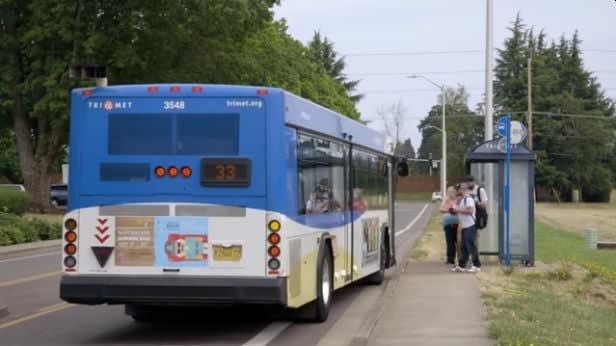
TriMet's low-income fare program allows participants access to unlimited rides on the system for $28 per month, a 72% discount off the cost of adult fare.
Screenshot via TriMet
4 min to read
TriMet's low-income fare program allows participants access to unlimited rides on the system for $28 per month, a 72% discount off the cost of adult fare.
Screenshot via TriMet
At 28 years old, Coty H. is starting over. He admits he’s made mistakes and is no stranger to the criminal justice system. He doesn’t like to talk about where he came from. He says it “wasn’t the coolest place in the world,” but during a visit to the Clackamas Community Corrections Transition Center, he did open up about where he’s going. He credits a program offered at the center, for helping to set his life in a new direction and TriMet, for helping him on the journey.
“When I got released from jail, I came here, to the Transition Center,” Coty said. “I was like, ‘I’m not leaving until I get into a program. I need something that’s stable and hard core.’ They hooked me up with the Foundations Program. It wasn’t easy, but it’s something I definitely needed.”
The Transition Center
Located just steps from the Clackamas County Jail, the Transition Center is a one-stop location for people leaving jail or prison and those at risk of returning, to connect with resources, support and services. Its mission is to help break patterns and change lives.
“I basically learned to change everything about myself as a person and where I came from, and what I learned from my criminal life and making mistakes,” Coty said. “I fought it, but I didn’t want to be a knucklehead anymore.”
The Transition Center provides access to housing and employment assistance, peer mentors, GED courses and parenting classes. It also serves as an enrollment site for TriMet’s low-income fare program.
Partnering to improve access to transit and reduced fare
Coty signed up after he got a job at a metal fabrication plant on Swan Island, some 12 miles away from where he lived in Milwaukie. He said he kicked a bad habit of driving without a license and started using TriMet to access almost everything. In addition to work, he took the bus or MAX to visit his children and finish his GED. He hoped that one day, transit would be part of his plan to go to school to become a welder.
“That way I can actually get a career instead of a job,” he said.
TriMet has partnered with dozens of non-profits, social service agencies, colleges and universities to expand access to the low-income fare program. Fifteen sites, including The Rosewood Initiative in East Portland, Community Action in Washington County and PSU Transportation and Parking Services in Downtown Portland are open to the public. Other locations, like the Transition Center, exclusively serve their clients. Included are service providers for people experiencing homelessness and offices of the Oregon Department of Human Services.
A sense of relief
“A lot of our clients risk riding without fare, getting stopped and receiving a citation,” explained Kimber Gillaspy, an employment and training specialist at the center. “It can be scary because there’s already anxiety around touches with authority and law enforcement. To be able to avoid that and know you’re riding with your fare… It’s a huge relief.”
The low-income fare program allows participants access to unlimited rides on TriMet for $28 per month, a 72% discount off the cost of Adult fare. It’s open to Oregon residents, between 18 and 64 years old, who live on up to double the federal poverty level. That’s currently about $25,000 for an individual and up to $50,000 for a family of four.
“It’s been a lovely match for individuals whose primary mode of transportation is TriMet because they can’t get a driver license because of fines, fees or sentencing guidelines,” Kimber continued. “When you’re already facing the hardship of unemployment, no housing or homelessness, it’s significant to say hey, if you meet these qualifiers, we can assist you by getting you the low-income (Honored Citizen) fare card.”
More than 26,000 enrolled
TriMet expanded our Honored Citizen reduced fare to allow qualification based on income, after the state of Oregon adopted Keep Oregon Moving. The 2017 transportation package provided the first-ever, ongoing, stable source of funding for public transportation in state history. More than 26,000 people enrolled in the program in the first 18 months that it was available.
“It makes it so I can buy other things, like food, and child support is an issue as well,” Coty offered. “What’s the regular fare, $100 a month? I have to pay rent and all of this other stuff and so, taking $72 away from that, it helps quite a bit.”
Learn more at trimet.org/lowincome.
More Management

LIT Marks 10-Year Milestone at Annual Summit
Hosted by the COTA from September 10 to 13, the Summit carried the theme “Celebrating 10 Years of Excellence, Leadership, and Impact,” with every part of the program honoring the people, agencies, and partners who built LIT over its first decade.
Read More →
People Movement: Dan Dipert Coaches Adds Third-Generation Leader, Keolis Names New Valley Metro VP/GM, and More
In this edition, we also cover recent appointments and announcements at the Wabtec, SilverRide, HNTB, and more, showcasing the individuals helping to shape the future of transportation.
Read More →
METRO Opens Submissions for 2026 Motorcoach Awards
Nominations are now being accepted for METRO Magazine’s Operator of the Year and Innovative Operator of the Year awards.
Read More →

New York MTA Advances Final Contract for Second Avenue Subway Expansion
Contract Four is the largest in the Second Avenue Subway Phase 2 project and includes construction of station infrastructure, tracks, and signals for the subway expansion, MTA officials said. Work on Contract Four will begin in 2027.
Read More →
Transit Agencies Highlight Safety Gains at National Summit
Leaders from 15 major transit systems shared crime-reduction results and safety initiatives while discussing the role of continued federal support.
Read More →
NITA Names New Leadership, Expands Reduced-Fare Program at First Board Meeting
The new regional transit authority appointed its first board chair and interim executive director while extending reduced fares across CTA, Metra, and Pace for eligible riders.
Read More →
Beyond the Checklist: A Structured Approach to Transit Maintenance
Reliability-Centered Maintenance helps transit agencies move beyond routine checklists to focus limited resources on the assets and failures that have the greatest impact on safety, reliability, and service.
Read More →
APTA 2026 Nominating Committee Selects Leadership Slate, Names Chair and Vice Chair Nominees
Leadership changes will help shape the association’s priorities and its representation of the transportation industry during the 2026–2027 term.
Read More →
DART Launches Major Security, Fare Enforcement Initiative
The 90-day demonstration will deploy coordinated security teams at five light rail stations while testing controlled access and gathering data to guide future investments.
Read More →
Sponsored•September 9, 2026
Advancing Fare Collection Through Technology and Innovation
Learn about delivering 1300 gates at 91 stations while managing fare evasion. Explore the large scale deployment, solution customization and real-world results that affect the region. Prepare for deployment in your region now.
Read More →