




Read More: New York MTA Approves Purchase of Additional Subway Cars
$300 Million ADA Upgrade Completed in Manhattan
One of the busiest subway station complexes in New York City just finished undergoing a massive redesign to make the facility ADA compliant.
January 22, 2025
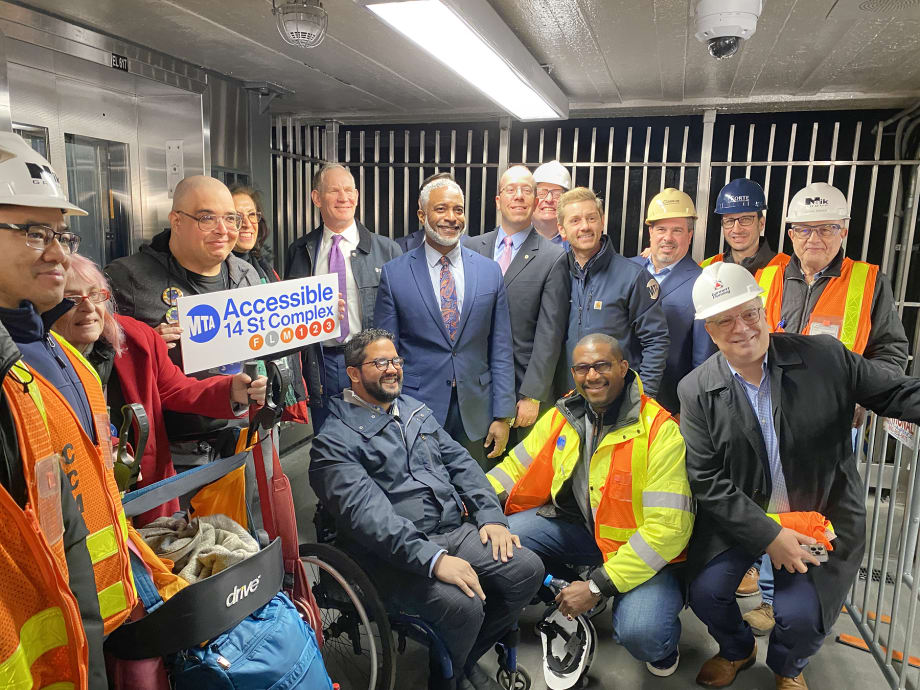
MTA Construction and Development, design-build contractor Citnalta-Forte, Joint Venture and designers Urbahn Architects and Gannett Fleming completed a $300 million accessibility upgrade and other renovations at the 14th Street Sixth Avenue subway station complex in Manhattan. Left to right: Naik Group Senior Project Manager Mekh Gurung; accessibility advocates Debra Greif and Christopher Greif; Permanent Citizens Advisory Committee to the MTA Executive Director Lisa Daglian; MTA Chair and CEO Janno Lieber; MTA Chief Accessibility Officer Quemuel Arroyo; New York City Transit President Demetrius Crichlow; Federal Transit Administration Regional Administrator Michael Culotta; Urbahn Architects Project Manager and Senior Associate Lawrence Gutterman; MTA C&D Vice President Matthew D. Zettwoch; MTA C&D Assoc. Vice President and Program Director Edmund C. Gbanite; Citnalta Construction President Michael Gargiulo; Gannett Fleming TranSystems Deputy Design Manager Amr Aly; Forte Construction President Larry Pappas; and Naik Group Lead Resident Engineer Souheil Ragheb.
Photo: Peter Wilk/Wilk Marketing Communications
7 min to read
The project team of New York’s Metropolitan Transit Authority (MTA), design-build contractor Citnalta-Forte, Joint Venture, and designers Urbahn Architects and Gannett Fleming completed a comprehensive accessibility upgrade at the 14th Street Sixth Avenue subway station complex in Manhattan.
MTA’s subsidiary, MTA Construction and Development, was the overall project manager, and Naik Group served as project management consultant.
The team celebrated the opening of the final elevator that marks the station’s full accessibility for all passengers.
“Newly accessible stations like the 14 Street complex are the fruits of our efforts to deliver projects better, faster, and cheaper,” said MTA Construction & Development President Jamie Torres-Springer. “These accessibility upgrades coupled with critical state of good repair work and station environment improvements have transformed 14 Street into a welcoming transit hub for all New Yorkers.”
Organizing the Project
Federal funds accounted for $274 million of the ADA upgrade project’s $300 million budget.
The station complex stretches along West 14th Street between Sixth and Seventh Avenues and is served by the F and M trains running north and south along Sixth Avenue.
The L train also serves the station running along 14th Street and the 1,2, and 3 lines run north and south along Sevent Avenue. There are a total of five platforms split between three stations in the complex.
The 14th Street Station Complex is one of numerous projects that Citnalta has completed for MTA. Their work on the New York City Transit system focuses on accessibility upgrades and rehabilitations that result in improved passenger comfort, more reliable technology, and increased safety.
Urbahn has an ongoing ADA accessibility redesign assignment within MTA’s initiative to make 95% of New York City’s subway stations accessible by 2045. They have designed upgrades at 16 stations so far.
“The MTA contracted the project in the design-build method, a process in which a client retains an entire team of contractor, architect, and engineers to deliver both the design and construction under one contract,” said Urbahn Project Manager and Sr. Associate Lawrence Gutterman. “This method, as opposed to the traditional design-bid-build process, streamlines and accelerates the work, provides one point of responsibility, and improves the overall team collaboration. MTA has been employing this innovative contracting method for several years to deliver multiple ADA upgrades and other renovations throughout the New York City subway system.”
Urbahn Architects was the architectural lead partner and architect for the Sixth Avenue portion of the project, while Gannett Fleming was the architect for the Seventh Avenue portion and structural engineer for the Sixth Avenue portion. Gannett Fleming also served as the elevator consultant and infrastructure controls designer.
The design-build contract holder and builder was Citnalta-Forte, Joint Venture, formed by Citnalta Construction Corp. and Forte Construction Corp.
Planning, Redesign, and Construction
“Early in the project’s design phase, the team surveyed all the underground utilities and structures to gain an understanding of the existing condition of the station complex, evaluate necessary upgrades and select the best locations for the new elevator and stair access points,” explained Urbahn Project Architect Michael Sheedy.
It was determined that the best sites for the majority of street level elevators were where preexisting stairs were located.
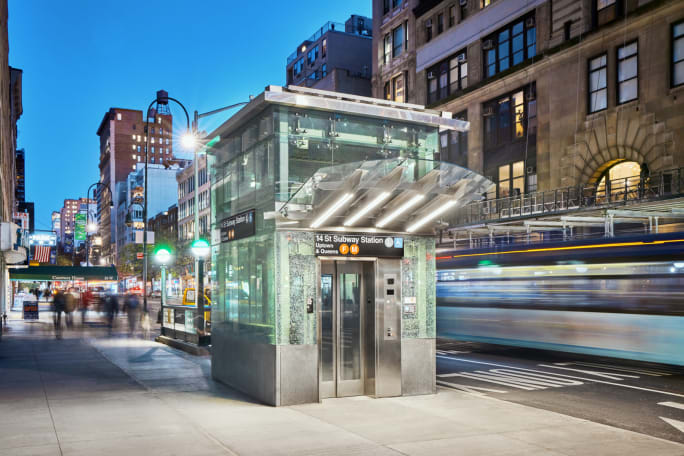
ADA upgrades at the 14th Street Sixth Avenue subway station complex in Manhattan included installation of nine new elevators and 25 new stairways and renovation of 39 existing stairways. Following the $300 million renovation, the station is now fully accessible.
Photo: Ola Wilk Studio
The team worked to relocate the stairs with two on the Sixth Avenue side being relocated approximately 30 feet and one on the Sevent Avenue side relocated approximately 100 feet.
Numerous logistical and engineering challenges were addressed by the designers and builders during the design and construction process.
A multitude of utility lines were relocated, as well as reconfiguring and expanding both the upper and lower mezzanine levels on the Sixth Avenue side in order to create access to the new elevators.
Another thing they had to take into account was that the platforms for the F and M lines on the Sixth Avenue side are separated by PATH train tracks and a platform that is operated by the Port Authority of New York and New Jersey, which necessitated the installation of dedicated elevators for each platform.
As one of the busiest stations in New York City, the project team had to carefully phase the work to provide continuous, uninterrupted access to the 14th St. station’s platforms at all times and ensure that the station would remain open throughout the renovations.
“The logistics was the most challenging aspect of the project, as our team had to complete the work without disrupting the commute of 130,000 passengers who use the station daily. Technical challenges included the complex task of excavating the bedrock to the depth of up to 40 feet to install the new elevators next to a busy street and in a densely developed area with an extensive network of underground infrastructure lines,” explained Citnalta’s Project Executive Michael Murphy. “In addition, due to the sections of the complex being originally constructed over 100 years ago, some of the existing conditions, deteriorated structural elements and locations of older infrastructure installations were not discovered until the renovation was already under way.”
To achieve full accessibility and improve circulation throughout the station the project team installed nine new elevators as well as 25 new and 39 renovated stairways. These take passengers from street level to the mezzanines and from the mezzanines to the platforms or directly from the street to the platforms.
Six elevators were installed in the Sixth Avenue section while three were installed in the Seventh Avenue segment.
Circulation capacity was increased throughout the complex by including several new internal stairways that connect the mezzanines to the platforms.
A new ADA ramp on the pathway between the sixth Avenue and Seventh Avenue sides was installed to address issues with the preexisting ramp that made it too steep for proper wheelchair access.
The new ramp runs approximately half the length of the pathway and was designed at a shallower angle for easier wheelchair use. A handrail separates the ramp and runs along the general pathway to allow passengers of varying physical abilities to be able to use the shared paths.
The ramp redevelopment work was phased to ensure safe access and egress for the occupants of the large back-of-house operations in the station complex. The back-of-house operation services almost all of the subway stations in Manhattan, and the upgrades to the complex required reconfiguration of the offices and storage rooms.
Several areas built early in the project allowed for subsequent relocation of the rooms displaced to accommodate the new elevators and elevator machine rooms. The Urbahn team interviewed the back-of-house employees to ascertain their day-to-day needs and ensure their work would continue uninterrupted.
Other Upgrades to the Stations
Other upgrades are repairs included platform surfaces, wayfinding signage and tiled walls in the pathway and within the platform areas.
Platforms received new concrete topping slabs to align them seamlessly with the elevator landings and train entrances.
The platforms also feature new tactile warning strips to indicate ADA boarding zones located in front of the trains’ doors.
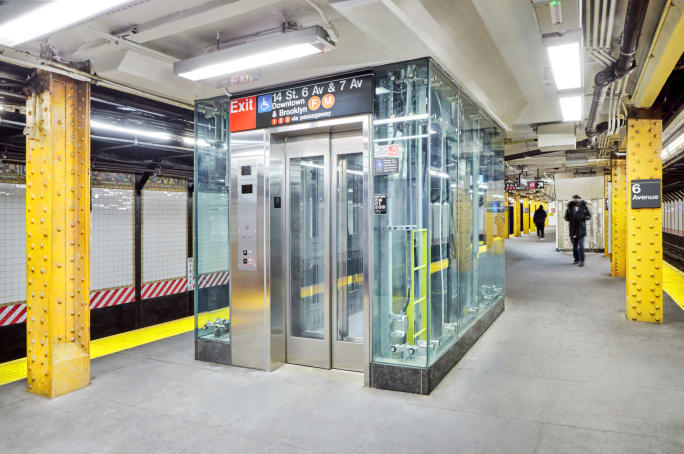
In order to achieve full accessibility and improve circulation throughout the station, the project team installed nine new elevators as well as 25 new and 39 renovated stairways, which now take passengers from the street level to the mezzanines and from the mezzanines to the platforms or directly from the street to the platforms
Photo: Ola Wilk Studio
A new ADA-compliant agent booth was added to the Seventh Avenue side of the station. The entire station features new wayfinding signage as well as new digital interactive Help Point screens that display arrival times and other relevant information about the subway system.
Most of the lighting fixtures throughout the station were replaced with high-efficiency LED linear fixtures to make them more energy efficient and provide increased levels of lighting that give passengers greater comfort and safety, especially for those who are visually impaired.
There are also new access control centers consisting of turnstiles and emergency doors, which were included on the lower mezzanine of the Sixth Avenue side of the station and serve the newly created elevator access in that area.
The project team coordinated installation of six new large-scale artwork pieces throughout the stations complex. The suite of six mosaics titled Wild Things, is a permanent artwork by Fred Tomaselli.
Sections of damaged tiles were replaced with new subway tiles manufactured by Heritage Tile in some of the platform areas and along the underground pathway connecting the sixth and seventh Avenue sections.
Outside the station the New York City Department of Transportation designed sidewalk improvements, including curb cuts and street-level elevator access, which were built by the design-build team.
More Management

LIT Marks 10-Year Milestone at Annual Summit
Hosted by the COTA from September 10 to 13, the Summit carried the theme “Celebrating 10 Years of Excellence, Leadership, and Impact,” with every part of the program honoring the people, agencies, and partners who built LIT over its first decade.
Read More →
People Movement: Dan Dipert Coaches Adds Third-Generation Leader, Keolis Names New Valley Metro VP/GM, and More
In this edition, we also cover recent appointments and announcements at the Wabtec, SilverRide, HNTB, and more, showcasing the individuals helping to shape the future of transportation.
Read More →
METRO Opens Submissions for 2026 Motorcoach Awards
Nominations are now being accepted for METRO Magazine’s Operator of the Year and Innovative Operator of the Year awards.
Read More →

New York MTA Advances Final Contract for Second Avenue Subway Expansion
Contract Four is the largest in the Second Avenue Subway Phase 2 project and includes construction of station infrastructure, tracks, and signals for the subway expansion, MTA officials said. Work on Contract Four will begin in 2027.
Read More →
Transit Agencies Highlight Safety Gains at National Summit
Leaders from 15 major transit systems shared crime-reduction results and safety initiatives while discussing the role of continued federal support.
Read More →
NITA Names New Leadership, Expands Reduced-Fare Program at First Board Meeting
The new regional transit authority appointed its first board chair and interim executive director while extending reduced fares across CTA, Metra, and Pace for eligible riders.
Read More →
Beyond the Checklist: A Structured Approach to Transit Maintenance
Reliability-Centered Maintenance helps transit agencies move beyond routine checklists to focus limited resources on the assets and failures that have the greatest impact on safety, reliability, and service.
Read More →
APTA 2026 Nominating Committee Selects Leadership Slate, Names Chair and Vice Chair Nominees
Leadership changes will help shape the association’s priorities and its representation of the transportation industry during the 2026–2027 term.
Read More →
DART Launches Major Security, Fare Enforcement Initiative
The 90-day demonstration will deploy coordinated security teams at five light rail stations while testing controlled access and gathering data to guide future investments.
Read More →
Sponsored•September 9, 2026
Advancing Fare Collection Through Technology and Innovation
Learn about delivering 1300 gates at 91 stations while managing fare evasion. Explore the large scale deployment, solution customization and real-world results that affect the region. Prepare for deployment in your region now.
Read More →