



6 public-private teams compete to build Md. light rail
In late 2014 or early 2015, MDOT / MTA will select a preferred partner and recommend the final agreement to the Board of Public Works for their review and approval. Construction could begin in spring 2015.

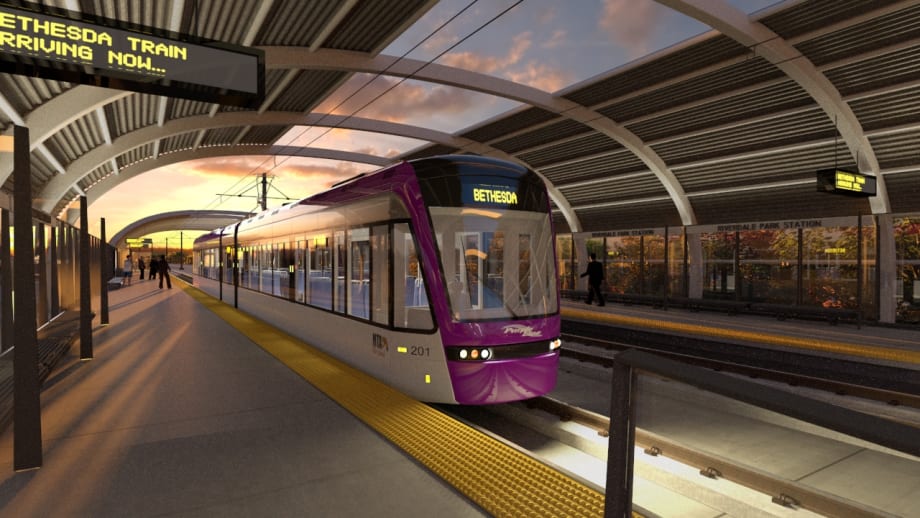
Purple Line rendering courtesy MTA
Purple Line rendering courtesy MTA
Six private-sector teams are competing to design, build, construct, finance, operate and maintain Maryland's light rail Purple Line, according to state officials.
Following a thorough review of all the responses, Maryland Department of Transportation (MDOT)/Maryland Transit Administration (MTA) will announce a short list of teams in January, who will be invited to submit formal proposals in early summer. In late 2014 or early 2015, MDOT/MTA will select a preferred partner and recommend the final agreement to the Board of Public Works for their review and approval. Construction could begin in spring 2015.
“Our intent is to short list as many as four teams to ensure competition and innovation in the Purple Line project,” said Maryland Transit Administrator Robert L. Smith. “The Maryland Transit Administration will continue to play a prominent role through every phase of this project and will remain very engaged with all communities along the route.”
Last month, the Board of Public Works gave its approval to deliver the Purple Line through a P3. In the P3 delivery method, a single private partner will be responsible for providing private financing to design, construct, operate and maintain the project. This innovative project delivery method differs from a typical project in which the state hires a contractor to design and construct a transit line and then MTA operates the system.
The Baltimore Light Rail Line was built using this traditional delivery method. Lt. Governor Anthony G. Brown led the administration’s efforts to successfully pass legislation this past session that establishes a framework for P3 solicitations.
The Purple Line is a 16-mile light rail line that runs east-west inside the Capital Beltway between Bethesda in Montgomery County and New Carrollton in Prince George’s County, with 21 stations planned that will provide direct connections to Metrorail’s Orange Line, Green Line and two branches of the Red Line, and the MARC Brunswick, Camden and Penn Lines.
The total project cost is $2.2 billion, which is being funded by a combination of federal, state and local governments. Passage of the Transportation Infrastructure Investment Act of 2013 added $711 million in state funds for design and construction of the Purple Line to MTA’s six-year capital budget (FY 2014–FY 2019).
By having the team who builds it also responsible for long-term operations and maintenance, the team has greater incentive to manage risks and design a project that is well operated and maintained over the long term, according to officials.
In return for operating, maintaining, refurbishing / replacing equipment and financing a portion of construction for the Purple Line, the MTA will pay the contractor annual payments once the line is operating. Deductions will be made from the payments if the contractor does not meet pre-determined performance targets, such as on-time performance, vehicle cleanliness and customer service. The MTA will be responsible for setting fares.
The Purple Line solicitation includes provisions to realize economic benefits for Marylanders, including goals for participation in construction, operations and maintenance by Disadvantaged Businesses Enterprises; encouragement to purchase equipment manufactured in the U.S.; agreements to assure labor peace; and encouragement to provide wages and benefits that compare with existing operations in Maryland.
More information on the project and competitive solicitation process can be found at www.purplelinemd.com.
More Management

METRO Opens Submissions for 2026 Motorcoach Awards
Nominations are now being accepted for METRO Magazine’s Operator of the Year and Innovative Operator of the Year awards.
Read More →
New York MTA Advances Final Contract for Second Avenue Subway Expansion
Contract Four is the largest in the Second Avenue Subway Phase 2 project and includes construction of station infrastructure, tracks, and signals for the subway expansion, MTA officials said. Work on Contract Four will begin in 2027.
Read More →
Transit Agencies Highlight Safety Gains at National Summit
Leaders from 15 major transit systems shared crime-reduction results and safety initiatives while discussing the role of continued federal support.
Read More →

NITA Names New Leadership, Expands Reduced-Fare Program at First Board Meeting
The new regional transit authority appointed its first board chair and interim executive director while extending reduced fares across CTA, Metra, and Pace for eligible riders.
Read More →
Beyond the Checklist: A Structured Approach to Transit Maintenance
Reliability-Centered Maintenance helps transit agencies move beyond routine checklists to focus limited resources on the assets and failures that have the greatest impact on safety, reliability, and service.
Read More →
APTA 2026 Nominating Committee Selects Leadership Slate, Names Chair and Vice Chair Nominees
Leadership changes will help shape the association’s priorities and its representation of the transportation industry during the 2026–2027 term.
Read More →
DART Launches Major Security, Fare Enforcement Initiative
The 90-day demonstration will deploy coordinated security teams at five light rail stations while testing controlled access and gathering data to guide future investments.
Read More →
Advancing Fare Collection Through Technology and Innovation
Learn about delivering 1300 gates at 91 stations while managing fare evasion. Explore the large scale deployment, solution customization and real-world results that affect the region. Prepare for deployment in your region now.
Read More →
Game Day in Motion: Moving Millions During the 2026 World Cup
Between packed transit stations and team motorcoaches, see how agencies and operators across North America tackled the transportation demands of the 2026 FIFA World Cup.
Read More →
Surface Transportation Extension Averts Shutdown, Leaves Transit Funding Gap
The stopgap keeps federal transportation programs moving, but missing advance funding could complicate the transit and rail projects agencies are planning next.
Read More →