



AC Transit Sees First Sustained Three-Month Ridership Climb Since 2022
Officials said the ridership gains recorded in February, March, and April signal renewed public confidence in transit and reinforce AC Transit’s vital role in connecting East Bay residents with jobs, schools, healthcare, shopping, and recreational destinations.

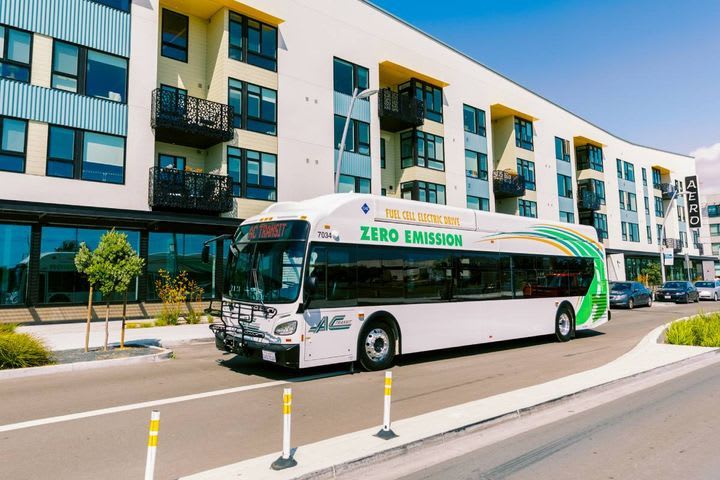
Realign launched in summer 2025 and was necessary to right-size AC Transit’s bus network and make service more nimble, reliable, and responsive to how East Bay riders travel today.
Photos: AC Transit
- AC Transit experienced a consistent increase in ridership over February, March, and April for the first time since 2022.
- The increase in ridership indicates a renewed public confidence in using public transit.
- AC Transit plays a crucial role in connecting East Bay residents to essential services and destinations.
*Summarized by AI
Oakland, California’s Alameda-Contra Costa Transit District (AC Transit) announced its first consecutive three-month year-over-year ridership increase of the post-pandemic era, signaling a major milestone in the East Bay’s transit recovery and a sharp acceleration in rider demand in Fiscal Year 2025–26.
Officials said the ridership gains recorded in February, March, and April signal renewed public confidence in transit and reinforce AC Transit’s vital role in connecting East Bay residents with jobs, schools, healthcare, shopping, and recreational destinations.
The momentum began in February 2026, when AC Transit posted a remarkable 6% year-over-year ridership increase, adding 192,875 monthly riders compared to February FY 2024–25.
The increase stands in sharp contrast to the prior fiscal year, when February ridership declined by approximately 130,270 riders, or 4%. February 2026 marked the strongest February ridership performance recorded by the District in the last three fiscal years.
Continued Ridership Growth
Ridership momentum intensified even further in March. AC Transit recorded an impressive 8% year-over-year increase, adding 270,247 riders systemwide compared to March FY 2024–25.
By comparison, the previous fiscal year saw only a modest increase of 15,137 riders, or 0.4% growth. The sharp jump illustrates a substantial strengthening in transit demand and rider activity across the District’s service area.
The trend continued into April, as East Bay residents increasingly relied on AC Transit bus lines for work commutes, school trips, medical appointments, and everyday travel.
April FY 2025–26 ridership increased by 108,379 rides, representing more than 3% year-over-year growth over April FY 2024–25. In comparison, April FY 2024–25 recorded an increase of 80,881 rides, or approximately 2.3% growth over FY 2023–24.
“This is far more than incremental ridership growth,” said Sal Llamas, AC Transit’s GM. “It is real-time proof that the refinements made to our Realign bus network, implemented on the very first day of February, are responding directly to what riders and frontline employees told us mattered most in their daily lives. From reliability and trip timing to stronger connections across the East Bay, we are seeing riders step on board with renewed confidence.”
Realign in Action
Realign launched in summer 2025 and was necessary to right-size AC Transit’s bus network and make service more nimble, reliable, and responsive to how East Bay riders travel today.
More than two years of planning informed its implementation. However, with any major service change involving more than 120 bus lines, even the strongest plans cannot predict every real-world variable: shifting traffic patterns, hybrid work realities, construction impacts, and evolving rider habits, said officials.
Quick Answers
AC Transit has observed a sustained three-month ridership increase in February, March, and April.
*Summarized by AI
More Management

Indian River Transit’s Community-Focused Approach Earns National Recognition
Named APTA’s 2026 Outstanding Public Transportation System in its size category, Florida’s Indian River County transit system continues to grow ridership through fare-free service and a focus on evolving community needs.
Read More →
ENC Lands MATA Contract and More in Biz Briefs
In this edition of Biz Briefs, we spotlight the latest developments shaping the future of mobility.
Read More →
From Surviving to Thriving: Building Stronger Transportation Organizations
Bus Business Consultants founder Brian Dickson shares lessons on leadership, organizational health, and creating options for long-term success in a changing transportation industry.
Read More →

Everett Transit, Community Transit Outline Consolidation Agreement
The proposed agreement calls for a 50% increase in bus service in Everett, a new microtransit zone, continued paratransit service, and the transfer of Everett Transit operations to Community Transit.
Read More →
Strada360’s Steve Lassey on Turning Transit Data Into Better Decisions
From breaking down data silos to preparing for AI, Strada360 CEO Steve Lassey discusses how transit agencies can use technology to improve operations, customer information, and long-term decision-making.
Read More →
People Movement: Phil Washington Joins HNTB, Denver RTD Launches CEO Search, and More
In this edition, we also spotlight recent personnel moves at STV, the Eno Center for Transportation, and more, highlighting the people taking on new roles across the transportation industry.
Read More →
SEPTA Details Accelerate Vision for Transit System
The plan outlines investments in trolley modernization, new Metro and Regional Rail vehicles, accessible stations, and more frequent bus and rail service.
Read More →
FTA Ends Direct Oversight of MBTA Safety Actions
The federal agency closed its remaining special directive to the Massachusetts Department of Public Utilities following a safety review that began in 2022.
Read More →
Report: Transit Bus Manufacturing Supports 34,100 Jobs, $5.1B in GDP
The “Buses Mean Business” report examines the transit bus manufacturing industry’s economic footprint, supply chain, and rising demand for vehicle replacements.
Read More →
LIT Marks 10-Year Milestone at Annual Summit
Hosted by the COTA from September 10 to 13, the Summit carried the theme “Celebrating 10 Years of Excellence, Leadership, and Impact,” with every part of the program honoring the people, agencies, and partners who built LIT over its first decade.
Read More →