




2023 in Review: Amtrak Shares Results, Accomplishments from FY23
Amtrak Begins Construction at Gray 30th Street Station
This project is part of the first phase of the District Plan.
January 22, 2024
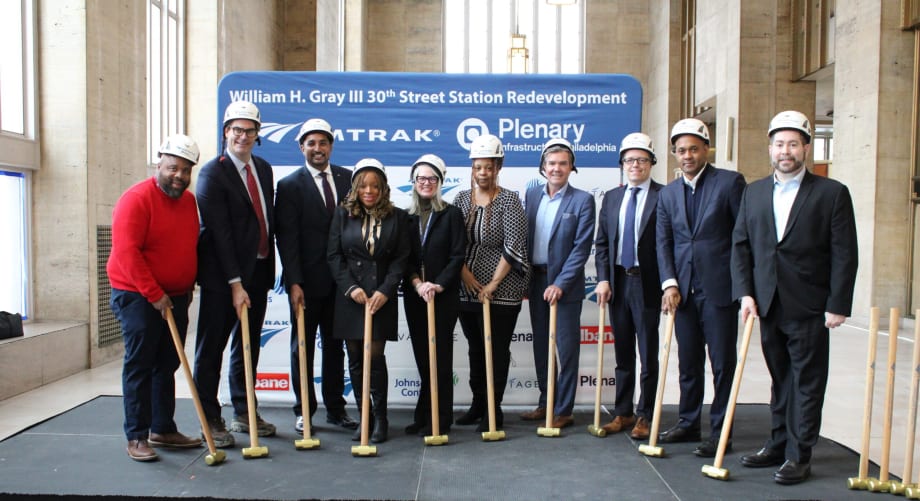
Amtrak has partnered with Plenary Infrastructure Philadelphia (PIP) as the master developer whose responsibility it is to design, build, finance, operate, and maintain the station improvements for 50 years as part of a public-private partnership (P3) agreement.
Photo: Amtrak
3 min to read
Amtrak announced officials gathered on Jan. 19 with federal, state, and local representatives and other community leaders to celebrate the construction kickoff for major renovations at William H. Gray III 30th Street Station in Philadelphia.
In 2016, in partnership with Brandywine Realty Trust, Drexel University, the Pennsylvania Department of Transportation, and the Southeastern Pennsylvania Transportation Authority, Amtrak developed a vision to serve as a roadmap for the improvement and development of Gray 30th Street Station and the surrounding district.
This project is part of the first phase of the District Plan.
“This large-scale restoration and renovation project will enhance the station’s functionality and improve the customer experience for Amtrak, SEPTA, and NJ TRANSIT customers while preserving this iconic Philadelphia landmark for future generations,” said Amtrak CFO Tracie Winbigler. “Additionally, this station transformation will improve Market Street Plaza, expand retail offerings, and provide other benefits to the local community.”
Restoration and Renovation Coming to Gray 30th Street Station
Amtrak has partnered with Plenary Infrastructure Philadelphia (PIP) as the master developer whose responsibility it is to design, build, finance, operate, and maintain the station improvements for 50 years as part of a public-private partnership (P3) agreement.
Contractors currently performing various portions of its work include Gilbane Building Company as design-build lead, Johnson Controls Inc. for facility operations and maintenance, and Vantage Airport Group for concessions development and management.
The project has an estimated capital construction value of $550 million with elements of the station restoration and renovation including:
Modernizing and expanding station food & beverage and retail offerings
Improving station operations and enhancing the customer experience
Upgrading the Porch landscaping and community amenities
Modernizing Amtrak corporate offices
Enhancing building infrastructure to achieve and maintain a state of good repair

The project has an estimated capital construction value of $550 million.
Photo: Amtrak
Investing in the Amtrak Project
PIP equity sponsor, Plenary Americas, LP, will also be investing $2.5 million into a community impact fund dedicated to supporting career development and small business growth aspirations of women, people of color, and individuals of under-represented groups in West Philadelphia and throughout the City.
The first grants will be provided to worker training programs run by the Philadelphia Building & Construction Trades Council (Samuel Staten Sr. Pre-Apprenticeship Program) and Finishing Trades Institute of the Mid-Atlantic Region (WINC, Women in Non-traditional Careers).
The Enterprise Center will receive a grant to support their ongoing efforts to promote racial and economic equity by providing access to capital to small businesses, and grants will be made to other local small business advocates including the African American Chamber of Commerce of PA/DE/NJ, Asian American Chamber of Commerce of Greater Philadelphia, Greater Philadelphia Hispanic Chamber of Commerce, Eastern Minority Supplier Development Council, and Women Business Enterprise Council East.
Elevator and escalator work will begin in January 2024. Additional construction phases will continue through 2027. The station’s South Concourse closed for major construction on Jan. 1., and is expected to reopen in summer 2025.
Amtrak Hard at Work
The William H. Gray III 30th Street Station construction follows a year of projects for Amtrak.
In August 2023, the Washington Department of Transportation (WSDOT) and Amtrak announced they were replacing a diesel-powered bus with an electric vehicle (EV) on the Amtrak Cascades route.
Shortly after, Amtrak completed a $1.4 million project at the Jefferson City, Mo., station. The Amtrak Missouri River Runner travels between St. Louis and Kansas City with stops in Jefferson City twice daily eastbound and westbound.
In late November, Amtrak, in coordination with NJ TRANSIT, announced it had begun the procurement process for the Sawtooth Bridges Replacement Project.
Replacement of the Sawtooth Bridges is a component of the Gateway Program to preserve and expand the busiest section of the Northeast Corridor (NEC).
More Rail

New York MTA Advances Final Contract for Second Avenue Subway Expansion
Contract Four is the largest in the Second Avenue Subway Phase 2 project and includes construction of station infrastructure, tracks, and signals for the subway expansion, MTA officials said. Work on Contract Four will begin in 2027.
Read More →
San Diego MTS Breaks Monthly Trolley Ridership Record
Agency officials said July’s ridership indicates MTS’s continued recovery from the pandemic.
Read More →
Report Examines NJ TRANSIT Reliability, Funding Challenges
The Garden State Initiative analysis examines the roles of Amtrak infrastructure, fleet management, and agency operations while recommending a more performance-based approach to improving reliability.
Read More →
Stadler, CapMetro Sign Long-Term Rail Fleet Support Agreement
Beginning in 2027, Stadler will provide on-site technical expertise, spare parts support, training, and obsolescence management to help extend the reliability and longevity of CapMetro’s GTW fleet.
Read More →
Biz Briefs: Alstom Lands Canadian Contract, LYT to Supply California TSP, and More
In METRO's latest installment, we take a look at recent news from Complete Coach Works, Beep, FlixBus, and more partnerships making headlines across the transportation sector.
Read More →
CATS Gold Line Marks 5 Years of Service, 2.8M Passenger Trips
With a six-mile expansion planned, the Charlotte streetcar is positioned to connect more neighborhoods and major transit hubs across the region.
Read More →
Why Simulating Pedestrian Movement Has Become Essential for Modern Rail Stations
Pedestrian microsimulation is helping rail planners identify bottlenecks, test station designs, and prepare complex transit hubs for growing passenger volumes.
Read More →
Amtrak Begins Major Construction at New York’s Sunnyside Yard
The new maintenance facility will support Amtrak’s Airo trainsets while improving maintenance efficiency and turnaround times in New York.
Read More →
Chicago Leaders Unveil Plans for O’Hare Airport Express Train
The privately developed project would offer a 15-minute trip between downtown and O’Hare’s Terminal 2, with trains operating every 15 minutes on a dedicated track. The service would use battery-electric trains and three existing freight rail rights-of-way.
Read More →
OCTA Maps Out 30-Year Strategy to Protect Coastal Rail Corridor
The draft feasibility report identifies strategies to protect the coastal rail line for decades as the agency continues near-term stabilization and sand placement efforts.
Read More →