




RELATED: Navya, Keolis launch driverless public transit vehicle pilot in Las Vegas
Autonomous vehicles: threat or opportunity for urban mobility?
AVs will lead to a dystopian future of even more private car traffic on the road unless they are put to use in shared fleets and integrated with traditional public transport services.
January 17, 2017
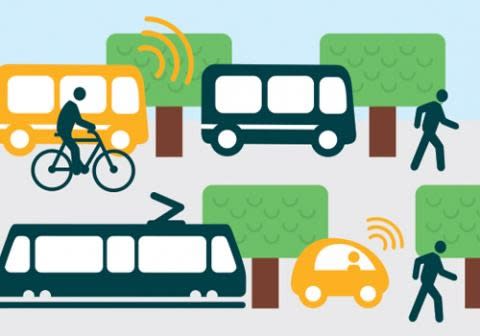
Graphic: UITP
2 min to read
Graphic: UITP
According to a new position paper from UITP (the International Association of Public Transport), autonomous vehicles (AVs) will lead to a dystopian future of even more private car traffic on the road unless they are put to use in shared fleets and integrated with traditional public transport services.
The paper, ‘Autonomous vehicles: a potential game changer for urban mobility,’ demonstrates that despite the risk of increased congestion due to car travel becoming even more comfortable and attractive, an alternative exists. If AVs are put to use in shared fleets as ‘robo-taxis,’ mini-buses or in car-sharing fleets, they could dramatically reduce the number of cars on the road by reaching people and places it was too difficult to before, plugging first/last-mile gaps and feeding into public transport trunk lines.
Shared fleets, integrated with traditional public transport offer the possibility of a better urban future, cutting noise and environmental pollution, improving traffic efficiency and parking and in the process liberating vast amounts of urban space for other purposes. “When 1.2 million people around the world die each year in car-related deaths, 90% of which are due to human error, the road safety benefits are also significant,” said UITP Secretary General, Alain Flausch.
Ensuring the successful roll-out of AVs, which are already being trialled in many cities, is also contingent on the use of fully driverless operation, without which AVs will not be able to form a new mode of transport and would be unable to enhance existing public transport.
Public authorities must take an active role in the roll-out of AVs to ensure their shared use with measures to encourage shared mobility and limit single car occupancy (eg. road pricing or taxation) and provide ‘Mobility as a Service’ platforms (as whoever controls the platform controls travel behaviour). Trials should also begin on public roads to see how best to integrate AVs into the mobility eco-system and preparations made for the impact on employment as some driving jobs could disappear and others needing specific skills could arise.
“AVs are a potential game-changer for urban mobility and cities and countries must act now to shape their roll-out,” concluded Flausch. “AVs offer the chance for a fundamental change – as a key part of tomorrow’s integrated transport systems with public transport as a backbone – but if we do not act now vehicle automation might even further increase the volume and use of private cars with all of the associated negative externalities.”
For more information: http://www.uitp.org/autonomous-vehicles
More New Mobility

From Hardware to Digital Partner: Luminator Charts Its Next Chapter
CEO Magnus Friberg discusses Luminator’s shift toward becoming a digital partner, the growing importance of software and interoperability, and how AI can help agencies improve operations and passenger experience.
Read More →
Biz Briefs: Alstom Lands Canadian Contract, LYT to Supply California TSP, and More
In METRO's latest installment, we take a look at recent news from Complete Coach Works, Beep, FlixBus, and more partnerships making headlines across the transportation sector.
Read More →
CharterUP’s Armir Harris on Technology, AI, and the Future of Group Mobility
In a recent episode of METROspectives, CharterUP Founder/CEO Armir Harris discussed the company’s evolution from an online charter bus marketplace into a technology platform supporting public- and private-sector mobility and much more.
Read More →
Jacksonville’s NAVI Project Charts a New Course for Autonomous Public Transportation
Through its NAVI program, JTA is showing how autonomous vehicles, intelligent infrastructure, and coordinated operations can work together to deliver everyday public transportation.
Read More →
Biz Briefs: Luminator Marks Milestone and More
From manufacturers and suppliers to transit agencies and motorcoach operators, these updates offer a snapshot of the projects, partnerships and business moves driving the industry forward.
Read More →
New Tricks for Old Bureaucracies: Joshua Schank on Making Transit Innovation Stick
Former LA Metro Chief Innovation Officer Joshua Schank discusses why good ideas aren't enough, how transit agencies can overcome resistance to change, and why today's challenges demand more innovation.
Read More →
How DART's GoPass Is Redefining Regional Mobility
Serving 14 transit agencies, GoPass simplifies multimodal travel by allowing riders to plan, pay for, and manage an entire trip through one app.
Read More →
Biz Briefs: OCTA Taps Clean Energy for Hydrogen Station, Stadler to Supply Via Rail Vehicles, and More
From manufacturers and suppliers to transit agencies and motorcoach operators, these updates offer a snapshot of the projects, partnerships and business moves driving the industry forward.
Read More →CharterUP Expands Into New Mobility and Autonomous Transportation
Vice President of New Mobility Stephen Joos discusses how CharterUP is leveraging its nationwide transportation network, technology platform, and autonomous vehicle partnerships to expand into workforce mobility, campus shuttles, and transit solutions.
Read More →
METRO Magazine Announces 2026 Innovative Solutions Awards Winners
Projects Recognized for Advancing Mobility Through Technology, Accessibility, Workforce Innovation, and Operational Excellence
Read More →