




Photo Gallery: To view more photos from the event, click here.
BYD breaks ground on Phase II expansion of vehicle manufacturing facility
The Phase II expansion marks an important step in BYD’s plan to triple employment in three years, undertaken in response to increased demand for its zero-emission coaches, buses, and new medium- and heavy-duty truck product lineup.
September 15, 2016
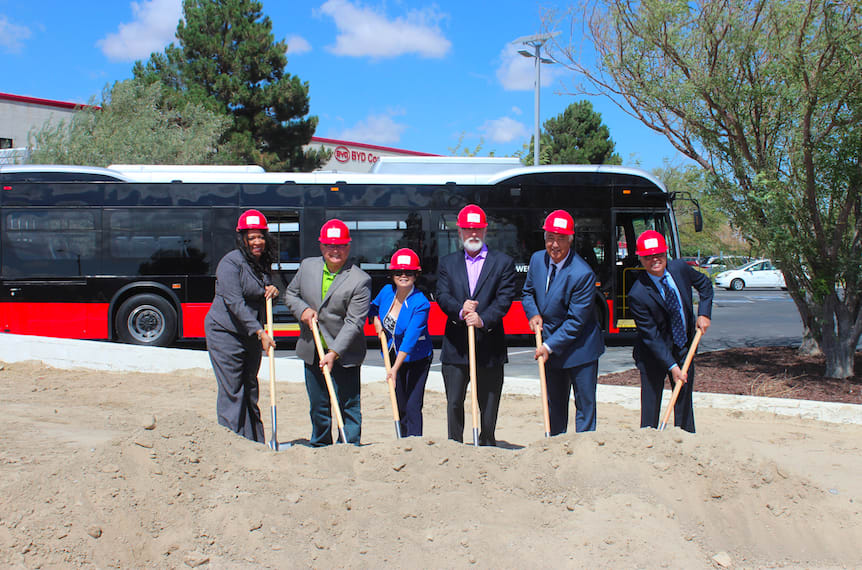
BYD America President Stella Li, Lancaster Mayor R. Rex Parris and VP, Coach and Bus Sales, Macy Neshati (middle) and local dignitaries attended the groundbreaking ceremony.
2 min to read
BYD America President Stella Li, Lancaster Mayor R. Rex Parris and VP, Coach and Bus Sales, Macy Neshati (middle) and local dignitaries attended the groundbreaking ceremony.
BYD broke ground on the second of three phases of construction at its vehicle manufacturing facility in Lancaster, Calif.
The facility is already the site of BYD’s coach and bus vehicle plant that employs approximately 400 people working in areas such as engineering, production, quality control, procurement and customer service. The Phase II expansion marks an important step in BYD’s plan to triple employment in three years, undertaken in response to increased demand for its zero-emission coaches, buses, and new medium- and heavy-duty truck product lineup.
"We’re proud to produce efficient, reliable electric trucks and buses in California that help boost the local economy with good paying manufacturing and engineering jobs,” said BYD America President Stella Li. “By standing here today and breaking ground on this Phase II expansion, BYD is demonstrating its long-term commitment to this community to create even more good paying jobs with benefits and career advancement opportunities. The people who work at BYD’s Lancaster plant are assembling buses for transit systems all over the country, and soon we’ll be able to increase production line capacity to deliver these cutting-edge zero emission vehicles even faster to customers.”
The Phase II expansion will add tens of thousands of additional square feet to the existing facility and is scheduled for completion in 2017. A third phase, to begin thereafter, will add hundreds of thousands of additional square feet to the site in Lancaster and bring the facility up to its full size and capacity.
"Through our growing partnership with BYD, the local economy has already realized a significant boost from the addition of much-needed jobs. BYD will soon triple the number of its employees with the expansion of this facility over the next three years,” said City of Lancaster Mayor R. Rex Parris. “In addition, by utilizing BYD electric buses, the Antelope Valley Transit Authority is doing its part to ensure our region has cleaner air. As always, reaching Zero Net Energy status is at the forefront of our city goals, and BYD is helping us achieve this vision faster.”
BYD recently signed an important neutrality agreement with the International Association of Sheet Metal, Air, Rail and Transportation Workers, one of North America’s most dynamic and diverse unions with 216,000 members, which is part of a good-faith negotiation around unionizing workers at the Lancaster facility. As BYD proceeds with its plans to triple the number of people employed in Lancaster, it is committed to creating good-paying jobs with benefits and real opportunities for career growth.
“Our buses and trucks move people and goods, but it is the people of Lancaster who move our buses and trucks,” Li said. “BYD couldn’t be prouder to grow here in Lancaster.”
More Technology
Almaviva Looks to Open Architecture to Advance Transit Technology
Eric Reese discusses how interoperability, open architecture, and modular design can help transit agencies control costs, reduce vendor lock-in, and upgrade technology without starting over.
Read More →
Driving Smarter Paratransit
John Hanlon shares how AlphaRoute is leveraging AI-powered technology to help paratransit providers optimize operations, support frontline staff, and enhance the rider experience.
Read More →
From Hardware to Digital Partner: Luminator Charts Its Next Chapter
CEO Magnus Friberg discusses Luminator’s shift toward becoming a digital partner, the growing importance of software and interoperability, and how AI can help agencies improve operations and passenger experience.
Read More →

Beyond the Checklist: A Structured Approach to Transit Maintenance
Reliability-Centered Maintenance helps transit agencies move beyond routine checklists to focus limited resources on the assets and failures that have the greatest impact on safety, reliability, and service.
Read More →
NJ TRANSIT Advances Bus Technology Upgrades Across Statewide Fleet
More than 1,500 buses now feature upgraded technology designed to improve arrival predictions and provide free Wi-Fi, with deployment expected to reach nearly 2,000 buses by the end of 2026.
Read More →
Building a Flexible Path to Transit Electrification
John Hroncich discusses BAE Systems’ modular and scalable approach, lessons learned from decades of real-world operations, and how agencies can identify electrification strategies that fit their fleets.
Read More →
Biz Briefs: Alstom Lands Canadian Contract, LYT to Supply California TSP, and More
In METRO's latest installment, we take a look at recent news from Complete Coach Works, Beep, FlixBus, and more partnerships making headlines across the transportation sector.
Read More →
Sponsored•September 8, 2026
From Legacy Silos to Conversational Intelligence
What if transit leaders could ask any operational question and get a trusted answer in seconds? Conversational AI is transforming how agencies use their data.
Read More →
USDOT Announces Rail Vehicle Replacement Grants, Chattanooga AV Shuttle Funding
More than $191 million in federal funding will help three transit agencies replace aging rail vehicles and support a new autonomous shuttle service in Chattanooga.
Read More →
Bus Tech Talk: Keeping Transit Technicians Ahead of the Technology Curve
LA Metro’s Obed Mejia discusses technician training, evolving maintenance technology, fleet replacement, and strategies for getting the most out of today’s transit fleets.
Read More →