



Calif.'s Omnitrans adding 15 New Flyers featuring audible turn signals
The new buses have one rear-facing securement and one forward-facing securement. The rear-facing system gives passengers with wheelchairs more independence.

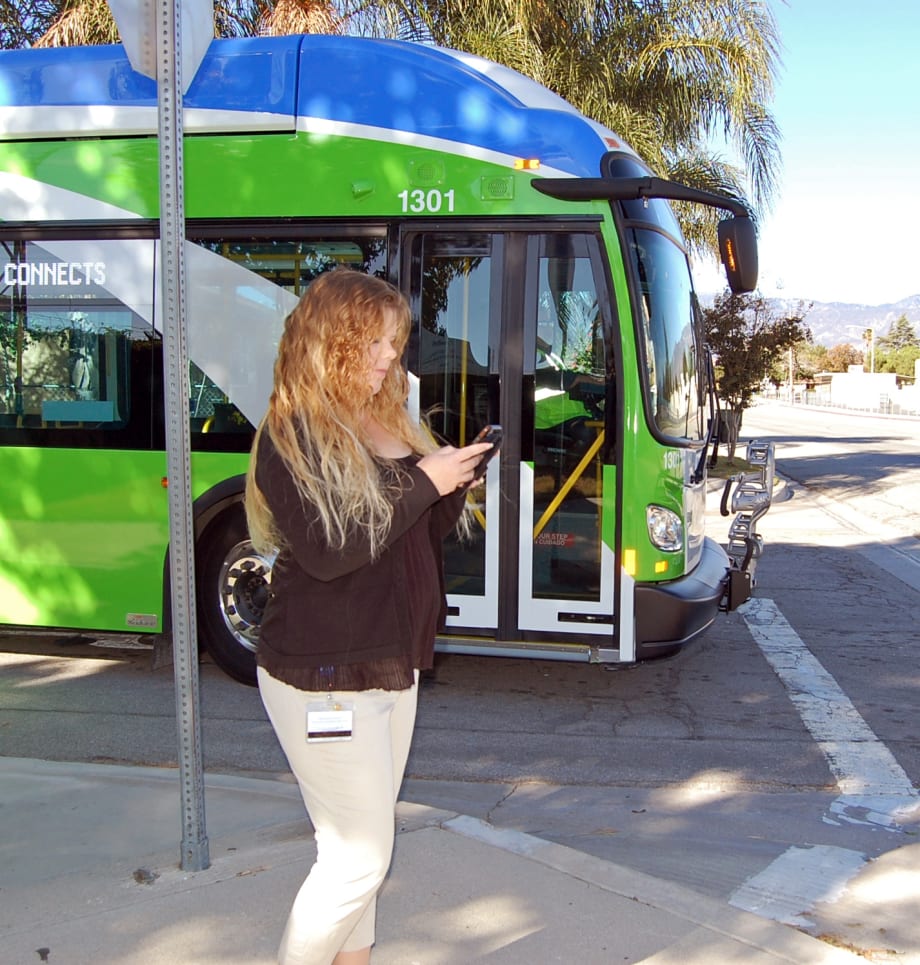
San Bernardino, Calif.'s Omnitrans introduced 15 new buses, manufactured by New Flyer of America Inc., which will replace three 35-foot 2003 model year coaches and 12 40-foot model year 2001 and 2001 coaches. All are powered by compressed natural gas.
With pedestrians often texting, listening to music or watching the latest cat video on their phone instead of paying attention to surrounding traffic, Omnitrans is making an extra effort to get their attention by incorporating audible turn signals on the new buses going into service this month.
The caution announcement, given in English and Spanish, is triggered automatically when the driver turns the steering wheel. Omnitrans will evaluate the effectiveness of the new safety feature before considering a retrofit of the rest of its 177 bus fleet.
In response to customer requests, the new buses are also equipped with front-mounted bicycle racks that hold three bikes at a time. This brings the number of 40-foot buses with triple bicycle racks up to 37, while the remaining buses have racks that hold two bicycles.
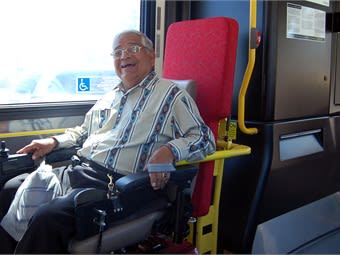
After getting positive marks for new generation wheelchair securement devices used on the agency’s sbX bus rapid transit line, Omnitrans will phase them into the rest of the fleet. New buses have one rear-facing securement and one forward-facing securement. The rear-facing system gives passengers with wheelchairs more independence. They can back their mobility device into the area, pull the arm down and set the brake, without assistance from the operator. This also helps reduce dwell time at bus stops.
The new-style forward facing wheelchair securement allows the coach operator to more easily secure mobility devices with minimal reaching and bending. Passengers then click together a lap belt to secure themselves to the mobility device. Omnitrans buses transport about 120,000 customers with wheelchairs each year.
Positive customer feedback on the rear-facing wheelchair option on sbX vehicles, led Omnitrans to buy them for new 40-foot buses.
More Bus

New York MTA Plans Largest Bus Fleet Upgrade in More Than a Decade
The agency is seeking manufacturers for 650 new CNG buses to replace aging vehicles, improve reliability, and advance its broader fleet modernization strategy.
Read More →
Building a Flexible Path to Transit Electrification
John Hroncich discusses BAE Systems’ modular and scalable approach, lessons learned from decades of real-world operations, and how agencies can identify electrification strategies that fit their fleets.
Read More →
Bus Tech Talk: Keeping Transit Technicians Ahead of the Technology Curve
LA Metro’s Obed Mejia discusses technician training, evolving maintenance technology, fleet replacement, and strategies for getting the most out of today’s transit fleets.
Read More →
Biz Briefs: RIPTA Unveils New Frontrunners, Clevland RTA Adds New Siemens, and More
In METRO's latest installment, we take a look at recent news from Siemens, Prevost, Dodge, and more partnerships making headlines across the transportation sector.
Read More →
People Movement: Holly Arnold Joins Transdev and More
In this edition, we also cover recent appointments and announcements at Pace, CamTran, MCI, and more, showcasing the individuals helping to shape the future of transportation.
Read More →
The High Cost of Transit Buses: Industry Leaders Look to Procurement Reform
Transit leaders and policymakers examine how standardized bus designs, streamlined procurement, and predictable funding could help agencies stretch budgets and deliver better service.
Read More →
The Business Voice Behind Public Transportation
As chair of APTA’s Business Members Board of Governors, Ray Melleady explains how more than 850 business members are partnering with transit agencies to advance funding, innovation, and industry-wide collaboration.
Read More →
From Surviving to Thriving: Building Stronger Transportation Organizations
Bus Business Consultants founder Brian Dickson shares lessons on leadership, organizational health, and creating options for long-term success in a changing transportation industry.
Read More →
Finding the ‘Happy Medium’: Optimizing Maintenance Without Sacrificing Reliability
The key to maintenance optimization isn’t doing less work—it’s doing the right work at the right time on the right assets.
Read More →
LA Metro, City of West Hollywood, and Partners Advance Smarter Bus Lane Enforcement
The award-winning partnership combines AI-powered detection with human oversight to improve bus reliability, accessibility, and enforcement efficiency.
Read More →