




"You really have to think about the entire trip for riders when it comes to getting from one point of, for example, affordable housing to another easily accessible point of income generation."
Car commuters dwarf public transit riders in job access
According to a study, low-income workers who commuted by car had 30 times the access to jobs than those who took public transit. The advent of ridesharing and bikesharing could close the gap.
August 28, 2017
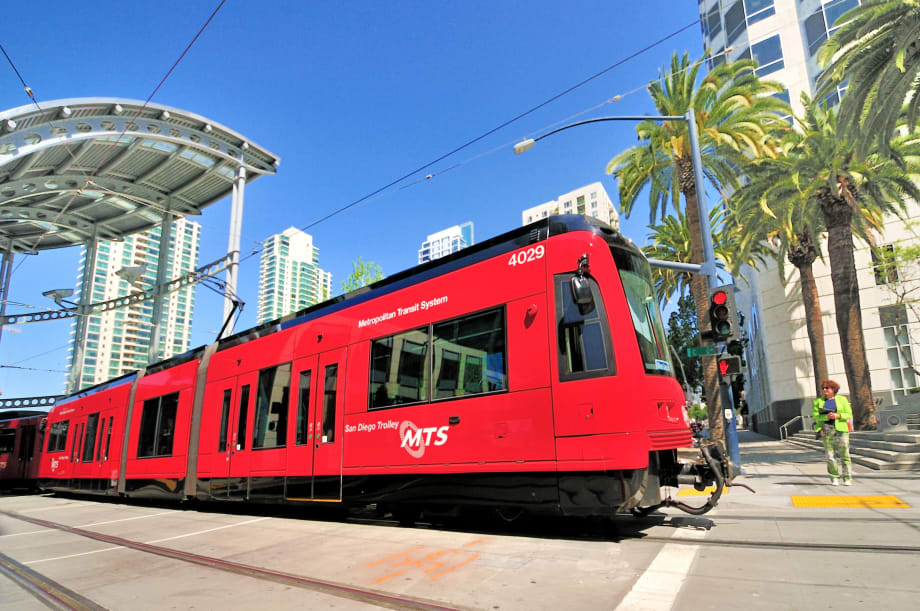
San Diego Metropolitan Transit System's Trolley at American Plaza. Photo: San Diego MTS
4 min to read
San Diego Metropolitan Transit System's Trolley at American Plaza. Photo: San Diego MTS
The way that public transit riders reach their nearest stop to home could make an important difference in the jobs available to them.
USC researchers found that this is especially true for low-wage workers in suburban areas with limited rail, bus, and other public transportation services, according to a study from the journal Transportation Research Part A.
Researchers found that car commuters in low-income neighborhoods in San Diego have about 30 times greater job accessibility than those who take public transit. The team decided to look at San Diego because of its similarities with many other large cities in America’s Sun Belt, including Dallas, Atlanta, Phoenix, Orlando, Las Vegas, San Jose, and others, which tend to be more sprawling and have less extensive transit infrastructure.
The different ways riders leave and arrive at the stops closest to home and workplaces — what researchers term “first and last mile access” — can close this gap even more effectively than more traditional and costly public transit measures, like increasing transit frequency by adding buses and drivers.
Those short distances that bookend a commute are crucial, according to the study’s lead author, Marlon Boarnet, professor of public policy and chair of the department of urban planning and spatial analysis at the USC Price School of Public Policy.
“Transit providers think about the system they provide and focus more on headway reductions, and you really have to think about the entire trip for riders when it comes to getting from one point of, for example, affordable housing to another easily accessible point of income generation,” he said.
Security and sustainability are among the problems that are the focus of multidisciplinary USC researchers, including those at the METRANS Transportation Center, which supported the study. METRANS is a collaboration of the USC Price School, the USC Viterbi School of Engineering, and California State University, Long Beach. It is dedicated to solving transportation problems of large metropolitan regions through interdisciplinary research, education, and outreach.
America’s Sun Belt: public transit and job access
“The disparity between the access for car drivers and transit riders may be larger in places outside of the largest transit systems in the United States," Boarnet said. "Sun Belt cities have been somewhat overlooked in studies of job access.”
Boarnet and the team focused on the availability of jobs for low-wage workers, who are more likely to depend on public transportation for getting around.
In San Diego County, households in the lowest-income neighborhoods are nearly three times more likely to have no car compared to the county average.
The researchers identified a group of 37 census tracts that have a large share of low-income workers, as defined by the U.S. Department of Housing and Urban Development. They then compared job accessibility, measured as available low-wage jobs within a half-hour commute, among these tracts.
Finally, they cross-referenced transit network data from the San Diego Association of Governments to create a model for transit travel time to and from all census tracts in San Diego County across different segments of a trip, including in-vehicle travel time, time spent waiting while transferring on transit, and time spent on getting to or leaving transit stops. They did the same calculation for car trips.
Job access by public transit and by car
The researchers found that low-wage workers who drive in San Diego have access to more than 30 times the job opportunities of the workers who depend on public transit (444,677 jobs vs. 24,703). Researchers found that driving or biking to a transit station more than doubled the number of jobs that could be reached, by transit, in a 30-minute commute.
Boarnet said the findings indicate that one of the significant personal transportation developments in the last several years, the growth of ridesharing services like Uber, Lyft, and others, can help workers make up the “first mile/last mile” part of the job accessibility gap. Bicycle access, and first-last mile bike-share programs, can be almost as effective at improving the job access from transit. Los Angeles Metro has recently added bike share hubs to areas like Pasadena and the Port of Los Angeles.
More New Mobility

From Hardware to Digital Partner: Luminator Charts Its Next Chapter
CEO Magnus Friberg discusses Luminator’s shift toward becoming a digital partner, the growing importance of software and interoperability, and how AI can help agencies improve operations and passenger experience.
Read More →
Biz Briefs: Alstom Lands Canadian Contract, LYT to Supply California TSP, and More
In METRO's latest installment, we take a look at recent news from Complete Coach Works, Beep, FlixBus, and more partnerships making headlines across the transportation sector.
Read More →
CharterUP’s Armir Harris on Technology, AI, and the Future of Group Mobility
In a recent episode of METROspectives, CharterUP Founder/CEO Armir Harris discussed the company’s evolution from an online charter bus marketplace into a technology platform supporting public- and private-sector mobility and much more.
Read More →
Jacksonville’s NAVI Project Charts a New Course for Autonomous Public Transportation
Through its NAVI program, JTA is showing how autonomous vehicles, intelligent infrastructure, and coordinated operations can work together to deliver everyday public transportation.
Read More →
Biz Briefs: Luminator Marks Milestone and More
From manufacturers and suppliers to transit agencies and motorcoach operators, these updates offer a snapshot of the projects, partnerships and business moves driving the industry forward.
Read More →
New Tricks for Old Bureaucracies: Joshua Schank on Making Transit Innovation Stick
Former LA Metro Chief Innovation Officer Joshua Schank discusses why good ideas aren't enough, how transit agencies can overcome resistance to change, and why today's challenges demand more innovation.
Read More →
How DART's GoPass Is Redefining Regional Mobility
Serving 14 transit agencies, GoPass simplifies multimodal travel by allowing riders to plan, pay for, and manage an entire trip through one app.
Read More →
Biz Briefs: OCTA Taps Clean Energy for Hydrogen Station, Stadler to Supply Via Rail Vehicles, and More
From manufacturers and suppliers to transit agencies and motorcoach operators, these updates offer a snapshot of the projects, partnerships and business moves driving the industry forward.
Read More →CharterUP Expands Into New Mobility and Autonomous Transportation
Vice President of New Mobility Stephen Joos discusses how CharterUP is leveraging its nationwide transportation network, technology platform, and autonomous vehicle partnerships to expand into workforce mobility, campus shuttles, and transit solutions.
Read More →
METRO Magazine Announces 2026 Innovative Solutions Awards Winners
Projects Recognized for Advancing Mobility Through Technology, Accessibility, Workforce Innovation, and Operational Excellence
Read More →