



Connected vehicle tech tested in Tampa, Florida
The program has now deployed the potentially lifesaving technology in 1,000 cars, 10 buses, and eight streetcars.

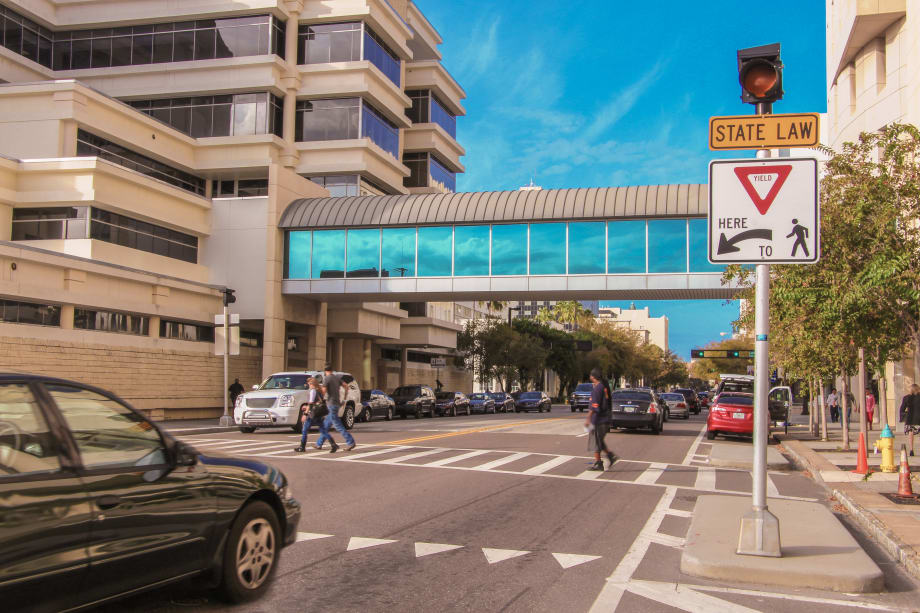
Drivers of connected vehicles receive an alert if they are on a potential collision course with a pedestrian in the crosswalk ahead.
THEA
Drivers of connected vehicles receive an alert if they are on a potential collision course with a pedestrian in the crosswalk ahead.
THEA
The Tampa Hillsborough Expressway Authority (THEA) and the Hillsborough Area Regional Transit Authority (HART) demonstrated connected vehicle technology in HART transit vehicles for the first time. The live demonstrations were a milestone for the THEA Connected Vehicle Pilot, which has now deployed the potentially lifesaving technology in 1,000 cars, 10 buses, and eight streetcars to improve safety and mobility in downtown Tampa.
Connected vehicle technology enables vehicles to communicate wirelessly with each other and with traffic signals, crosswalks, and other infrastructure. In a series of controlled demonstrations, onboard equipment successfully alerted drivers to potential collisions between a car and a TECO Line streetcar; between a car and a HART bus; and between a car and a pedestrian.
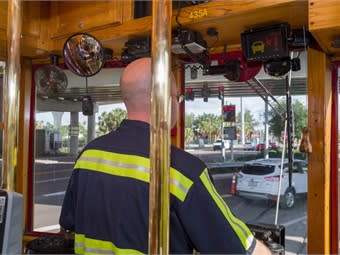
The streetcar motorman receives a warning that a connected vehicle is crossing the track ahead.
THEA
Officials from the Florida Division of the Federal Highway Administration and the U.S. Department of Transportation (U.S. DOT) participated in the demonstrations. The THEA Connected Vehicle Pilot is sponsored by the U.S. DOT.
“Connected vehicles hold the promise of saving lives while making travel more convenient and efficient,” said James Christian, Florida Division Administrator for the Federal Highway Administration. “This project is truly one of a kind, and we are excited to see the results. We are taking safety to a new level by showcasing this technology.”
More New Mobility

From Hardware to Digital Partner: Luminator Charts Its Next Chapter
CEO Magnus Friberg discusses Luminator’s shift toward becoming a digital partner, the growing importance of software and interoperability, and how AI can help agencies improve operations and passenger experience.
Read More →
Biz Briefs: Alstom Lands Canadian Contract, LYT to Supply California TSP, and More
In METRO's latest installment, we take a look at recent news from Complete Coach Works, Beep, FlixBus, and more partnerships making headlines across the transportation sector.
Read More →
CharterUP’s Armir Harris on Technology, AI, and the Future of Group Mobility
In a recent episode of METROspectives, CharterUP Founder/CEO Armir Harris discussed the company’s evolution from an online charter bus marketplace into a technology platform supporting public- and private-sector mobility and much more.
Read More →
Jacksonville’s NAVI Project Charts a New Course for Autonomous Public Transportation
Through its NAVI program, JTA is showing how autonomous vehicles, intelligent infrastructure, and coordinated operations can work together to deliver everyday public transportation.
Read More →
Biz Briefs: Luminator Marks Milestone and More
From manufacturers and suppliers to transit agencies and motorcoach operators, these updates offer a snapshot of the projects, partnerships and business moves driving the industry forward.
Read More →
New Tricks for Old Bureaucracies: Joshua Schank on Making Transit Innovation Stick
Former LA Metro Chief Innovation Officer Joshua Schank discusses why good ideas aren't enough, how transit agencies can overcome resistance to change, and why today's challenges demand more innovation.
Read More →
How DART's GoPass Is Redefining Regional Mobility
Serving 14 transit agencies, GoPass simplifies multimodal travel by allowing riders to plan, pay for, and manage an entire trip through one app.
Read More →
Biz Briefs: OCTA Taps Clean Energy for Hydrogen Station, Stadler to Supply Via Rail Vehicles, and More
From manufacturers and suppliers to transit agencies and motorcoach operators, these updates offer a snapshot of the projects, partnerships and business moves driving the industry forward.
Read More →CharterUP Expands Into New Mobility and Autonomous Transportation
Vice President of New Mobility Stephen Joos discusses how CharterUP is leveraging its nationwide transportation network, technology platform, and autonomous vehicle partnerships to expand into workforce mobility, campus shuttles, and transit solutions.
Read More →
METRO Magazine Announces 2026 Innovative Solutions Awards Winners
Projects Recognized for Advancing Mobility Through Technology, Accessibility, Workforce Innovation, and Operational Excellence
Read More →