




RELATED: How Universities Tap Tech to Provide Safe Transportation
Driverless shuttle to deliver rides at UW–Madison
The college, which is leading the federally designated Wisconsin Automated Vehicle Proving Grounds collaboration, will host an AV on campus April 24 and 25.
April 23, 2018
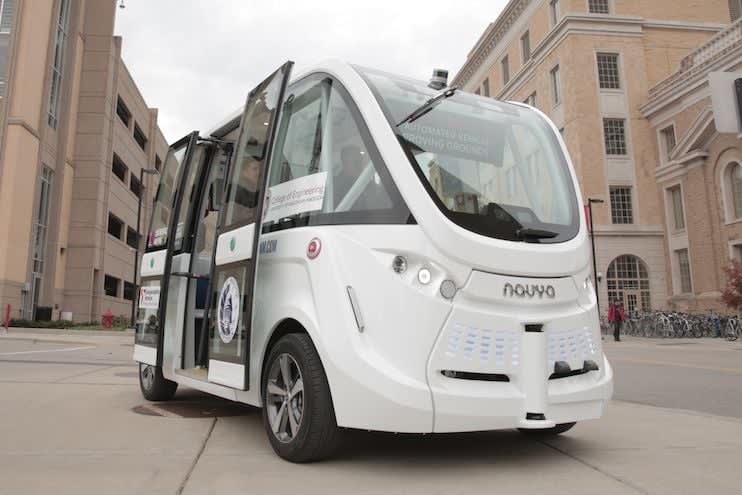
The Navya autonomous shuttle was on campus in November 2017 for a public viewing. Photo: Renee Meiller
3 min to read
The Navya autonomous shuttle was on campus in November 2017 for a public viewing. Photo: Renee Meiller
A group of University of Wisconsin–Madison students piles into an 11-seat vehicle, opting for a smooth shuttle ride up Observatory Drive instead of a long walk to the Sewell Social Sciences Building.
The vehicle steadily treks eastward at about 15 mph, following its high-definition base map and watching out for obstacles with lidar sensors rather relying on a driver — because there isn’t one.
While that remains a hypothetical scenario at the moment, it’s one that could become a reality in the not-too-distant future as part of the array of autonomous and connected vehicle research emerging from the UW–Madison College of Engineering.
The college, which is leading the federally designated Wisconsin Automated Vehicle Proving Grounds collaboration (WiscAV), will host one such autonomous vehicle on campus April 24 and 25. Members of the public can ride in an Autonom Shuttle, made by the French company Navya.
Researchers from the College of Engineering will be on hand to discuss their work and the latest developments in an evolving industry.
“A big part of our work as the proving grounds — especially as a more public-based, university-based proving grounds compared to the private test tracks — is getting people comfortable with this new technology that’s coming very, very fast, whether agencies or regulators are ready for it or not,” says Peter Rafferty, a program manager in the Traffic Operations and Safety Laboratory and one of the leaders of WiscAV.
Rafferty and researchers in the TOPS Laboratory are helping drive autonomous and connected vehicle research through projects like a partnership with the City of Madison to test connected vehicle technology on South Park Street. The laboratory also houses a full-scale driving simulator.
But work in the area involves researchers from across the College of Engineering and the UW–Madison campus.
For example, mechanical engineering professor Dan Negrut conducts high-resolution vehicle dynamics simulations. Industrial and systems engineering professor John Lee studies human adaptation to and interaction with automated vehicles.
David Noyce, transportation engineering professor and TOPS Laboratory director, and civil and environmental engineering professor Bin Ran are developing new technologies for connected and automated vehicles, and are considering the safety aspects of autonomous transportation. Noyce and Ran are also leading UW–Madison’s recently established research collaboration with Southeast University in Nanjing, China.
Meanwhile, other UW–Madison researchers are investigating related topics such as agricultural applications, artificial intelligence, liability, public perception, urban planning and more.
“Autonomous and connected vehicles are going to transform society,” says Jon Riehl, a researcher in the TOPS Laboratory. “So our work here is a perfect example of the Wisconsin Idea in action.”
American Family Insurance, a longtime supporter of UW–Madison, is among the lead sponsors for the event, along with the Department of Civil and Environmental Engineering and UW–Madison Transportation Services.
“As autonomous and connected vehicle technology advances, it will have a tremendous impact on the customers and communities we serve,” says Nyra Jordan, American Family’s director overseeing the company’s corporate responsibility and sustainability efforts. “It’s critical that the experience is safe for users, which is part of the reason this research is so important. This technology will enhance the future of mobility and reduce the environmental impacts associated with transportation. It’s an exciting collaboration with UW–Madison.”
AAA Wisconsin, Green Cab Madison, the TOPS Laboratory, the City of Madison and Schmidt’s Auto are also providing funding for Navya’s visit to campus.
More New Mobility

From Hardware to Digital Partner: Luminator Charts Its Next Chapter
CEO Magnus Friberg discusses Luminator’s shift toward becoming a digital partner, the growing importance of software and interoperability, and how AI can help agencies improve operations and passenger experience.
Read More →
Biz Briefs: Alstom Lands Canadian Contract, LYT to Supply California TSP, and More
In METRO's latest installment, we take a look at recent news from Complete Coach Works, Beep, FlixBus, and more partnerships making headlines across the transportation sector.
Read More →
CharterUP’s Armir Harris on Technology, AI, and the Future of Group Mobility
In a recent episode of METROspectives, CharterUP Founder/CEO Armir Harris discussed the company’s evolution from an online charter bus marketplace into a technology platform supporting public- and private-sector mobility and much more.
Read More →
Jacksonville’s NAVI Project Charts a New Course for Autonomous Public Transportation
Through its NAVI program, JTA is showing how autonomous vehicles, intelligent infrastructure, and coordinated operations can work together to deliver everyday public transportation.
Read More →
Biz Briefs: Luminator Marks Milestone and More
From manufacturers and suppliers to transit agencies and motorcoach operators, these updates offer a snapshot of the projects, partnerships and business moves driving the industry forward.
Read More →
New Tricks for Old Bureaucracies: Joshua Schank on Making Transit Innovation Stick
Former LA Metro Chief Innovation Officer Joshua Schank discusses why good ideas aren't enough, how transit agencies can overcome resistance to change, and why today's challenges demand more innovation.
Read More →
How DART's GoPass Is Redefining Regional Mobility
Serving 14 transit agencies, GoPass simplifies multimodal travel by allowing riders to plan, pay for, and manage an entire trip through one app.
Read More →
Biz Briefs: OCTA Taps Clean Energy for Hydrogen Station, Stadler to Supply Via Rail Vehicles, and More
From manufacturers and suppliers to transit agencies and motorcoach operators, these updates offer a snapshot of the projects, partnerships and business moves driving the industry forward.
Read More →CharterUP Expands Into New Mobility and Autonomous Transportation
Vice President of New Mobility Stephen Joos discusses how CharterUP is leveraging its nationwide transportation network, technology platform, and autonomous vehicle partnerships to expand into workforce mobility, campus shuttles, and transit solutions.
Read More →
METRO Magazine Announces 2026 Innovative Solutions Awards Winners
Projects Recognized for Advancing Mobility Through Technology, Accessibility, Workforce Innovation, and Operational Excellence
Read More →