



<font color=red>Web Extra:</font> Md.'s Mobility Paratransit revises services, policies
The MTA introduced two major changes: upgrading its curb-to-curb service to door-to-door service and greater enforcement of its no-show policy.

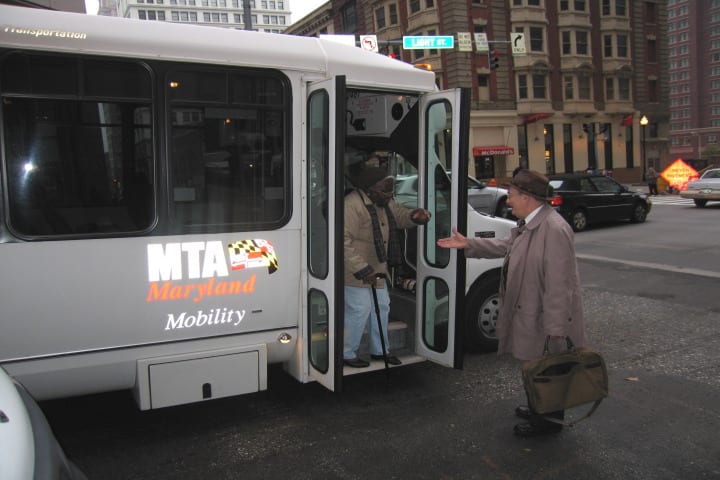
[IMAGE]Mobility-.jpg[/IMAGE]The New Year is bringing new changes for the Maryland Transit Administration's (MTA) Mobility Paratransit service, including a revised origin-to-destination service, revised no-show policy and travel training for those customers that would like to use MTA's regular fixed-route service.
"We decided to implement these modifications due to growing demand and customer expectations," says Cheron Victoria Wicker, a spokesperson at the MTA. "We have seen such a tremendous growth in our mobility service."
The MTA introduced two major changes: upgrading its curb-to-curb service to door-to-door service, which will include escorting the customer and assisting them with packages of 20 pounds or less, and greater enforcement of its no-show policy to discourage customers from scheduling a trip and then not meeting the vehicle at the designated location and time.
"The current policy establishes a no-show if the passenger is not ready within five minutes of the arrival of the vehicle" says Wicker of the changes to the policy. "Now, for customers that do that on a frequent basis, their service will be suspended after they've been properly notified and warned."
[IMAGE]Mobility2-.jpg[/IMAGE]
For customers who want to expand their ability to travel and have more options, the MTA is also offering travel training for its local bus, light rail and metro subway systems.
"This program will cover all aspects of fixed-route service including how to read service finding stops, and entering and exiting the vehicles," says Wicker. "It will increase their flexibility and give them the opportunity to travel more spontaneously."
Wicker adds that the program is voluntary and, even if they do successfully complete the training, it will not have any impact on the customers' mobility status.
This January, MTA is holding several "Mobility Town Hall Meetings" to reach out to its customers and make them aware of what they could expect. To this point, Wicker says that feedback has been positive.
The MTA's Mobility Paratransit service currently 390 vehicles that make up to 28,000 one-way trips per week.
More New Mobility

Biz Briefs: Luminator Marks Milestone and More
From manufacturers and suppliers to transit agencies and motorcoach operators, these updates offer a snapshot of the projects, partnerships and business moves driving the industry forward.
Read More →
New Tricks for Old Bureaucracies: Joshua Schank on Making Transit Innovation Stick
Former LA Metro Chief Innovation Officer Joshua Schank discusses why good ideas aren't enough, how transit agencies can overcome resistance to change, and why today's challenges demand more innovation.
Read More →
How DART's GoPass Is Redefining Regional Mobility
Serving 14 transit agencies, GoPass simplifies multimodal travel by allowing riders to plan, pay for, and manage an entire trip through one app.
Read More →
Biz Briefs: OCTA Taps Clean Energy for Hydrogen Station, Stadler to Supply Via Rail Vehicles, and More
From manufacturers and suppliers to transit agencies and motorcoach operators, these updates offer a snapshot of the projects, partnerships and business moves driving the industry forward.
Read More →
CharterUP Expands Into New Mobility and Autonomous Transportation
Vice President of New Mobility Stephen Joos discusses how CharterUP is leveraging its nationwide transportation network, technology platform, and autonomous vehicle partnerships to expand into workforce mobility, campus shuttles, and transit solutions.
Read More →
METRO Magazine Announces 2026 Innovative Solutions Awards Winners
Projects Recognized for Advancing Mobility Through Technology, Accessibility, Workforce Innovation, and Operational Excellence
Read More →
Biz Briefs: STV teams with Amtrak, Motorcoach Operators Boost Fleet and Land Contracts, and More
From manufacturers and suppliers to transit agencies and motorcoach operators, these updates offer a snapshot of the projects, partnerships and business moves driving the industry forward.
Read More →
Biz Briefs: Masabi Teams with St. Louis Metro and More
In METRO's latest installment, we take a look at recent news from Transdev, Hitachi, and more partnerships making headlines across the transportation sector.
Read More →
Microtransit's Next Test: Becoming Part of the Network
Freebee shows how electric microtransit is moving beyond pilots to fill network gaps, connect riders to transit, and prove lasting value.
Read More →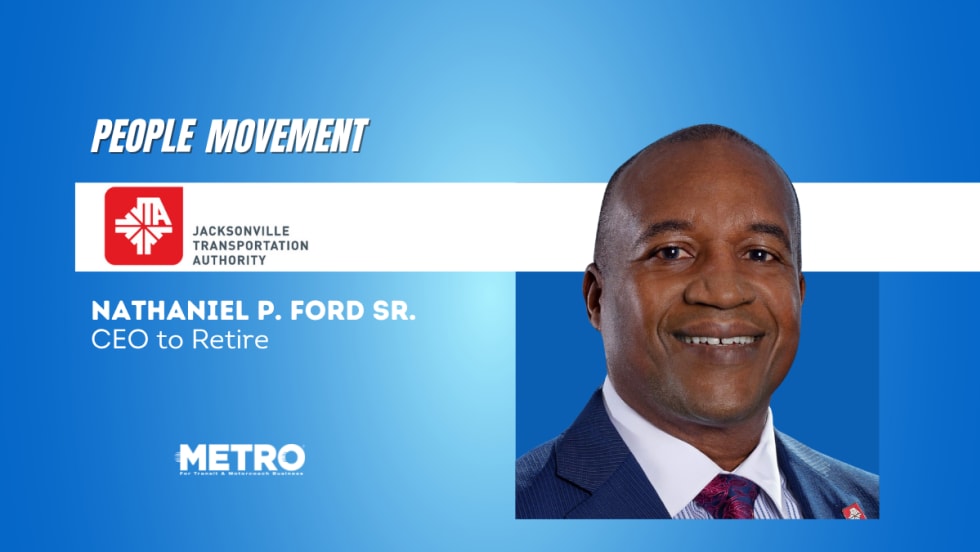
Ford to Leave JTA After More Than 10 Years as CEO
He plans to continue his work advancing innovative mobility solutions to improve the quality of life in communities across the nation. He did not announce specific plans.
Read More →