



FRA awards $25M in grants for PTC implementation
The agency received 30 eligible applications requesting $90.6 million, nearly four times the $25 million Congress provided in the appropriations bill that funds FRA for Fiscal Year 2016.

The Federal Railroad Administration (FRA) awarded $25 million in grants for 11 projects in six states and the District of Columbia to assist in implementing Positive Train Control (PTC).
The agency received 30 eligible applications requesting $90.6 million, nearly four times the $25 million Congress provided in the appropriations bill that funds FRA for Fiscal Year 2016. Many awards will help railroads achieve interoperability among the different PTC systems that railroads are deploying.
“These grants get us a bit closer to implementing Positive Train Control – a long overdue technology that prevents accidents and saves lives,” said U.S. Transportation Secretary Anthony Foxx. “We will continue to do everything in our power to help railroads install this technology. We encourage Congress to fully fund the President’s request for significant funds to help more railroads activate PTC.”
In 2008, Congress mandated PTC implementation on the main lines of Class I railroads and entities providing regularly scheduled intercity or commuter rail passenger transportation over which any poisonous or toxic by inhalation hazardous materials are transported, or over which intercity or commuter rail passenger transportation is regularly provided. Last October, Congress extended the original PTC implementation deadline from Dec. 31, 2015 to at least Dec. 31, 2018.
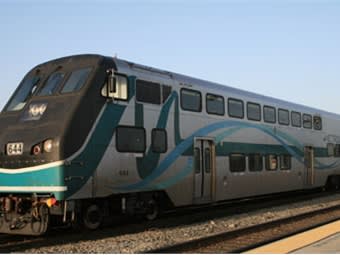
Metrolink
Metrolink – $2.4 million to develop, test, and deploy a full-feature service desk management suite of software applications that will allow each railroad to create, track, manage and share PTC system and asset trouble tickets internally within the organization and with interoperable railroad partners.
Sonoma-Marin Area Rail TransitDistrict – $3 million to install PTC and integrated new grade crossing warning systems on the 2.1-mile passenger rail extension between downtown San Rafael and Larkspur, Calif.
Caltrain – $2.88 million to conduct two test procedures for the field integration and functional testing of Caltrain’s Interoperable-Incremental Train Control System (I-ITCS) that will allow Interoperable Electronic Train Management System (I-ETMS) equipped tenants to seamlessly operate on Caltrain’s tracks.
Amtrak – $2.64 million to put in place authentication technology to fully secure the PTC wireless communication and data transmittal between a train’s point of origin and targeted receivers on the Northeast Corridor.
American Short Line and Regional Railroad Assoc. – $2.5 million to create a Crew Initialization Back Office Server System (CI-BOS) hosted service to assist small railroads tasked with implementing PTC, particularly systems that interoperate with Class I railroads.
Providence and Worcester Railroad Co. (P&W) – $965,832 to acquire and install eight Advanced Civil Speed Enforcement System (ACSES) PTC onboard units for P&W’s locomotives utilized on Amtrak’s Northeast Corridor.
Twin Cities & Western Railroad Co. –$1.1 million to implement and test PTC systems, including a contract with a back office service and interoperability message software provider, initial activation and licensing fees of hosted back office systems, and two PTC equipped locomotives.
Missouri Department of Transportation – $3 million to jointly partner with the Terminal Railroad Association of St. Louis (TRRA) for an Interoperable Electronic Train Management System (I-ETMS) implementation project on the Missouri side of TRRA’s territory.
North Carolina Department of Transportation – $771,070 to equip five converted Cab Control Units with Interoperable Electronic Train Management System (I-ETMS) and conduct testing on the Piedmont corridor or within any adjacent rail territory of NCDOT’s rail partners (Norfolk Southern Corporation and Amtrak).
Capital Metropolitan Transportation Authority –$3 million to implement Enhanced Automatic Train Control (E-ATC) that will overlay the existing wayside signal system and enhance onboard, wayside, and control office equipment and software to create a functional PTC system in the Austin area.
Fort Worth & Western Railroad – $2.56 million to install PTC on-board equipment and 220 MHz radios on nine locomotives in a phased installation, develop a crew initialization back office server, and train necessary personnel to operate and maintain the PTC system.
More Rail

New York MTA Advances Final Contract for Second Avenue Subway Expansion
Contract Four is the largest in the Second Avenue Subway Phase 2 project and includes construction of station infrastructure, tracks, and signals for the subway expansion, MTA officials said. Work on Contract Four will begin in 2027.
Read More →
San Diego MTS Breaks Monthly Trolley Ridership Record
Agency officials said July’s ridership indicates MTS’s continued recovery from the pandemic.
Read More →
Report Examines NJ TRANSIT Reliability, Funding Challenges
The Garden State Initiative analysis examines the roles of Amtrak infrastructure, fleet management, and agency operations while recommending a more performance-based approach to improving reliability.
Read More →
Stadler, CapMetro Sign Long-Term Rail Fleet Support Agreement
Beginning in 2027, Stadler will provide on-site technical expertise, spare parts support, training, and obsolescence management to help extend the reliability and longevity of CapMetro’s GTW fleet.
Read More →
Biz Briefs: Alstom Lands Canadian Contract, LYT to Supply California TSP, and More
In METRO's latest installment, we take a look at recent news from Complete Coach Works, Beep, FlixBus, and more partnerships making headlines across the transportation sector.
Read More →
CATS Gold Line Marks 5 Years of Service, 2.8M Passenger Trips
With a six-mile expansion planned, the Charlotte streetcar is positioned to connect more neighborhoods and major transit hubs across the region.
Read More →
Why Simulating Pedestrian Movement Has Become Essential for Modern Rail Stations
Pedestrian microsimulation is helping rail planners identify bottlenecks, test station designs, and prepare complex transit hubs for growing passenger volumes.
Read More →
Amtrak Begins Major Construction at New York’s Sunnyside Yard
The new maintenance facility will support Amtrak’s Airo trainsets while improving maintenance efficiency and turnaround times in New York.
Read More →
Chicago Leaders Unveil Plans for O’Hare Airport Express Train
The privately developed project would offer a 15-minute trip between downtown and O’Hare’s Terminal 2, with trains operating every 15 minutes on a dedicated track. The service would use battery-electric trains and three existing freight rail rights-of-way.
Read More →
OCTA Maps Out 30-Year Strategy to Protect Coastal Rail Corridor
The draft feasibility report identifies strategies to protect the coastal rail line for decades as the agency continues near-term stabilization and sand placement efforts.
Read More →