



APTA: Surface Transportation Funding Delivers 5:1 Economic Return, Supports 41,400 Jobs per $1B
The findings provide clear evidence that sustained Federal investment in public transit and passenger rail delivers significant returns for workers, communities, taxpayers, and the U.S. economy, APTA officials said.

The report, Economic Impact of Public Transportation Investment, finds that public transportation investment delivers strong taxpayer returns through job creation, increased tax revenue, improved access to jobs and healthcare, reduced congestion, and lower household transportation costs.
METRO
- Federal investment in public transit and passenger rail yields a 5:1 economic return, as reported by APTA officials.
- The funding supports 41,400 jobs for every $1 billion invested in surface transportation.
- These investments benefit workers, communities, taxpayers, and the broader U.S. economy.
*Summarized by AI
A new independent economic study assessing the American Public Transportation Association (APTA) Surface Transportation Authorization Recommendations finds that every $1 billion invested in public transportation generates $5 billion in long-term economic value and supports tens of thousands of jobs nationwide.
The findings provide clear evidence that sustained Federal investment in public transit and passenger rail delivers significant returns for workers, communities, taxpayers, and the U.S. economy, APTA officials said.
Upcoming Surface Transportation Bill
In February, the APTA board approved the APTA Surface Transportation Authorization Recommendations, which urge Congress and the Administration to build upon current investment for public transit and passenger rail to drive job creation, innovation, and economic growth by providing $138 billion for public transit and $130 billion for passenger rail over the next five years.
The report, Economic Impact of Public Transportation Investment, finds that public transportation investment delivers strong taxpayer returns through job creation, increased tax revenue, improved access to jobs and healthcare, reduced congestion, and lower household transportation costs. The report specifically finds that these critical public transportation investments will create an additional $140 billion in annual economic impact.
“Public transportation is one of the smartest investments we can make in America’s economic future,” said APTA President/CEO Paul P. Skoutelas. “A $1 billion investment doesn’t just move people. It moves our entire economy forward, creating tens of thousands of jobs and unlocking billions in economic opportunity.”
Federal investment enables public transit agencies nationwide to address the more than $150 billion state-of-good-repair backlog, meet growing mobility demands in our communities, and drive innovation and new technologies to enhance safety and expand access to jobs, healthcare, and education, APTA officials said.
Creating Economic Impact
The Economic Impact of Public Transportation Investment finds that each $1 billion invested in public transit delivers:
Economic Impact
- $5 billion of economic value (GDP) (5-to-1 economic return on investment), including:
- $1.4 billion in direct spending from construction, manufacturing, and operations.
- $3.6 billion in long-term benefits from improved mobility, reduced congestion, and expanded access to jobs and healthcare.
Job Creation
- 41,400 jobs created or sustained across construction, manufacturing, operations, and supplier industries.
- $3.1 billion in worker income is supported.
Taxpayer Returns
- $251 million in Federal, State, and local tax revenue
“These results are not accidental. They are the direct outcome of Federal leadership and investment,” Skoutelas said. “When the Federal Government invests in public transportation, communities see real improvements, such as expanded service, modern vehicles, good-paying jobs, and stronger local economies.”
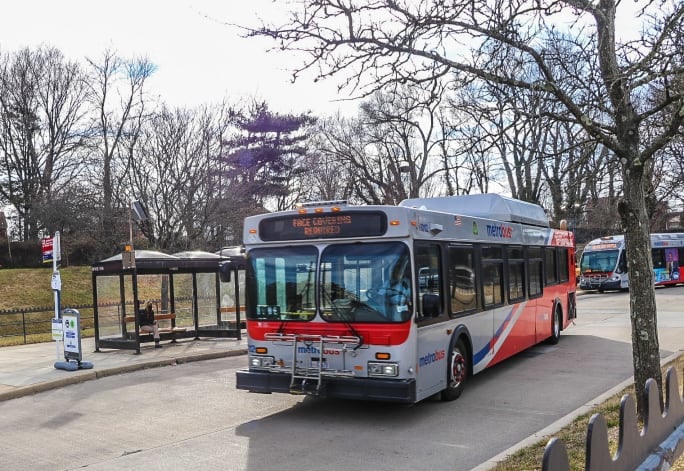
Federal investment enables public transit agencies nationwide to address the more than $150 billion state-of-good-repair backlog, meet growing mobility demands in our communities, and drive innovation and new technologies to enhance safety and expand access to jobs, healthcare, and education, APTA officials said.
Larry Levine/WMATA
Additional Research
Other APTA research finds that 77% of Federal public transit funds flow to the private sector, supporting American manufacturing and family-wage jobs.
APTA also released updated bus manufacturing and railcar manufacturing schematics illustrating how Federal public transit investment supports 3,000 suppliers in more than 1,700 communities in 50 states.
“Federal investment has delivered results, but the job is far from finished,” Skoutelas said. “A strong, long-term Federal commitment is essential to drive job creation, innovation, and economic growth across the nation.”
Three key initiatives guide the APTA Surface Transportation Authorization Recommendations for the next surface transportation law:
- Build on current investments in public transit and passenger rail to drive job creation, innovation, and economic growth.
- Accelerate project delivery by eliminating statutory and regulatory barriers to building infrastructure.
- Strengthen collaborative, local decision-making.
Economic Impact of Public Transportation Investment was prepared for APTA by EBP. The analysis uses U.S. Department of Transportation benefit-cost guidance, industry-standard economic modeling, and comprehensive transit data to project impacts through 2045. All figures are in 2023 dollars.
Quick Answers
The economic return ratio for surface transportation funding is 5:1, meaning $1 invested returns $5.
*Summarized by AI
More Management

METRO Opens Submissions for 2026 Motorcoach Awards
Nominations are now being accepted for METRO Magazine’s Operator of the Year and Innovative Operator of the Year awards.
Read More →
New York MTA Advances Final Contract for Second Avenue Subway Expansion
Contract Four is the largest in the Second Avenue Subway Phase 2 project and includes construction of station infrastructure, tracks, and signals for the subway expansion, MTA officials said. Work on Contract Four will begin in 2027.
Read More →
Transit Agencies Highlight Safety Gains at National Summit
Leaders from 15 major transit systems shared crime-reduction results and safety initiatives while discussing the role of continued federal support.
Read More →

NITA Names New Leadership, Expands Reduced-Fare Program at First Board Meeting
The new regional transit authority appointed its first board chair and interim executive director while extending reduced fares across CTA, Metra, and Pace for eligible riders.
Read More →
Beyond the Checklist: A Structured Approach to Transit Maintenance
Reliability-Centered Maintenance helps transit agencies move beyond routine checklists to focus limited resources on the assets and failures that have the greatest impact on safety, reliability, and service.
Read More →
APTA 2026 Nominating Committee Selects Leadership Slate, Names Chair and Vice Chair Nominees
Leadership changes will help shape the association’s priorities and its representation of the transportation industry during the 2026–2027 term.
Read More →
DART Launches Major Security, Fare Enforcement Initiative
The 90-day demonstration will deploy coordinated security teams at five light rail stations while testing controlled access and gathering data to guide future investments.
Read More →
Advancing Fare Collection Through Technology and Innovation
Learn about delivering 1300 gates at 91 stations while managing fare evasion. Explore the large scale deployment, solution customization and real-world results that affect the region. Prepare for deployment in your region now.
Read More →
Game Day in Motion: Moving Millions During the 2026 World Cup
Between packed transit stations and team motorcoaches, see how agencies and operators across North America tackled the transportation demands of the 2026 FIFA World Cup.
Read More →
Surface Transportation Extension Averts Shutdown, Leaves Transit Funding Gap
The stopgap keeps federal transportation programs moving, but missing advance funding could complicate the transit and rail projects agencies are planning next.
Read More →