




Read More: USDOT Announces Funding for 162 Infrastructure Projects
FTA Announces Progress on Hudson River Tunnel Project
Once the project begins, it is expected to create more than 72,000 American jobs in the region.
July 6, 2023
The Hudson River Tunnel project is particularly critical because the existing North River Tunnel serving Penn Station is more than 110 years old and was severely damaged during Superstorm Sandy in 2012.
Photo: NJ Transit
3 min to read
The Federal Transit Administration (FTA), part of the U.S. Department of Transportation, informed the Gateway Development Commission (GDC) that the Hudson River Tunnel project has received approval to enter the Engineering phase of the FTA Capital Investment Grants (CIG) program.
Once the project begins, it is expected to create more than 72,000 American jobs in the region.
“Every day, 200,000 people pass through the North River Tunnel, and a closure affects not just the entire Northeast Corridor, but the entire country,” said U.S. Transportation Secretary Pete Buttigieg. “Today, we are proud to announce that the Hudson River Tunnel project is entering the Engineering phase, moving us a huge step closer to finally revitalizing and expanding this century-old piece of American infrastructure.”
Hudson River Tunnel Project Details
The Hudson River Tunnel project is part of the Gateway Program, a series of strategic infrastructure investments designed to improve New York and New Jersey rail service.
The Hudson River Tunnel project is particularly critical because the existing North River Tunnel serving Penn Station is more than 110 years old and was severely damaged during Superstorm Sandy in 2012.
While the tunnel has been repaired frequently, its age and damaged condition present reliability concerns for more than 200,000 people who travel through the tunnel on more than 400 trains every weekday.
According to a study by the Northeast Corridor Commission, commuters in 2020 were delayed more than 210 hours due to maintenance issues.
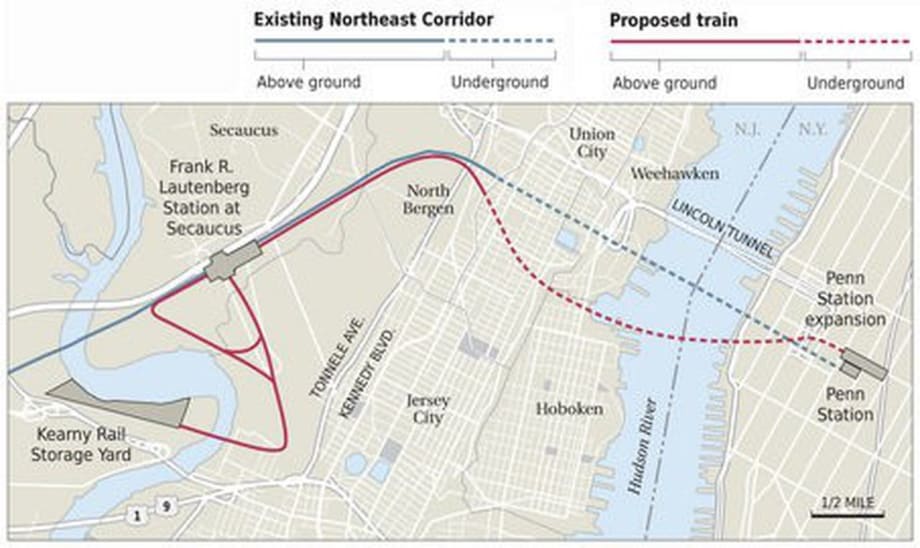
The Hudson River Tunnel project will build a new two-track rail tunnel from the Bergen Palisades in New Jersey to Manhattan, directly serving New York Penn Station and rehabilitating the existing North River Tunnel.
Additionally, nearly 5,000 new affordable housing units will be created in the adjacent Hudson Yards as part of the construction.
The project will improve New Jersey Transit and Amtrak service for a region that impacts more than 20% of the nation’s economy.
“Hundreds of thousands of Americans travel under the Hudson River every day, not just between New York and New Jersey but between points all along the East Coast,” said FTA Administrator Nuria Fernandez. "FTA is proud to invest in the Hudson River Tunnel, through the CIG program, so these rails can continue to carry millions of people and billions of dollars that help define our country’s economy every year.”
Once all financial, technical, and legal requirements are completed, FTA’s anticipated funding commitment to the Hudson River Tunnel project will be $6.88 billion, subject to the annual appropriation of funds by Congress.
The overall project cost is approximately $17.18 billion.
U.S. DOT's Support for Gateway Program
In addition to the Hudson River Tunnel project, U.S. DOT has provided support for the Gateway program including through a CIG grant agreement for Portal North Bridge, a Mega grant for the Hudson Yard Concrete Casing, which will provide the opening of the new Hudson River tunnel on the New York side, and most recently a RAISE grant for Tonnelle Avenue, which will provide the opening of the tunnel on the New Jersey side.
The Hudson River Tunnel project is also under consideration for Federal Railroad Administration grant funds.
While moving into the Engineering phase means the Hudson River Tunnel project is one step closer to accessing billions of dollars in anticipated federal funding, this step also allows GDC to incur costs for engineering activities, demolition, utility relocation, property acquisition, and other non-construction costs, including procurement of specialized equipment and materials.
The CIG program is a multi-step, multi-year funding opportunity to help communities carry out transformational transit projects nationwide. More than five dozen potential projects are currently in various phases of the CIG “pipeline,” covering 23 states and every time zone.
The program received a significant authorization boost thanks to President Biden’s Bipartisan Infrastructure Law – up to $23 billion over five years to invest in new high-capacity transit projects.
More Management

LIT Marks 10-Year Milestone at Annual Summit
Hosted by the COTA from September 10 to 13, the Summit carried the theme “Celebrating 10 Years of Excellence, Leadership, and Impact,” with every part of the program honoring the people, agencies, and partners who built LIT over its first decade.
Read More →
People Movement: Dan Dipert Coaches Adds Third-Generation Leader, Keolis Names New Valley Metro VP/GM, and More
In this edition, we also cover recent appointments and announcements at the Wabtec, SilverRide, HNTB, and more, showcasing the individuals helping to shape the future of transportation.
Read More →
METRO Opens Submissions for 2026 Motorcoach Awards
Nominations are now being accepted for METRO Magazine’s Operator of the Year and Innovative Operator of the Year awards.
Read More →

New York MTA Advances Final Contract for Second Avenue Subway Expansion
Contract Four is the largest in the Second Avenue Subway Phase 2 project and includes construction of station infrastructure, tracks, and signals for the subway expansion, MTA officials said. Work on Contract Four will begin in 2027.
Read More →
Transit Agencies Highlight Safety Gains at National Summit
Leaders from 15 major transit systems shared crime-reduction results and safety initiatives while discussing the role of continued federal support.
Read More →
NITA Names New Leadership, Expands Reduced-Fare Program at First Board Meeting
The new regional transit authority appointed its first board chair and interim executive director while extending reduced fares across CTA, Metra, and Pace for eligible riders.
Read More →
Beyond the Checklist: A Structured Approach to Transit Maintenance
Reliability-Centered Maintenance helps transit agencies move beyond routine checklists to focus limited resources on the assets and failures that have the greatest impact on safety, reliability, and service.
Read More →
APTA 2026 Nominating Committee Selects Leadership Slate, Names Chair and Vice Chair Nominees
Leadership changes will help shape the association’s priorities and its representation of the transportation industry during the 2026–2027 term.
Read More →
DART Launches Major Security, Fare Enforcement Initiative
The 90-day demonstration will deploy coordinated security teams at five light rail stations while testing controlled access and gathering data to guide future investments.
Read More →
Sponsored•September 9, 2026
Advancing Fare Collection Through Technology and Innovation
Learn about delivering 1300 gates at 91 stations while managing fare evasion. Explore the large scale deployment, solution customization and real-world results that affect the region. Prepare for deployment in your region now.
Read More →