




Read More: Officials Celebrate Funding for Chicago Transit at New Pace Markham Facility
Illinois Governor Announces $4M Investment in Freedman Seating
The $4 million investment will create 50 new jobs and help retain 676 jobs through modernizing Freedman Seating Company’s facilities in Chicago’s Austin neighborhood.
February 13, 2025
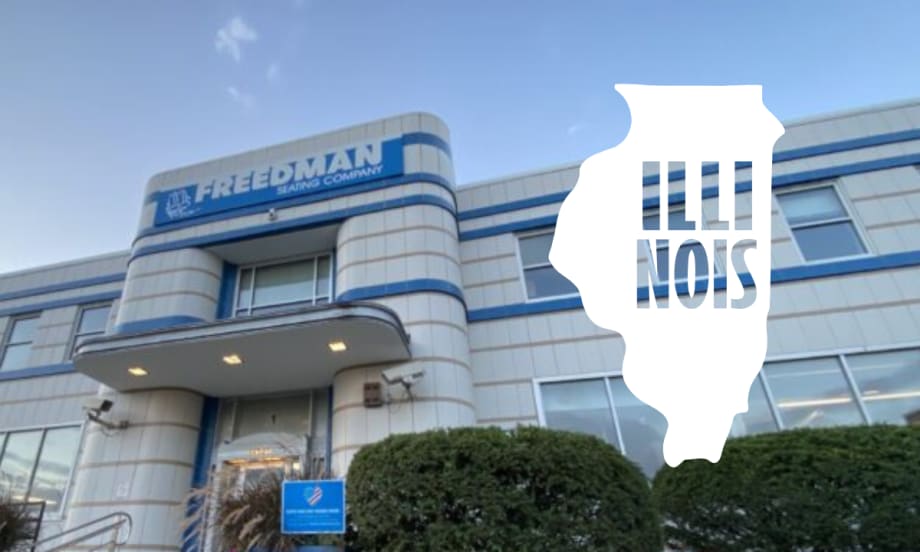
Freedman Seating Company currently produces around 2,000 seats per day, this $4 million investment will help their facilities keep up with demand.
Photo: Freedman Seating | Metro
2 min to read
Gov. JB Pritzker announced new investments in Freedman Seating Co.’s Chicago manufacturing facility with the Illinois Department of Commerce and Economic Opportunity (DCEO).
The $4 million investment in Freedman Seating Company is bolstered by an Economic Development for a Growing Economy (EDGE) agreement and is for capital expenditures.
Creating Jobs in Illinois
With this investment Freedman Seating Co. will be able to make site improvements to accommodate new manufacturing equipment at its facility in Chicago’s Austin neighborhood.
These improvements will create 50 new full-time jobs and help retain 676 full-time jobs.
“Through the competitive incentive programs, workforce development, and other business development efforts, our state is supporting businesses that create jobs and invest back into their communities,” said Gov. Pritzker. “Illinois is one of the best places in the world for manufacturing companies, and today once again we’re proving that our state is open for business.”
Freedman Seating Co. is a specialty seating manufacturer, and was incorporated in 1954. The company manufactures and engineers approximately 2,000 seats per day for bus, rail, marine, delivery truck, specialty, and commercial vehicle markets.
“Programs like EDGE don’t give businesses a handout — they help level the playing field. They allow companies like ours to invest, grow, and compete while creating more opportunities where they are needed most,” said Craig Freedman, CEO of Freedman Seating Co. “Without real, tangible support, businesses will leave. When that happens, communities suffer. We continue to invest in our facilities and our people because we believe in the West Side, we believe in Chicago, and we believe in Illinois.”
Strengthening the Economy
With EDGE incentives, the facility improvements will accommodate new equipment at the recently expanded 650,000-square-foot plant and support continued growth and expansion.
Freedman Seating Co. will continue to be an economic driver in the area as they aim to leverage and develop local talent, create skilled jobs, and offer extensive training opportunities.
The project will also boost operational efficiency and expand the company’s capabilities, allowing better service and stronger contributions to the transportation industry.
“The EDGE incentive program continues to help companies to grow in Illinois – supporting economic development and good-paying jobs throughout the state,” said DCEO Director Kristin Richards. “Freedman Seating Company has a storied history in Illinois, and the State of Illinois’ investments will provide them with long-term growth opportunities to serve their customers and the Austin community as an industry leader.”
As part of the State’s Comprehensive incentive package, Freedman Seating Company is receiving an EDGE tax credit, and will be making a $4 million investments.
In calendar year 2024, companies in the EDGE program committed more than $650 million in investments in Illinois communities across the state.
More Management

METRO Opens Submissions for 2026 Motorcoach Awards
Nominations are now being accepted for METRO Magazine’s Operator of the Year and Innovative Operator of the Year awards.
Read More →
New York MTA Advances Final Contract for Second Avenue Subway Expansion
Contract Four is the largest in the Second Avenue Subway Phase 2 project and includes construction of station infrastructure, tracks, and signals for the subway expansion, MTA officials said. Work on Contract Four will begin in 2027.
Read More →
Transit Agencies Highlight Safety Gains at National Summit
Leaders from 15 major transit systems shared crime-reduction results and safety initiatives while discussing the role of continued federal support.
Read More →

NITA Names New Leadership, Expands Reduced-Fare Program at First Board Meeting
The new regional transit authority appointed its first board chair and interim executive director while extending reduced fares across CTA, Metra, and Pace for eligible riders.
Read More →
Beyond the Checklist: A Structured Approach to Transit Maintenance
Reliability-Centered Maintenance helps transit agencies move beyond routine checklists to focus limited resources on the assets and failures that have the greatest impact on safety, reliability, and service.
Read More →
APTA 2026 Nominating Committee Selects Leadership Slate, Names Chair and Vice Chair Nominees
Leadership changes will help shape the association’s priorities and its representation of the transportation industry during the 2026–2027 term.
Read More →
DART Launches Major Security, Fare Enforcement Initiative
The 90-day demonstration will deploy coordinated security teams at five light rail stations while testing controlled access and gathering data to guide future investments.
Read More →
Sponsored•September 9, 2026
Advancing Fare Collection Through Technology and Innovation
Learn about delivering 1300 gates at 91 stations while managing fare evasion. Explore the large scale deployment, solution customization and real-world results that affect the region. Prepare for deployment in your region now.
Read More →
Game Day in Motion: Moving Millions During the 2026 World Cup
Between packed transit stations and team motorcoaches, see how agencies and operators across North America tackled the transportation demands of the 2026 FIFA World Cup.
Read More →
Surface Transportation Extension Averts Shutdown, Leaves Transit Funding Gap
The stopgap keeps federal transportation programs moving, but missing advance funding could complicate the transit and rail projects agencies are planning next.
Read More →