




RELATED: Calif. agency gets grant for GreenPower electric buses, charging tech.
GreenPower breaks ground on Calif. facility
During the event, representatives from CARB and California Climate Investments presented the City of Porterville with a giant check representing a grant for $9.5 million, which will bring 10 zero-emission battery-electric buses and supportive infrastructure to serve disadvantaged communities in the region.
June 8, 2017

From left to right: Green Power CEO Phillip Oldridge, CARB Board Member Dr. Alex Sheriffs, Green Power Chairman Fraser Atkinson, San Joaquin Valley Air Pollution Control District Director Seyed Sadredin, and Green Power President Brendan Riley.
2 min to read
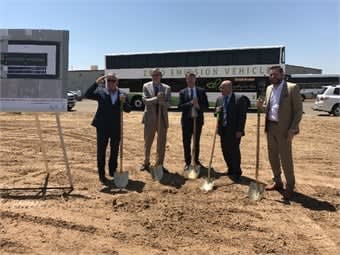
From left to right: Green Power CEO Phillip Oldridge, CARB Board Member Dr. Alex Sheriffs, Green Power Chairman Fraser Atkinson, San Joaquin Valley Air Pollution Control District Director Seyed Sadredin, and Green Power President Brendan Riley.
GreenPower Motor Co. hosted a successful groundbreaking ceremony for its upcoming manufacturing facility in Porterville, Calif.
During the event, representatives from the California Air Resources Board (CARB) and California Climate Investments presented the City of Porterville with a giant check representing a grant for $9.5 million, which will bring 10 zero-emission battery-electric buses and supportive infrastructure to serve disadvantaged communities in the region. In addition to the buses, the project will include installation of charging stations and solar panels. Funding is from the California Climate Investments (CCI), the state’s climate change-fighting, cap-and-trade program.
Manufactured by GreenPower Motor Co. and expected to arrive by early 2018, the 10 new GreenPower EV350 40-foot zero-emission all-electric transit buses and the charging infrastructure will service all nine of the Porterville Transit routes in the disadvantaged communities of Porterville, East Porterville, Strathmore, and the Tule River Indian Reservation, all heavily affected by air pollution. GreenPower will build a manufacturing facility for all-electric buses and batteries, expected to open in 2018. Southern California Edison will support the installation of infrastructure and provide special rates for high-voltage bus charging.
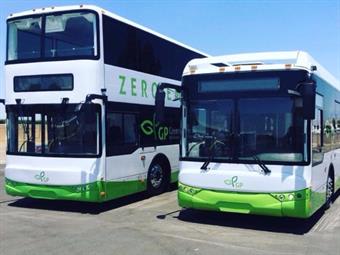
GreenPower's EV550 Double-Decker Bus and EV350 40-Foot Bus.
“We are excited to be working with the City of Porterville on a system-wide deployment of our all-electric transit buses and charging infrastructure,” said Fraser Atkinson, chairman of GreenPower. “The Porterville project will serve as a model for other operators in the San Joaquin Valley Air Pollution Control District and across North America who are seeking to deploy not just a zero-emission vehicle, but a zero-emission solution.”
The $9.5 million award to the City of Porterville was one of only nine awards from the highly competitive Zero-Emission Truck and Bus Pilot Project solicitation. In addition to the grant amount, the project partners — GreenPower, San Joaquin Valley Air Pollution Control District, and Southern California Edison — will contribute more than $7 million in a combination of cash and in-kind matching funds.
The award is part of CCCI, a statewide program that puts billions of cap-and-trade dollars to work reducing greenhouse gas emissions, strengthening the economy, and improving public health and the environment — particularly in disadvantaged communities. The cap-and-trade program also creates a financial incentive for industries to invest in clean technologies and develop innovative ways to reduce pollution. California Climate Investments projects include affordable housing, renewable energy, public transportation, zero-emission vehicles, environmental restoration, more sustainable agriculture, recycling, and much more. At least 35% of these investments are made in disadvantaged and low-income communities.
More Technology

From Hardware to Digital Partner: Luminator Charts Its Next Chapter
CEO Magnus Friberg discusses Luminator’s shift toward becoming a digital partner, the growing importance of software and interoperability, and how AI can help agencies improve operations and passenger experience.
Read More →
Beyond the Checklist: A Structured Approach to Transit Maintenance
Reliability-Centered Maintenance helps transit agencies move beyond routine checklists to focus limited resources on the assets and failures that have the greatest impact on safety, reliability, and service.
Read More →
NJ TRANSIT Advances Bus Technology Upgrades Across Statewide Fleet
More than 1,500 buses now feature upgraded technology designed to improve arrival predictions and provide free Wi-Fi, with deployment expected to reach nearly 2,000 buses by the end of 2026.
Read More →

Building a Flexible Path to Transit Electrification
John Hroncich discusses BAE Systems’ modular and scalable approach, lessons learned from decades of real-world operations, and how agencies can identify electrification strategies that fit their fleets.
Read More →
Biz Briefs: Alstom Lands Canadian Contract, LYT to Supply California TSP, and More
In METRO's latest installment, we take a look at recent news from Complete Coach Works, Beep, FlixBus, and more partnerships making headlines across the transportation sector.
Read More →
Sponsored•September 8, 2026
From Legacy Silos to Conversational Intelligence
What if transit leaders could ask any operational question and get a trusted answer in seconds? Conversational AI is transforming how agencies use their data.
Read More →
USDOT Announces Rail Vehicle Replacement Grants, Chattanooga AV Shuttle Funding
More than $191 million in federal funding will help three transit agencies replace aging rail vehicles and support a new autonomous shuttle service in Chattanooga.
Read More →
Bus Tech Talk: Keeping Transit Technicians Ahead of the Technology Curve
LA Metro’s Obed Mejia discusses technician training, evolving maintenance technology, fleet replacement, and strategies for getting the most out of today’s transit fleets.
Read More →
Biz Briefs: RIPTA Unveils New Frontrunners, Clevland RTA Adds New Siemens, and More
In METRO's latest installment, we take a look at recent news from Siemens, Prevost, Dodge, and more partnerships making headlines across the transportation sector.
Read More →
Why Simulating Pedestrian Movement Has Become Essential for Modern Rail Stations
Pedestrian microsimulation is helping rail planners identify bottlenecks, test station designs, and prepare complex transit hubs for growing passenger volumes.
Read More →