



Inadequate highway markings led to deadly Greyhound crash: NTSB
Two passengers were killed and 13 others plus the driver were injured when the bus struck a crash attenuator.

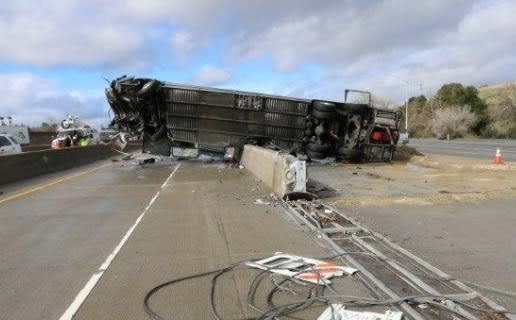
California Highway Patrol
California Highway Patrol
The National Transportation Safety Board determined that the Jan. 19, 2016, Greyhound bus crash in San Jose, Calif., was caused by the state’s failure to provide adequate traffic guidance and highway markings.
Two passengers were killed and 13 others plus the driver were injured when the bus struck a crash attenuator — which was not properly marked with a reflective sign — rode up a barrier, rolled onto its right side, and came to rest atop the barrier with its undercarriage facing traffic.
The bus was exiting left from Highway 101 at the time of the crash. In the rainy darkness of the early morning, with worn and missing highway markings, the driver thought he was in the exit lane. In fact, he was in the adjacent gore — the paved area between the main lane and the exit lane. Ahead of him was the unmarked, energy-absorbing barrier called a crash attenuator, and ahead of the attenuator was the concrete barrier. The California Department of Transportation did not mark the gore with stripes or chevrons, which are often used to differentiate the gore from the roadway.
Contributing to the severity of the injuries was the lack of seat belt use by the bus passengers. Seat belts were available for all passenger seats on board the bus, yet only two of the 21 passengers were wearing them at the time of the crash. The two passengers who died in the crash were not wearing seat belts and were ejected from the bus, according to the NTSB.
“This crash did not have to happen because the barrier that the bus hit should have been visible, even in the bad weather, but it was not,’’ said NTSB Acting Chairman T. Bella Dinh-Zarr. “Moreover, the crash would probably have resulted in fewer deaths and injuries if the occupants had worn their seat belts.”
Dinh-Zarr: In this crash, only two of the 21 passengers
were restrained. Too often our investigators find belts that were not used.— NTSB_Newsroom (@NTSB_Newsroom) March 28, 2017
The NTSB recommended that chevrons be painted in gore areas, left-exit signage improved and that Greyhound provide pre-trip safety briefings to include the importance and use of seat belts.
The synopsis, findings, opening and closing statements and all recommendations related to the accident are available here.
More Security and Safety

Transit Agencies Highlight Safety Gains at National Summit
Leaders from 15 major transit systems shared crime-reduction results and safety initiatives while discussing the role of continued federal support.
Read More →
DART Launches Major Security, Fare Enforcement Initiative
The 90-day demonstration will deploy coordinated security teams at five light rail stations while testing controlled access and gathering data to guide future investments.
Read More →
RTD Launches NextRide App to Consolidate Trip Planning, Fares, Security Reporting
The app expands on RTD’s existing NextRide web application and allows customers to view real-time vehicle locations and service alerts, purchase and store digital fares, and access customer support.
Read More →

TAPTCO Updates OSHA Compliance Training for Transit Maintenance Operations
The revamped program addresses 26 OSHA standards for maintenance facilities, with TAPTCO pointing to training, documentation, and everyday shop hazards as continuing challenges for transit operations.
Read More →
How VaporVision Adds Value to Transit Door Systems
Wabtec engineers explain how the system improves doorway detection, strengthens diagnostics and gives transit agencies and OEMs greater operating flexibility.
Read More →
FRA Announces $5.3B in Rail Investments, Including $2B for Amtrak
Funding will support grade-crossing improvements, infrastructure upgrades, and new Amtrak equipment in 23 states.
Read More →
Chicago, Maryland Expand Non-Law-Enforcement Safety, Rider Support
The CTA and MTA are launching new programs aimed at de-escalation, crisis response, rider assistance, and greater transparency.
Read More →
LA Metro, City of West Hollywood, and Partners Advance Smarter Bus Lane Enforcement
The award-winning partnership combines AI-powered detection with human oversight to improve bus reliability, accessibility, and enforcement efficiency.
Read More →
LA Metro Reports 57% Decline in Homelessness on Transit System Since 2024
The agency's latest homelessness count offers new data on how care-based services and cross-sector partnerships can complement traditional transit security strategies.
Read More →
FTA Launches 'Transit Moves America' Dashboard to Highlight Agency Safety and Performance
The online dashboard transforms National Transit Database information into a public-facing resource that allows users to compare transit agencies on key operational and safety metrics.
Read More →