




RELATED: Trip-planning app uses augmented reality to offer real-time passenger info
INIT processes first virtual fare card via Android Pay
The ground-breaking development constitutes a history-making milestone for TriMet, moovel, the provider of the Hop Fastpass mobile app, and INIT Innovations in Transportation Inc.
December 13, 2017
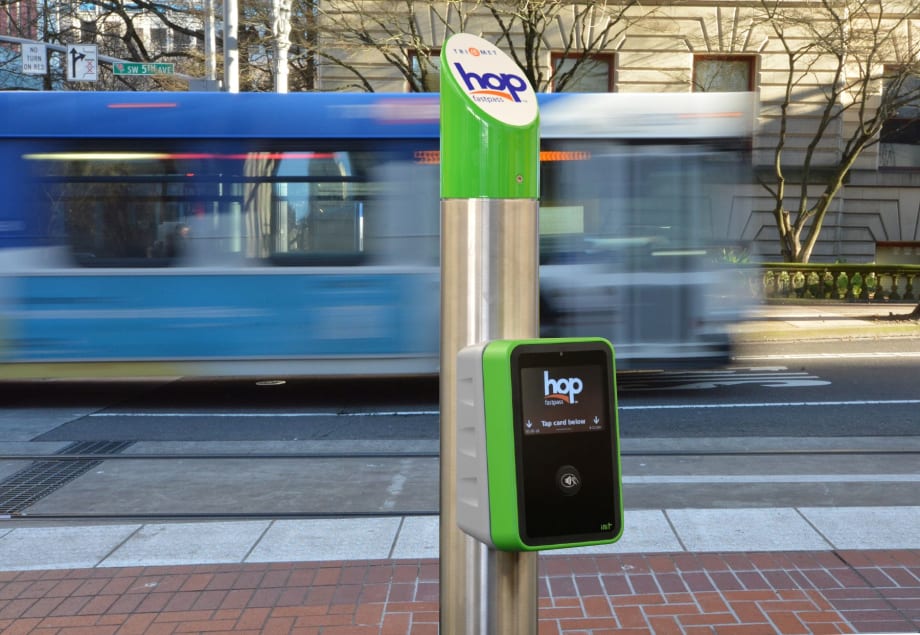
The Hop Fastpass™ system was designed following an open architecture approach which was a success of the project to allow easy integration with partners like Google.
2 min to read
The Hop Fastpass™ system was designed following an open architecture approach which was a success of the project to allow easy integration with partners like Google.
Portland, Ore.’s Tri-County Metropolitan Transportation District (TriMet) recently announced the beta launch of the first virtual public transit card via Android Pay. Through a partnership just announced with Google, select TriMet riders will now be able to tap and pay their transit fare using a virtual Hop card stored securely in their Android smartphone with Near Field Communication (NFC). The ground-breaking development constitutes a history-making milestone for TriMet, moovel, the provider of the Hop FastpassTM mobile app, and INIT Innovations in Transportation Inc.
INIT’s back-end processing system, MOBILEvario, serves as the core intelligence for the project processing all forms of payment for the multi-agency system including physical debit or credit cards or digital versions stored in Android Pay, Apple Pay, and Samsung pay, and now virtual Hop FastpassTM transit cards via Android Pay.
When a rider taps their device to any of the 1,200 INIT PROXmobil validators, MOBILEvario calculates the fare, validates the transaction against the back office account, and displays the fare validation result to the rider in real-time. Since all transactions are performed against the back office, riders can get accurate and up to date account information anytime and anyplace.
The Hop Fastpass™ system was designed following an open architecture approach which was a success of the project to allow easy integration with partners like Google. Due to the open architecture design, more than a dozen partners associated with the project were integrated without changes to the core system.
Since MOBILEvario is designed as a financial system, its main focus is to account for each and every transaction performed. The ease of interface to multiple off-the-shelf accounting software provided convenient integration into the existing accounting system. This strong revenue package delivers sophisticated management of earned revenue, deferred revenue, revenue recognition, and revenue sharing. For the multi-agency, bi-state Hop Fastpass™ system, automated clearing of revenues are securely performed.
INIT’s first open payments system in Portland-Vancouver has experienced more than one million taps since its initial launch in July of 2017. Virtual Hop cards via Android Pay are expected to be available to users of Android smartphones* in early 2018 pending the success of the agency’s beta test.
More Technology

From Hardware to Digital Partner: Luminator Charts Its Next Chapter
CEO Magnus Friberg discusses Luminator’s shift toward becoming a digital partner, the growing importance of software and interoperability, and how AI can help agencies improve operations and passenger experience.
Read More →
Beyond the Checklist: A Structured Approach to Transit Maintenance
Reliability-Centered Maintenance helps transit agencies move beyond routine checklists to focus limited resources on the assets and failures that have the greatest impact on safety, reliability, and service.
Read More →
NJ TRANSIT Advances Bus Technology Upgrades Across Statewide Fleet
More than 1,500 buses now feature upgraded technology designed to improve arrival predictions and provide free Wi-Fi, with deployment expected to reach nearly 2,000 buses by the end of 2026.
Read More →

Building a Flexible Path to Transit Electrification
John Hroncich discusses BAE Systems’ modular and scalable approach, lessons learned from decades of real-world operations, and how agencies can identify electrification strategies that fit their fleets.
Read More →
Biz Briefs: Alstom Lands Canadian Contract, LYT to Supply California TSP, and More
In METRO's latest installment, we take a look at recent news from Complete Coach Works, Beep, FlixBus, and more partnerships making headlines across the transportation sector.
Read More →
Sponsored•September 8, 2026
From Legacy Silos to Conversational Intelligence
What if transit leaders could ask any operational question and get a trusted answer in seconds? Conversational AI is transforming how agencies use their data.
Read More →
USDOT Announces Rail Vehicle Replacement Grants, Chattanooga AV Shuttle Funding
More than $191 million in federal funding will help three transit agencies replace aging rail vehicles and support a new autonomous shuttle service in Chattanooga.
Read More →
Bus Tech Talk: Keeping Transit Technicians Ahead of the Technology Curve
LA Metro’s Obed Mejia discusses technician training, evolving maintenance technology, fleet replacement, and strategies for getting the most out of today’s transit fleets.
Read More →
Biz Briefs: RIPTA Unveils New Frontrunners, Clevland RTA Adds New Siemens, and More
In METRO's latest installment, we take a look at recent news from Siemens, Prevost, Dodge, and more partnerships making headlines across the transportation sector.
Read More →
Why Simulating Pedestrian Movement Has Become Essential for Modern Rail Stations
Pedestrian microsimulation is helping rail planners identify bottlenecks, test station designs, and prepare complex transit hubs for growing passenger volumes.
Read More →