



Intel acquires Moovit
By working together as part of Intel and Mobileye, Moovit will advance the company’s MaaS strategy and the global adoption of autonomous transportation.

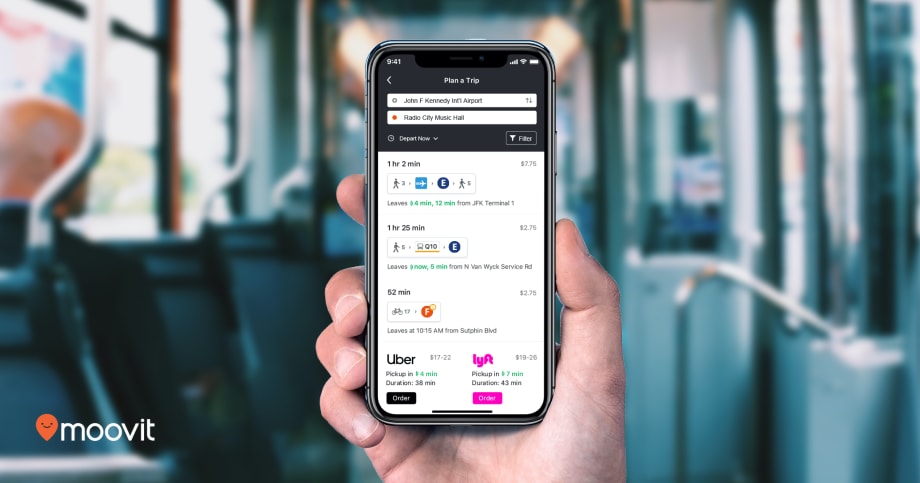
Moovit
Moovit has established its leadership in the MaaS space with more than 800 million users and services in 3,100 cities across 102 countries. Moovit
Intel Corporation acquired Moovit for approximately $900 million. Moovit is known for its urban mobility application that offers travelers around the world multimodal trip planning by combining public transportation, bicycle and scooter services, ride-hailing, and car-sharing.
The addition of Moovit brings Intel’s Mobileye closer to achieving its plan to become a complete mobility provider, including robotaxi services, which is forecast to be an estimated $160 billion opportunity by 2030.
Moovit has established its leadership in the MaaS space with more than 800 million users and services in 3,100 cities across 102 countries. Today, Mobileye is the leading automotive solutions partner that enables advanced driver-assistance systems (ADAS) deployed on nearly 60 million vehicles with more than 25 automaker partners.
Mobileye is a growth engine for Intel as the company transforms for a world where the exponential growth of data fuels demand for technology solutions that can process, move, and store more data faster. Intel is investing and expanding to serve new data-rich market opportunities, including the fast-growing market for ADAS, data, and MaaS technologies, which together represent an opportunity totaling more than $230 billion by 2030. Upon close, Moovit will join the Mobileye business while retaining its brand and existing partnerships.
Moovit was founded in 2012 and is based in Tel Aviv, with approximately 200 employees. Moovit combines information from public transit operators and authorities with live information from the user community to offer travelers a real-time picture of the best route for their journey. In the past 24 months, the company has achieved a seven-times increase in users. Moovit has also signed strategic partnership agreements with major ride-sharing operators and mobility ecosystem companies for analytics, routing, optimization and operations for MaaS. With this acquisition, Mobileye will be able to use Moovit’s large proprietary transportation dataset to optimize predictive technologies based on customer demand and traffic patterns, as well as tap into the company’s transit data repository of more than 7,500 key transit agencies and operators, and improve the consumer experience for more than 800 million users worldwide. Moovit’s consumer applications and user experience will continue under its own brand.
Intel acquired Mobileye in 2017. Since then, Mobileye revenues have more than doubled on the increased adoption of ADAS based on Mobileye’s industry-leading technology. The company’s vision-safety technology aims to make roads safer, reduce traffic congestion and save lives. Mobileye provides a complete autonomous vehicle solution stack that is technically advanced, provides unmatched agility and safety, and copes with a wide variety of driving complexities.
Mobileye’s business model encompasses the entire automated driving value chain, including the front-facing camera that powers most of today’s ADAS, conditional autonomy — also known as level 2+ — and the self-driving system (SDS) for self-driving shuttles and robotaxis as well as consumer autonomous vehicles (AVs). Mobileye has strong performance in every one of these categories with advanced vision sensing technology, crowd-sourced mapping capability (REM) and the Responsibility-Sensitive Safety (RSS) driving policy.
By working together as part of Intel and Mobileye, Moovit will advance the company’s MaaS strategy and the global adoption of autonomous transportation.
More New Mobility

From Hardware to Digital Partner: Luminator Charts Its Next Chapter
CEO Magnus Friberg discusses Luminator’s shift toward becoming a digital partner, the growing importance of software and interoperability, and how AI can help agencies improve operations and passenger experience.
Read More →
Biz Briefs: Alstom Lands Canadian Contract, LYT to Supply California TSP, and More
In METRO's latest installment, we take a look at recent news from Complete Coach Works, Beep, FlixBus, and more partnerships making headlines across the transportation sector.
Read More →
CharterUP’s Armir Harris on Technology, AI, and the Future of Group Mobility
In a recent episode of METROspectives, CharterUP Founder/CEO Armir Harris discussed the company’s evolution from an online charter bus marketplace into a technology platform supporting public- and private-sector mobility and much more.
Read More →
Jacksonville’s NAVI Project Charts a New Course for Autonomous Public Transportation
Through its NAVI program, JTA is showing how autonomous vehicles, intelligent infrastructure, and coordinated operations can work together to deliver everyday public transportation.
Read More →
Biz Briefs: Luminator Marks Milestone and More
From manufacturers and suppliers to transit agencies and motorcoach operators, these updates offer a snapshot of the projects, partnerships and business moves driving the industry forward.
Read More →
New Tricks for Old Bureaucracies: Joshua Schank on Making Transit Innovation Stick
Former LA Metro Chief Innovation Officer Joshua Schank discusses why good ideas aren't enough, how transit agencies can overcome resistance to change, and why today's challenges demand more innovation.
Read More →
How DART's GoPass Is Redefining Regional Mobility
Serving 14 transit agencies, GoPass simplifies multimodal travel by allowing riders to plan, pay for, and manage an entire trip through one app.
Read More →
Biz Briefs: OCTA Taps Clean Energy for Hydrogen Station, Stadler to Supply Via Rail Vehicles, and More
From manufacturers and suppliers to transit agencies and motorcoach operators, these updates offer a snapshot of the projects, partnerships and business moves driving the industry forward.
Read More →CharterUP Expands Into New Mobility and Autonomous Transportation
Vice President of New Mobility Stephen Joos discusses how CharterUP is leveraging its nationwide transportation network, technology platform, and autonomous vehicle partnerships to expand into workforce mobility, campus shuttles, and transit solutions.
Read More →
METRO Magazine Announces 2026 Innovative Solutions Awards Winners
Projects Recognized for Advancing Mobility Through Technology, Accessibility, Workforce Innovation, and Operational Excellence
Read More →