L.A. launches P3 to accelerate transportation innovation
Will bring stakeholders together to develop new ideas, test them, and roll them out in close partnership with local communities.
by Alex Roman, Managing Editor
November 15, 2019
UML is the latest initiative led by Mayor Garcetti to ensure a sustainable, equitable, and accessible future for transportation in Los Angeles.
Mayor Garcetti's Office
2 min to read
UML is the latest initiative led by Mayor Garcetti to ensure a sustainable, equitable, and accessible future for transportation in Los Angeles.
Mayor Garcetti's Office
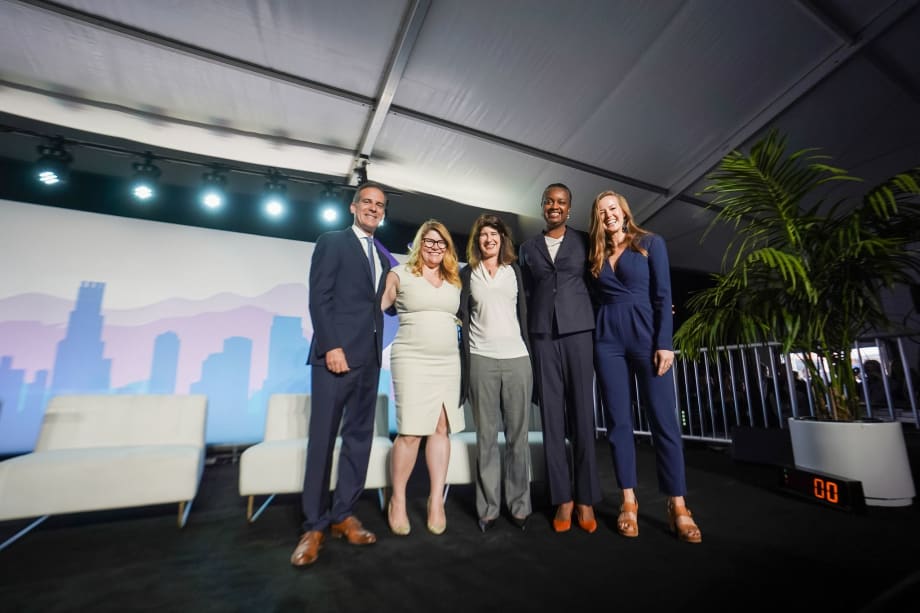
Mayor Eric Garcetti announced the creation of Urban Movement Labs (UML), a first-of-its-kind public-private partnership that will work to accelerate transportation innovation across Los Angeles at CoMotion LA.
The venture will focus on creating more ways for Angelenos to get around — by bringing stakeholders to the table to develop new ideas, safely testing them on L.A.’s streets, and rolling them out in close partnership with local communities, Mayor Garcetti explained.
Ad Loading...
“Urban Movement Labs will secure L.A.’s standing as the transportation innovation capital of the world — a place where new technologies are tested, proven, and brought to life, and people in every community have a seat at the table today as we think about what our city will look like tomorrow,” said Mayor Garcetti.
UML is the latest initiative led by Mayor Garcetti to ensure a sustainable, equitable, and accessible future for transportation in Los Angeles. It will empower a coalition of public and private sector partners, non-profit organizations, academic experts, and local residents to design and deploy creative solutions to the city’s critical transportation challenges.
In its first year, UML will work with local communities across L.A. to confront major issues affecting daily life, including providing better transportation options to L.A.’s residents and 50 million annual visitors; easing commutes across the region; and converting underused transportation assets into affordable housing.
Beyond working with residents to tackle these immediate challenges, UML will be built around three core initiatives:
The Ideas Accelerator: UML will identify current challenges, match solutions to each of them, then develop pilot programs to test ideas on L.A.’s streets.
The Economic and Workforce Development Initiative: UML will be laser-focused on one of Mayor Garcetti’s top priorities: developing a pipeline of businesses and good-paying jobs for the local workforce.
The Urban Proving Grounds Initiative: UML leaders, partners and community members will identify and vet a network of L.A. neighborhoods where solutions can be tested, evaluated, scaled to size, and eventually deployed.
Ad Loading...
Founding partners of UML include Mayor Eric Garcetti’s Office of Economic Development, the Los Angeles Department of Transportation, Los Angeles World Airports, the Port of Los Angeles, Avis Budget Group, the L.A. Cleantech Incubator, Lyft, Verizon, and Waymo.
Since taking office, Mayor Garcetti has launched:
BlueLA, the country's first 100% electric vehicle car-sharing program designed to serve low-income communities, directed the largest deployment of micromobility vehicles of any U.S. city through the pilot Dockless Mobility Program, integrated more than 1,000 shared bicycles into the L.A. region's public transit network with Metro Bike Share, and allocated resources to digitize the city's expansive curb assets to more efficiently manage curb access.
Mayor Garcetti also led the coalition to pass Measure M to invest $120 billion in expanding L.A. Metro’s rail system, fixing streets and freeways, and putting more than 777,800 people to work over the next 40 years.
The Call for Papers is now open, allowing transit agency professionals and industry experts to help shape the PTC educational program by submitting session ideas for consideration.
The proposed agreement calls for a 50% increase in bus service in Everett, a new microtransit zone, continued paratransit service, and the transfer of Everett Transit operations to Community Transit.
CEO Magnus Friberg discusses Luminator’s shift toward becoming a digital partner, the growing importance of software and interoperability, and how AI can help agencies improve operations and passenger experience.
In METRO's latest installment, we take a look at recent news from Complete Coach Works, Beep, FlixBus, and more partnerships making headlines across the transportation sector.
In a recent episode of METROspectives, CharterUP Founder/CEO Armir Harris discussed the company’s evolution from an online charter bus marketplace into a technology platform supporting public- and private-sector mobility and much more.
Through its NAVI program, JTA is showing how autonomous vehicles, intelligent infrastructure, and coordinated operations can work together to deliver everyday public transportation.
From manufacturers and suppliers to transit agencies and motorcoach operators, these updates offer a snapshot of the projects, partnerships and business moves driving the industry forward.
Former LA Metro Chief Innovation Officer Joshua Schank discusses why good ideas aren't enough, how transit agencies can overcome resistance to change, and why today's challenges demand more innovation.