L.A. Metro Continues to Recapture Post-Pandemic Ridership
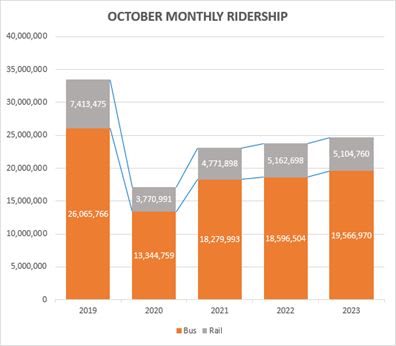
Metro’s monthly bus and rail ridership is now at 79% of its 2019 pre-pandemic level. Average weekend ridership is now at 92% of pre-pandemic (October 2019) levels and 78% for average weekdays.
L.A. Metro’s monthly bus and rail ridership is now at 79% of its 2019 pre-pandemic level. Average weekend ridership is now at 92% of pre-pandemic (October 2019) levels and 78% for average weekdays.
Photo: L.A. Metro
3 min to read
The Los Angeles County Metropolitan Transportation Authority (Metro) saw a nearly 12% increase in total system ridership in October 2023 compared to October 2022 with more than 26.5 million boardings, marking the 11th consecutive month of year-over-year ridership growth.
Metro’s monthly bus and rail ridership is now at 79% of its 2019 pre-pandemic level. Average weekend ridership is now at 92% of pre-pandemic (October 2019) levels and 78% for average weekdays.
Ad Loading...
The increased focus on safety, and the resulting 43% decrease in crime across the system since April, improved reliability and frequency of service, plus more Metro Ambassadors helping customers navigate the system, are all helping to drive increased ridership.
LA Metro’s October Ridership
In October, Metro had 26,528,697 boardings on its bus and rail services. An average of 956,754 rides were taken each weekday, highlighting the second consecutive month that weekday Metro ridership has surpassed 900,000 boardings. Saturday boardings averaged 667,506 and Sunday boardings averaged 562,017.
Weekends continue to show the greatest gains in post-pandemic ridership recovery, with average boardings on Saturdays reaching 89% of their (October 2019) pre-pandemic level and average boardings on Sundays reaching 95% of their (October 2019) pre-pandemic level.
October 2023 marked the fourth full month of operation for the A (Blue) and E (Gold) Lines. The A (Blue) Line, which serves customers from Azuza to Long Beach, saw a 9.5% increase in month over month ridership with 1,737,608 boardings in October 2023 and 1,586,470 boardings in September 2023.
The E (Gold) Line, which serves customers from East L.A. to Santa Monica, had a 7% increase in month over month ridership with 1,208,838 boardings in October 2023 and 1,130,105 boardings in September 2023.
Ad Loading...
The K Line, which celebrated its first anniversary in October, saw increased ridership on Saturdays, boosted in part by the annual Taste of Soul festival on Oct. 21. The K Line saw a 200% increase in boardings for the event over the previous Saturday.
In October, Metro had 26,528,697 boardings on its bus and rail services. An average of 956,754 rides were taken each weekday, highlighting the second consecutive month that weekday Metro ridership has surpassed 900,000 boardings.
Photo: L.A. Metro
Additional Factors Boosting Ridership
Sporting events, such as college football and Rams and Chargers games, are also contributing to increased ridership on the weekends.
In October 2023, Metro bus ridership saw a 12.5% year-over-year increase. Nearly 21 million rides were taken on Metro buses, with total bus ridership in October 2023 at 80% of its pre-pandemic level (October 2019).
Metro is making it easier for everyone to ride by providing accessible and affordable reduced-price transit pass programs such as the student GoPass pilot program, which offers free transit passes to K-12 and community college students, and its Low-Income Fare is Easy (LIFE) program that provides free rides and reduced fares to low-income customers.
In October, the GoPass pilot program saw nearly two million student boardings with 1,777,199 student bus boardings and 194,424 student rail boardings. To date the program has 340,000 registered students from 1570 participating schools in 115 participating school districts.
Ad Loading...
Metro’s Low-Income Fare is Easy (LIFE) program saw 1,437,046 boardings during October 2023 from the nearly 300,000 people enrolled in the program. New LIFE enrollees receive a free 90-day pass and after the first 90 days, riders can either load 20 free rides or purchase a discounted pass from any of the LIFE participating transit agencies.
The LIFE program helps qualifying Los Angeles County residents save money by providing free rides or deeply discounted fares on 13 transit systems across Los Angeles County.
The proposed budget includes funding for expanded transit service, safety initiatives, fleet upgrades, and infrastructure improvements across CTA, Metra, and Pace.
Executives from ABC Companies and MCI discuss how rising costs, changing market conditions, and post-pandemic challenges are prompting motorcoach operators to rethink financing strategies, fleet replacement cycles, and long-term planning.
Austin Transit Partnership CEO Greg Canally discusses the city's nearly 10-mile light rail project, its collaborative approach to project delivery, the importance of community engagement, and the milestones ahead as construction approaches in 2027.
ETA founder and CEO John Maglio explores the evolution of transit technology, the importance of reliable systems, and how stronger partnerships can help agencies improve operations and the passenger experience.
The Systemwide Network Plan identifies infrastructure needs and potential investments to expand all-day, bidirectional rail service across the Chicago region.
In this edition, we also spotlight recent personnel moves at HDR, PATH, STV, and more, highlighting the people taking on new roles across the transportation industry.
Transit agencies are using fare-free service, trip-planning tools, and targeted rides to improve voting access. See what other agencies can learn from these efforts.
The railroad’s shift to electric service has brought more frequent trains, stronger customer satisfaction, and increased ridership, earning it APTA’s Outstanding Public Transportation System award.
CTA launched crisis intervention teams as CATS prepares to deploy fare ambassadors, expanding customer assistance and security efforts across both systems.