




RELATED: LA Metro considering ridesharing-like microtransit option
LA Metro teams to bring shared rides to select train stations
The project will be supported in part by a $1.35 million from Mobility on Demand Sandbox grant from the Federal Transit Administration FTA.
November 21, 2017

Customers with disabilities, including those with service animals, wheelchairs, or other mobility aids or who need additional assistance to board or alight will be able to request rides that meet their needs.
Prayitno
3 min to read
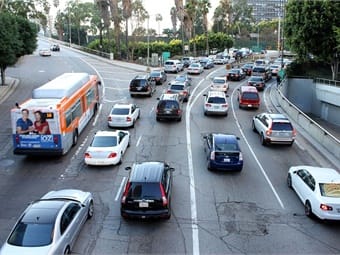
Customers with disabilities, including those with service animals, wheelchairs, or other mobility aids or who need additional assistance to board or alight will be able to request rides that meet their needs.
Prayitno
The Los Angeles County Metropolitan Transportation Authority (Metro) will pursue a partnership with Via, a transportation network company (TNC), to provide an affordable, equitable, and accessible first and last mile solution for customers to help bridge the first/last mile gap. The project will be supported in part by a $1.35 million from Mobility on Demand (MOD) Sandbox grant from the Federal Transit Administration (FTA).
Using new technology, customers will be able to book a seat in a shared, dynamically-routed vehicle to or from three major Metro stations. Metro will ensure that the rides are affordable for customers and will provide a payment solution for the unbanked. Customers with disabilities, including those with service animals, wheelchairs, or other mobility aids or who need additional assistance to board or alight will be able to request rides that meet their needs.
Metro’s project is part of a two-region partnership in Los Angeles County and the Puget Sound area with King County Metro and Sound Transit where each region will be testing a new type of partnership with a transportation network company.
The FTA developed the Mobility on Demand (MOD) program to support transit agencies and communities as they integrate new mobility tools like smart phone apps, bike- and car-sharing, and on-demand bus and van services. MOD projects help to make transportation systems more efficient and accessible, particularly for those who lack access to a car.
“We’re making our systems more inclusive — because access to public transportation is a right, not a privilege,” said Metro Chair and Los Angeles Mayor Eric Garcetti. “Everyone should be able to make a trip on Metro buses and trains, and these funds will help more riders get where they’re going quickly and conveniently."
“Our goal at Metro is to grow our service to provide more options and connections,” said Metro CEO Phillip A. Washington. “We think this project has the potential to help us reach out to more people and, hopefully, make their lives easier.”
The Metro project plan was developed by Metro’s Office of Extraordinary Innovation. “Metro is committed to expanding mobility options in Los Angeles County by leveraging Via’s innovations and expertise in offering dynamic shared rides,” said Joshua Schank, chief of Metro’s Office of Extraordinary Innovation. “Our project with Via demonstrates that there is potential to align public and private sector interests to improve mobility and provide a public benefit through ensuring that rides are affordable, equitable, and accessible for our customers.”
To ensure that the project can provide lessons for future partnerships, the Eno Center for Transportation, UCLA, and the University of Washington will be studying the project to identify lessons learned. The FTA will be working with Booz Allen Hamilton and the Transportation Sustainability Research Center to evaluate all participating MOD programs.
Metro and Via are finalizing an agreement with the intent of beginning the Mobility on Demand project in summer 2018.
More New Mobility

From Hardware to Digital Partner: Luminator Charts Its Next Chapter
CEO Magnus Friberg discusses Luminator’s shift toward becoming a digital partner, the growing importance of software and interoperability, and how AI can help agencies improve operations and passenger experience.
Read More →
Biz Briefs: Alstom Lands Canadian Contract, LYT to Supply California TSP, and More
In METRO's latest installment, we take a look at recent news from Complete Coach Works, Beep, FlixBus, and more partnerships making headlines across the transportation sector.
Read More →
CharterUP’s Armir Harris on Technology, AI, and the Future of Group Mobility
In a recent episode of METROspectives, CharterUP Founder/CEO Armir Harris discussed the company’s evolution from an online charter bus marketplace into a technology platform supporting public- and private-sector mobility and much more.
Read More →
Jacksonville’s NAVI Project Charts a New Course for Autonomous Public Transportation
Through its NAVI program, JTA is showing how autonomous vehicles, intelligent infrastructure, and coordinated operations can work together to deliver everyday public transportation.
Read More →
Biz Briefs: Luminator Marks Milestone and More
From manufacturers and suppliers to transit agencies and motorcoach operators, these updates offer a snapshot of the projects, partnerships and business moves driving the industry forward.
Read More →
New Tricks for Old Bureaucracies: Joshua Schank on Making Transit Innovation Stick
Former LA Metro Chief Innovation Officer Joshua Schank discusses why good ideas aren't enough, how transit agencies can overcome resistance to change, and why today's challenges demand more innovation.
Read More →
How DART's GoPass Is Redefining Regional Mobility
Serving 14 transit agencies, GoPass simplifies multimodal travel by allowing riders to plan, pay for, and manage an entire trip through one app.
Read More →
Biz Briefs: OCTA Taps Clean Energy for Hydrogen Station, Stadler to Supply Via Rail Vehicles, and More
From manufacturers and suppliers to transit agencies and motorcoach operators, these updates offer a snapshot of the projects, partnerships and business moves driving the industry forward.
Read More →CharterUP Expands Into New Mobility and Autonomous Transportation
Vice President of New Mobility Stephen Joos discusses how CharterUP is leveraging its nationwide transportation network, technology platform, and autonomous vehicle partnerships to expand into workforce mobility, campus shuttles, and transit solutions.
Read More →
METRO Magazine Announces 2026 Innovative Solutions Awards Winners
Projects Recognized for Advancing Mobility Through Technology, Accessibility, Workforce Innovation, and Operational Excellence
Read More →