




Related: Metro taps HDR to design emergency security ops center
LA Metro unveils new tunnel boring machine named Angeli
At the event Board Chair Fasana awarded TAP Cards to students who won contests to name the TBM and create an illustration for its tail shield.
October 21, 2016
Gary Leonard for LA Metro
3 min to read
Gary Leonard for LA Metro
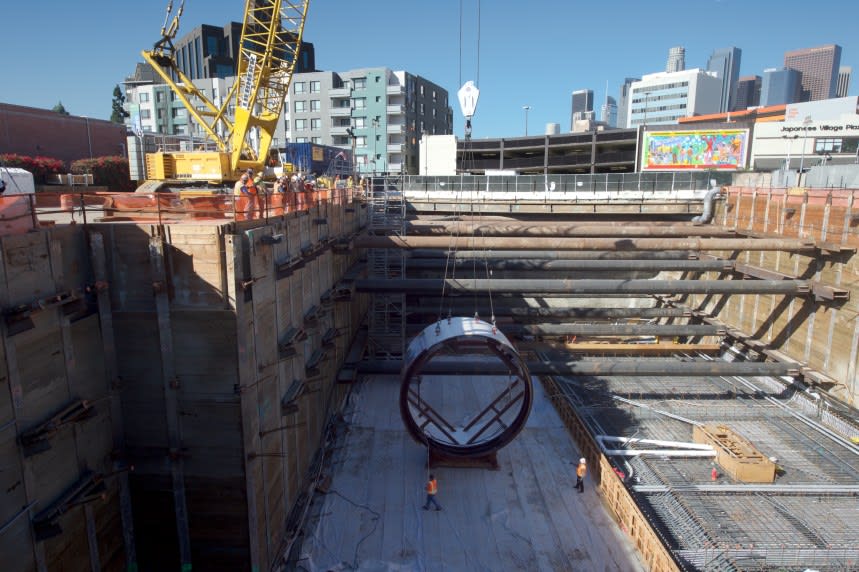
L.A. Metro joined elected officials and community stakeholders in Little Tokyo at the ceremonial naming and lowering of a segment of the tunnel boring machine (TBM) that will dig twin 1.1-mile underground rail tunnels under downtown Los Angeles. Excavation work will begin in January.
“This is a major milestone toward the completion of a vital project that truly connects the region by providing a one-seat ride to downtown Los Angeles for users of the Blue, Gold, and Expo lines,” said Metro Board Chair and Duarte City Council Member John Fasana. “The Regional Connector will reduce travel times for many Metro Rail riders and make our system much more convenient and attractive to those who want a transit alternative to driving.”
At the event Board Chair Fasana awarded TAP Cards to students who won contests to name the TBM and create an illustration for its tail shield. The winning name “Angeli” was submitted by eighth grade student Windsor McInerny, while the winning illustration was by Alexander Li.
The $1.55-billion Regional Connector Transit Project is a 1.9-mile underground light-rail tunnel that will connect the Blue, Expo, and Gold Lines in downtown Los Angeles and will include three new stations. The rail line is expected to serve 88,000 riders daily — including 17,000 new riders — and save commuters up to 20 minutes by reducing the need to transfer when traveling to and through downtown L.A. Construction is expected to be complete in 2021.
“The Regional Connector is a game changer for the entire region by connecting three light rail lines that already have more than 170,000 weekday boardings,” said Metro CEO Phillip A. Washington. “Measure R played a pivotal role in funding this project and helped us secure a federal grant and loan to build the infrastructure that will be enjoyed by generations to come.”
Naming of the TBM is a mining tradition that dates back to the 14th century. Saint Barbara, the patron saint for military engineers and miners, has been revered by underground workers as a symbol of protection and good luck for centuries. This homage evolved into the tradition of giving tunneling machines a female name before digging begins.
The TBM was manufactured in Germany by Herrenknecht AG. It weighs approximately 1,000 tons, is 450 feet long and is 21.5 feet in diameter. It will advance about 60 feet per day once digging begins and will take 16 to 18 months to excavate the twin 1.1-mile tunnels.
“Angeli” will begin its journey from the northeast corner of 1st and Alameda streets. The TBM will first dig the tunnel for the northbound tracks until it reaches 4th and Flower streets. From there, the TBM will be retrieved from underground and returned to Little Tokyo, where it will be re-launched to excavate the southbound tunnel.
Metro has contracted with Regional Connector Constructors, a joint venture between Skanska USA Civil West California District Inc., and Traylor Brothers Inc., to design and build the Regional Connector Transit Project.
More Rail

New York MTA Advances Final Contract for Second Avenue Subway Expansion
Contract Four is the largest in the Second Avenue Subway Phase 2 project and includes construction of station infrastructure, tracks, and signals for the subway expansion, MTA officials said. Work on Contract Four will begin in 2027.
Read More →
San Diego MTS Breaks Monthly Trolley Ridership Record
Agency officials said July’s ridership indicates MTS’s continued recovery from the pandemic.
Read More →
Report Examines NJ TRANSIT Reliability, Funding Challenges
The Garden State Initiative analysis examines the roles of Amtrak infrastructure, fleet management, and agency operations while recommending a more performance-based approach to improving reliability.
Read More →
Stadler, CapMetro Sign Long-Term Rail Fleet Support Agreement
Beginning in 2027, Stadler will provide on-site technical expertise, spare parts support, training, and obsolescence management to help extend the reliability and longevity of CapMetro’s GTW fleet.
Read More →
Biz Briefs: Alstom Lands Canadian Contract, LYT to Supply California TSP, and More
In METRO's latest installment, we take a look at recent news from Complete Coach Works, Beep, FlixBus, and more partnerships making headlines across the transportation sector.
Read More →
CATS Gold Line Marks 5 Years of Service, 2.8M Passenger Trips
With a six-mile expansion planned, the Charlotte streetcar is positioned to connect more neighborhoods and major transit hubs across the region.
Read More →
Why Simulating Pedestrian Movement Has Become Essential for Modern Rail Stations
Pedestrian microsimulation is helping rail planners identify bottlenecks, test station designs, and prepare complex transit hubs for growing passenger volumes.
Read More →
Amtrak Begins Major Construction at New York’s Sunnyside Yard
The new maintenance facility will support Amtrak’s Airo trainsets while improving maintenance efficiency and turnaround times in New York.
Read More →
Chicago Leaders Unveil Plans for O’Hare Airport Express Train
The privately developed project would offer a 15-minute trip between downtown and O’Hare’s Terminal 2, with trains operating every 15 minutes on a dedicated track. The service would use battery-electric trains and three existing freight rail rights-of-way.
Read More →
OCTA Maps Out 30-Year Strategy to Protect Coastal Rail Corridor
The draft feasibility report identifies strategies to protect the coastal rail line for decades as the agency continues near-term stabilization and sand placement efforts.
Read More →