



London to pilot all-electric double-decker bus
The new zero-emission electric double-deck buses manufactured by BYD will enter service beginning in October.

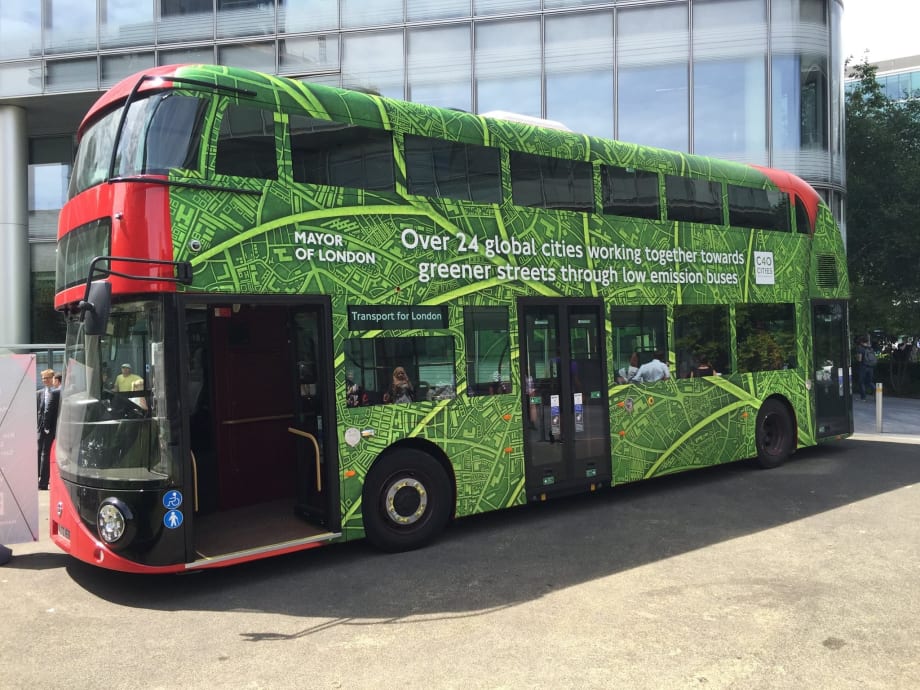
Transport for London double-decker electric bus. Photo: C40 Cities
Transport for London double-decker electric bus. Photo: C40 Cities
The world’s first purpose-built purely electric double-decker bus will enter passenger service in London this year, Mayor Boris Johnson announced this week, as he hosted representatives and major bus manufacturers from across the globe for the first ever global Clean Bus Summit.
The Clean Bus Summit and new trial underlines the Mayor’s continuing efforts to reduce emissions from London’s bus fleet, which is already one of the cleanest in the world.
Since 2008, the Mayor has rolled out more than 1,300 hybrid electric buses, retrofitted more than 1,400 buses to reduce their emissions by up to 88% and developed the New Routemaster, one of the cleanest double deck buses of its type in the world. There will be 800 New Routemasters on London’s streets by 2016 and they will reduce CO2 emissions in the Capital by around 27,500 tons a year.
This is part of the Mayor’s plan to halve NOx emissions from the bus fleet by the end of his term in office in 2016, compared to 2008. Cleaner buses have contributed to important steps forward in air quality for Londoners, including halving the number of Londoners living in areas above nitrogen dioxide limits, and a reduction in nitrogen oxide emissions by 20% and emissions of particulate matter down by 15%.
Many believed that a purely electric double-deck bus would not be possible due to the size of battery packs required to power it, according to city officials. However, by working with BYD and utilising the latest cutting-edge technology London has been able to secure another world-first. The new zero-emission electric double-decker buses manufactured by BYD will enter service beginning in October.
London will also shortly be welcoming two Irizar-manufactured electric single-deck buses. These new models join eight single-deck electric buses manufactured by Optare and BYD, which have been used successfully in London’s fleet since 2013. The Capital's first pure electric bus route, the 312 – which runs between Norwood and South Croydon – will also be created later this year.
The Mayor of London Boris Johnson said: “The iconic red double-decker bus is about to become greener than ever. I could not be more pleased that London will play host to these exciting pure electric double-deck buses, and I’m sure the lucky users of route 16 will embrace it with gusto. London is a world leader in clean buses but we can’t do it alone, and events like this Clean Bus Summit are key to making further progress.”
As part of his Ultra Low Emission Zone (ULEZ) proposals, Mayor Johnson has committed that by 2020 all 300 single-deck buses in central London will be zero emission at tailpipe. Furthermore, all 3,300 double deck buses in central London will be Euro VI electric hybrid, with the exception of a small number of Euro V Routemasters which nearly meet the Euro VI standard thanks to their superior design.
In order for there to be enough buses in the fleet to meet these requirements by 2020, TfL has to start procuring these buses now. Accordingly, the Mayor was delighted to confirm at the summit that all new buses joining the central London fleet are now ULEZ-compliant delivering vital emissions benefits well before the 2020 introduction date. This means the buses operating in central London will have to be either zero emission at tailpipe (single deck) or hybrid-electric (double-deck), and will be amongst the cleanest buses in the world.
The capital has also pioneered new technologies such as hydrogen and electric buses. As part of these trials, TfL will be piloting inductive charging technology from October this year. This means buses will be able to wirelessly charge their batteries while they wait at bus stands. The technology will be trialled on three extended range diesel electric hybrid buses in east London on route 69 – which runs between Canning Town and Walthamstow bus stations.
This is a major boost for UK jobs and growth as the UK is a major manufacturer of ultra-low emission buses and supporting technologies. These include Glasgow-based Alexander Dennis, Ballymena-based Wright Bus and Leeds-based Optare. The UK is also a leader in manufacturing retrofit equipment which can significantly reduce, by up to 88%, the NOx emissions of older buses. All of these companies were represented at the summit and participated in an exhibition showing their wares to the international delegates.
More Technology
Almaviva Looks to Open Architecture to Advance Transit Technology
Eric Reese discusses how interoperability, open architecture, and modular design can help transit agencies control costs, reduce vendor lock-in, and upgrade technology without starting over.
Read More →
Driving Smarter Paratransit
John Hanlon shares how AlphaRoute is leveraging AI-powered technology to help paratransit providers optimize operations, support frontline staff, and enhance the rider experience.
Read More →
From Hardware to Digital Partner: Luminator Charts Its Next Chapter
CEO Magnus Friberg discusses Luminator’s shift toward becoming a digital partner, the growing importance of software and interoperability, and how AI can help agencies improve operations and passenger experience.
Read More →

Beyond the Checklist: A Structured Approach to Transit Maintenance
Reliability-Centered Maintenance helps transit agencies move beyond routine checklists to focus limited resources on the assets and failures that have the greatest impact on safety, reliability, and service.
Read More →
NJ TRANSIT Advances Bus Technology Upgrades Across Statewide Fleet
More than 1,500 buses now feature upgraded technology designed to improve arrival predictions and provide free Wi-Fi, with deployment expected to reach nearly 2,000 buses by the end of 2026.
Read More →
Building a Flexible Path to Transit Electrification
John Hroncich discusses BAE Systems’ modular and scalable approach, lessons learned from decades of real-world operations, and how agencies can identify electrification strategies that fit their fleets.
Read More →
Biz Briefs: Alstom Lands Canadian Contract, LYT to Supply California TSP, and More
In METRO's latest installment, we take a look at recent news from Complete Coach Works, Beep, FlixBus, and more partnerships making headlines across the transportation sector.
Read More →
From Legacy Silos to Conversational Intelligence
What if transit leaders could ask any operational question and get a trusted answer in seconds? Conversational AI is transforming how agencies use their data.
Read More →
USDOT Announces Rail Vehicle Replacement Grants, Chattanooga AV Shuttle Funding
More than $191 million in federal funding will help three transit agencies replace aging rail vehicles and support a new autonomous shuttle service in Chattanooga.
Read More →
Bus Tech Talk: Keeping Transit Technicians Ahead of the Technology Curve
LA Metro’s Obed Mejia discusses technician training, evolving maintenance technology, fleet replacement, and strategies for getting the most out of today’s transit fleets.
Read More →