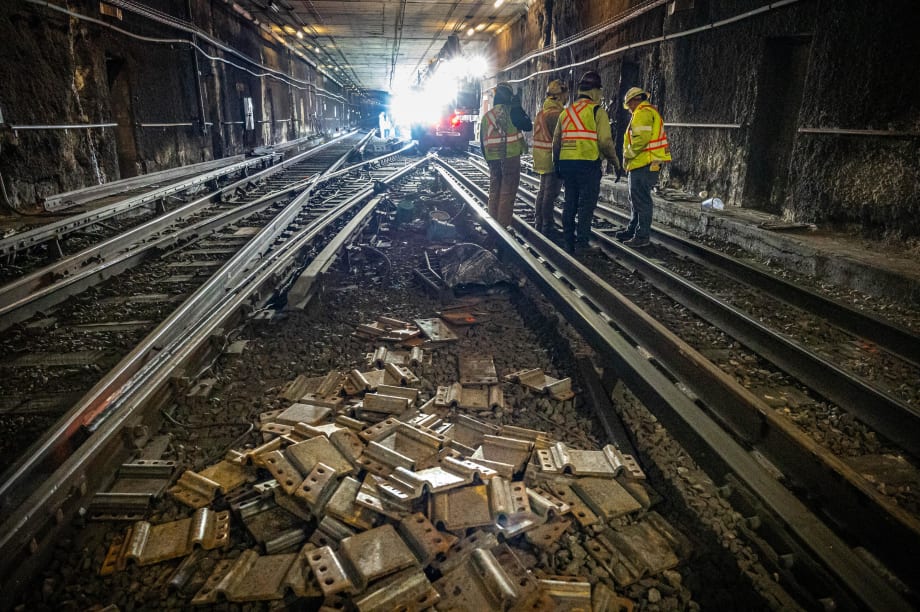
Crews accomplished this critical work due to unencumbered access to track areas while Red Line service was suspended between Alewife and Harvard stations for 10 days from February 5 to 14.
The important work means riders will experience a more reliable trip on the Red Line with fewer unplanned service disruptions related to older tracks, older infrastructure, signal issues, or power problems.
Photo: MBTA Customer and Employee Experience Department
3 min to read
Boston’s MBTA announced the successful and on-time completion of critical track work on the Red Line, which removed eight safety-related speed restrictions.
Crews accomplished this critical work due to unencumbered access to track areas while Red Line service was suspended between Alewife and Harvard stations for 10 days from February 5 to 14. In the evenings beginning at approximately 8:45 PM during the same period from February 5 to 14, the Red Line service suspension was extended to Park Street.
Ad Loading...
“We are committed to rebuilding our infrastructure, and the amount of work we were able to accomplish will improve service and reduce travel time along the Red Line,” said MBTA GM/CEO Phillip Eng. “This is another major step in the right direction. While we successfully completed the work and eliminated these speed restrictions, we continually look for lessons learned to minimize impacts as we move forward and accomplish even more work during future outages.”
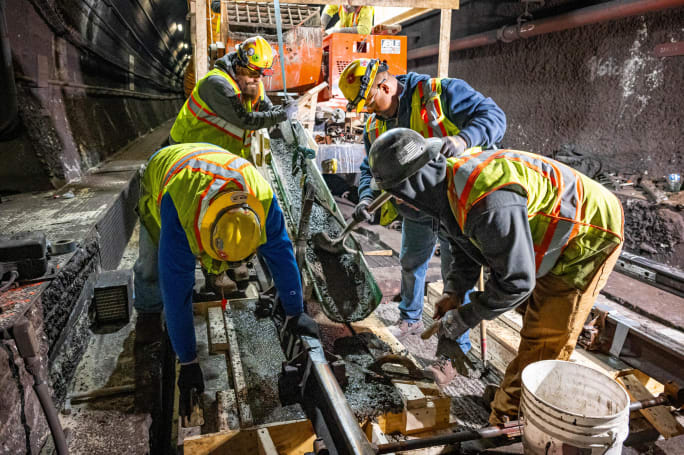
Crews repaired concrete slabs along the Red Line track area.
Photo: MBTA Customer and Employee Experience Department
Improving Reliability
The important work means riders will experience a more reliable trip on the Red Line with fewer unplanned service disruptions related to older tracks, older infrastructure, signal issues, or power problems. Riders will also be provided with a safer ride as a result of this state of good repair work.
Crews continued to maximize the Red Line shutdown in a number of ways. With unencumbered access to Red Line stations, crews were able to accomplish station enhancements and amenity upgrades like new flooring and lighting, which further improved the customer experience.
Additionally, through extensive planning and close coordination between contractor crews and multiple MBTA Operations departments, the MBTA was able to maximize the shutdown time by having numerous contractor crews and MBTA personnel working side-by-side and collaboratively within the very tight and confined underground Red Line tunnel area to be as efficient as possible during the shutdown in service.
Among this critical work:
Ad Loading...
2,500 feet of rail was installed.
Successfully removed and replaced dozens of signal bonds, reinstalled approximately 3,500 feet of signal cable, and performed work on many track circuits within the diversion area.
Installed one switch and performed additional rail work.
Regauged the third rail and other rail work.
Performed tunnel inspections along the southbound track between Harvard and Central stations, making repairs as needed.
Performed repairs to ceiling areas.
Performed hands-on inspections at stations.
Performed signal modernization work at stations.
Installed a new standpipe at Kendall/MIT station.
Accomplished security camera improvements at stations.
A variety of other in-station work also took place along the Red Line to further enhance the rider experience, including cleaning, sanding, and painting wooden station benches; yellow tactile edging repairs to platforms; flooring and tile repairs; concrete repairs; stairway upgrades and repairs, including handrail repairs; waste receptacle replacements; plumbing and HVAC maintenance; installing/replacing station signage; and more.
Contract Four is the largest in the Second Avenue Subway Phase 2 project and includes construction of station infrastructure, tracks, and signals for the subway expansion, MTA officials said. Work on Contract Four will begin in 2027.
The Garden State Initiative analysis examines the roles of Amtrak infrastructure, fleet management, and agency operations while recommending a more performance-based approach to improving reliability.
Beginning in 2027, Stadler will provide on-site technical expertise, spare parts support, training, and obsolescence management to help extend the reliability and longevity of CapMetro’s GTW fleet.
In METRO's latest installment, we take a look at recent news from Complete Coach Works, Beep, FlixBus, and more partnerships making headlines across the transportation sector.
Pedestrian microsimulation is helping rail planners identify bottlenecks, test station designs, and prepare complex transit hubs for growing passenger volumes.
The privately developed project would offer a 15-minute trip between downtown and O’Hare’s Terminal 2, with trains operating every 15 minutes on a dedicated track. The service would use battery-electric trains and three existing freight rail rights-of-way.
The draft feasibility report identifies strategies to protect the coastal rail line for decades as the agency continues near-term stabilization and sand placement efforts.