



MBTA, STV, partners launch new Boston Landing Station
The station provides a vital link to the popular shoe and athletic apparel company’s 250,000-square-foot world headquarters and the overall Boston Landing development, encompassing 2.15 million square feet of office/lab, sports, entertainment, retail, hotel, and residential space.

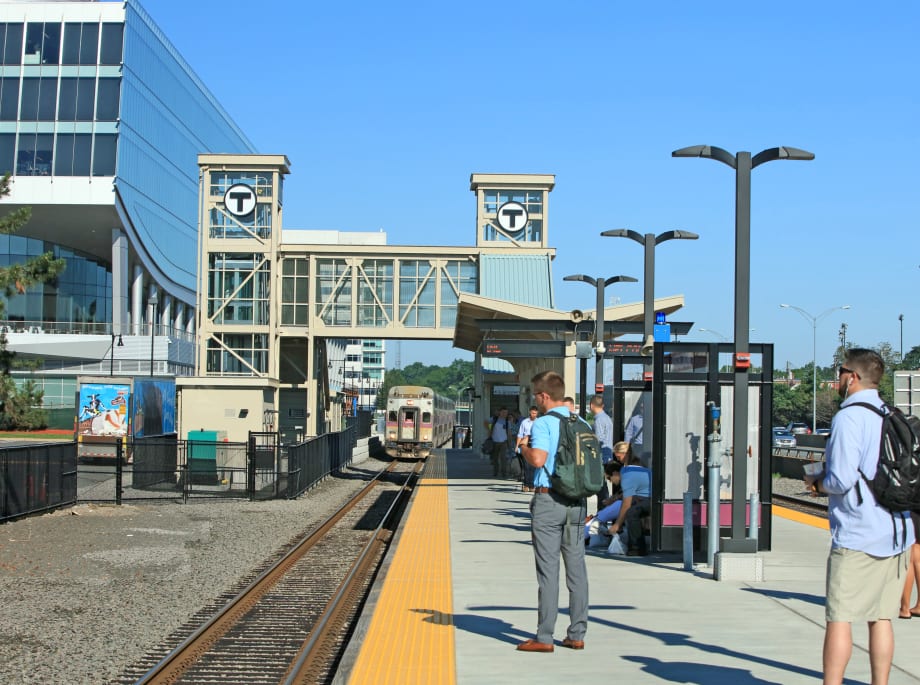
MBTA's new Landing Station. Photo courtesy STV
MBTA's new Landing Station. Photo courtesy STV
Commuter rail service is off to a running start near the new Boston Landing campus, world headquarters of New Balance Athletics, in Boston’s Brighton neighborhood, with STV working on the planning and design.
The new Boston Landing Station was designed by STV as part of an approximately $25 million public-private partnership (P3) between NB Development Group and Massachusetts transportation officials. The station provides a vital link to the popular shoe and athletic apparel company’s 250,000-square-foot world headquarters and the overall Boston Landing development, encompassing 2.15 million square feet of office/lab, sports, entertainment, retail, hotel, and residential space, including practice facilities for the Boston Bruins and Boston Celtics.
The station will serve customers along the Massachusetts Bay Transportation Authority’s (MBTA) Framingham/Worcester Line and its opening will mark the return of commuter rail service to the Allston-Brighton neighborhood for the first time since three stations were eliminated in the 1960s to make way for the Massachusetts Turnpike. The station is designed to provide easy access for employees, visitors, and residents of the 15-acre Boston Landing development and surrounding Allston-Brighton neighborhood. The station is initially expected to serve about 2,400 daily passengers.
The station features a state-of-the art 785-foot, high-level, center island platform with two platform canopies, accessible stairs, pedestrian bridge, and glass-enclosed elevators that provide easy access to the Boston Landing campus, Arthur Street, and the Everett Street bridge overpass. NB Development Group pursued the rail station as part of an overall Transit-Oriented-Development (TOD) initiative to maintain and attract a high-quality workforce along with first-in-class tenants to fill the commercial and residential components. The addition of transit also fulfills New Balance’s sustainability commitment — its corporate headquarters achieved the highest LEED® status of Platinum — and the overall campus is intended to be a first of its kind “health and wellness district” that focuses on fitness, sustainability, and support of the local economy.
STV has been involved with the project from the very beginning, developing the master plan for the commuter rail station and working with both the Massachusetts Department of Transportation and the MBTA on one of the Commonwealth’s first P3 projects. The use of the P3 allows NB Development Group to create a TOD that will provide access to an expanded workforce and give the MBTA the needed resources to reinstate service to the Allston-Brighton area.
STV went on to provide extensive engineering services for the design and construction of the new station while working with the MBTA and freight rail operator CSX to keep trains moving with minimal disruption.
More Rail

New York MTA Advances Final Contract for Second Avenue Subway Expansion
Contract Four is the largest in the Second Avenue Subway Phase 2 project and includes construction of station infrastructure, tracks, and signals for the subway expansion, MTA officials said. Work on Contract Four will begin in 2027.
Read More →
San Diego MTS Breaks Monthly Trolley Ridership Record
Agency officials said July’s ridership indicates MTS’s continued recovery from the pandemic.
Read More →
Report Examines NJ TRANSIT Reliability, Funding Challenges
The Garden State Initiative analysis examines the roles of Amtrak infrastructure, fleet management, and agency operations while recommending a more performance-based approach to improving reliability.
Read More →
Stadler, CapMetro Sign Long-Term Rail Fleet Support Agreement
Beginning in 2027, Stadler will provide on-site technical expertise, spare parts support, training, and obsolescence management to help extend the reliability and longevity of CapMetro’s GTW fleet.
Read More →
Biz Briefs: Alstom Lands Canadian Contract, LYT to Supply California TSP, and More
In METRO's latest installment, we take a look at recent news from Complete Coach Works, Beep, FlixBus, and more partnerships making headlines across the transportation sector.
Read More →
CATS Gold Line Marks 5 Years of Service, 2.8M Passenger Trips
With a six-mile expansion planned, the Charlotte streetcar is positioned to connect more neighborhoods and major transit hubs across the region.
Read More →
Why Simulating Pedestrian Movement Has Become Essential for Modern Rail Stations
Pedestrian microsimulation is helping rail planners identify bottlenecks, test station designs, and prepare complex transit hubs for growing passenger volumes.
Read More →
Amtrak Begins Major Construction at New York’s Sunnyside Yard
The new maintenance facility will support Amtrak’s Airo trainsets while improving maintenance efficiency and turnaround times in New York.
Read More →
Chicago Leaders Unveil Plans for O’Hare Airport Express Train
The privately developed project would offer a 15-minute trip between downtown and O’Hare’s Terminal 2, with trains operating every 15 minutes on a dedicated track. The service would use battery-electric trains and three existing freight rail rights-of-way.
Read More →
OCTA Maps Out 30-Year Strategy to Protect Coastal Rail Corridor
The draft feasibility report identifies strategies to protect the coastal rail line for decades as the agency continues near-term stabilization and sand placement efforts.
Read More →