




“What does it feel when you’re having a heart attack?”
Metro-North employees commended for saving colleague’s life
Jeff Ballard, a Brewster Yardmaster took his colleague’s pulse and recognized that he was having a heart attack.
April 26, 2017
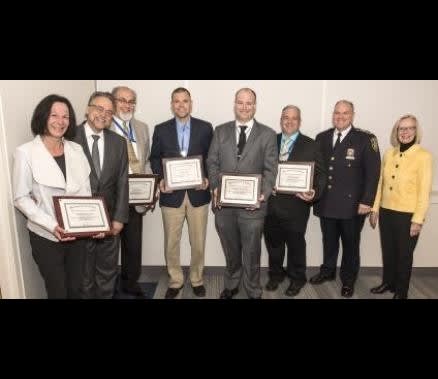
(Left to Right) Michele Salvatore, Metro-North President Joseph Giulietti, Jeff Ballard, Jeffrey Boyle, Andrew McClellan, Brendan Szabo, MTA Police Chief Owen Monaghan, MTA Board's Metro-North Railroad Committee Chair Susan Metzger.
3 min to read
(Left to Right) Michele Salvatore, Metro-North President Joseph Giulietti, Jeff Ballard, Jeffrey Boyle, Andrew McClellan, Brendan Szabo, MTA Police Chief Owen Monaghan, MTA Board's Metro-North Railroad Committee Chair Susan Metzger.
MTA Metro-North Railroad recognized five employees for saving a colleague who suffered a heart attack at the railroad’s Brewster Yard last month. Metro-North President Joseph Giulietti thanked the employees for their swift thinking and compassion at today’s meeting of the MTA Board’s Metro-North Railroad Committee.
The day was winding down for Jeff Ballard, a Brewster Yardmaster who resides in New Milford, Conn. He was typing in a few final figures at his computer before leaving for the day when a co-worker and colleague (who has asked that his identity remain private), asked him, “What does it feel when you’re having a heart attack?” Ballard, who worked for 20 years as an Emergency Medical Technician before coming to Metro-North, swiveled his chair around and looked at his colleague. “He was gripping his chest; his glasses were off, and he looked ashen. He told me that he was in a lot of pain, had shortness of breath and that he’d killed half a roll of Rolaids in twenty minutes,” said Ballard.
Ballard took his colleague’s pulse and recognized that he was having a heart attack. Wasting no time, Ballard gave him aspirin, which is considered helpful at the time of a heart attack. He immediately called the Brewster Mechanical Office Foreman, Jeff Boyle, who is an EMT and heads up the emergency response team there, as well as Brendan Szabo, a Mechanical Foreman and EMT who lives in Rhinebeck, New York.
As Boyle and Szabo arrived seconds later and initiated life-saving steps on their colleague and friend, Harlem Line Superintendent Michele Salvatore immediately contacted the regional emergency response team using 911. “He told us that he just wanted to go home, go to sleep and wait for his wife. We told him, no way. You’re staying put,” said Michelle.
“We placed him on oxygen, took his vitals and stabilized him until the ambulance arrived,” said Boyle. Downstairs, the MTA PD’s Sgt. James Smith, PO Armando Hernandez, PO Scott Hall, and PO Donna Snedecor cleared the area for the EMS. Trainmaster Andrew McClellan, from Danbury, Connecticut, directed the EMS upstairs to their colleague. “As scary as it was to see one of my co-workers and friends outside of work having a heart attack, it was incredibly reassuring to know that our own co-workers from Brewster mechanical are trained and equipped to respond to any medical emergency we have in literally a matter of seconds,” said McClellan.
When EMS arrived, they confirmed that the man was experiencing a true cardiac emergency, and he was transported to Danbury Hospital. Boyle and Szabo stayed with him inside the ambulance. In all, their stricken colleague was attended to by the first team in less than six minutes, and by the regional team in less than twelve minutes.
“What really sticks out for me about that day is that it was a fellow employee, and that always hits close to home. I’m grateful that my friend and co-worker had a speedy recovery and is now back with us here at Brewster,” said Szabo.
“Quick action on the part of our Brewster District team saved this man’s life,” said Joseph Giulietti, Metro-North President. “This incident demonstrates the character and compassion of Metro-North employees. They not only care about doing their jobs in an exemplary fashion, they care about one another. I’m proud to recognize Jeff, Brendan, Michele, Andrew and Jeff, and I thank them for their efforts.”
More Rail
Amtrak, CN Reach Agreements to Strengthen Passenger Rail Service, Safety
The agreement resolves a more than decade-long proceeding before the Surface Transportation Board concerning the terms and conditions for Amtrak services, such as the City of New Orleans, Illini/Saluki, and Wolverine.
Read More →
New York MTA Advances Final Contract for Second Avenue Subway Expansion
Contract Four is the largest in the Second Avenue Subway Phase 2 project and includes construction of station infrastructure, tracks, and signals for the subway expansion, MTA officials said. Work on Contract Four will begin in 2027.
Read More →
San Diego MTS Breaks Monthly Trolley Ridership Record
Agency officials said July’s ridership indicates MTS’s continued recovery from the pandemic.
Read More →
Report Examines NJ TRANSIT Reliability, Funding Challenges
The Garden State Initiative analysis examines the roles of Amtrak infrastructure, fleet management, and agency operations while recommending a more performance-based approach to improving reliability.
Read More →
Stadler, CapMetro Sign Long-Term Rail Fleet Support Agreement
Beginning in 2027, Stadler will provide on-site technical expertise, spare parts support, training, and obsolescence management to help extend the reliability and longevity of CapMetro’s GTW fleet.
Read More →
Biz Briefs: Alstom Lands Canadian Contract, LYT to Supply California TSP, and More
In METRO's latest installment, we take a look at recent news from Complete Coach Works, Beep, FlixBus, and more partnerships making headlines across the transportation sector.
Read More →
CATS Gold Line Marks 5 Years of Service, 2.8M Passenger Trips
With a six-mile expansion planned, the Charlotte streetcar is positioned to connect more neighborhoods and major transit hubs across the region.
Read More →
Why Simulating Pedestrian Movement Has Become Essential for Modern Rail Stations
Pedestrian microsimulation is helping rail planners identify bottlenecks, test station designs, and prepare complex transit hubs for growing passenger volumes.
Read More →
Amtrak Begins Major Construction at New York’s Sunnyside Yard
The new maintenance facility will support Amtrak’s Airo trainsets while improving maintenance efficiency and turnaround times in New York.
Read More →
Chicago Leaders Unveil Plans for O’Hare Airport Express Train
The privately developed project would offer a 15-minute trip between downtown and O’Hare’s Terminal 2, with trains operating every 15 minutes on a dedicated track. The service would use battery-electric trains and three existing freight rail rights-of-way.
Read More →