




RELATED: Sen. calls for NJ Transit, Metro-North to improve emergency communications
Metro-North Railroad to receive up to 94 M8 cars for New Haven Line
The new cars will come outfitted with security cameras and positive train control equipment when they are delivered to the railroad.
November 16, 2016
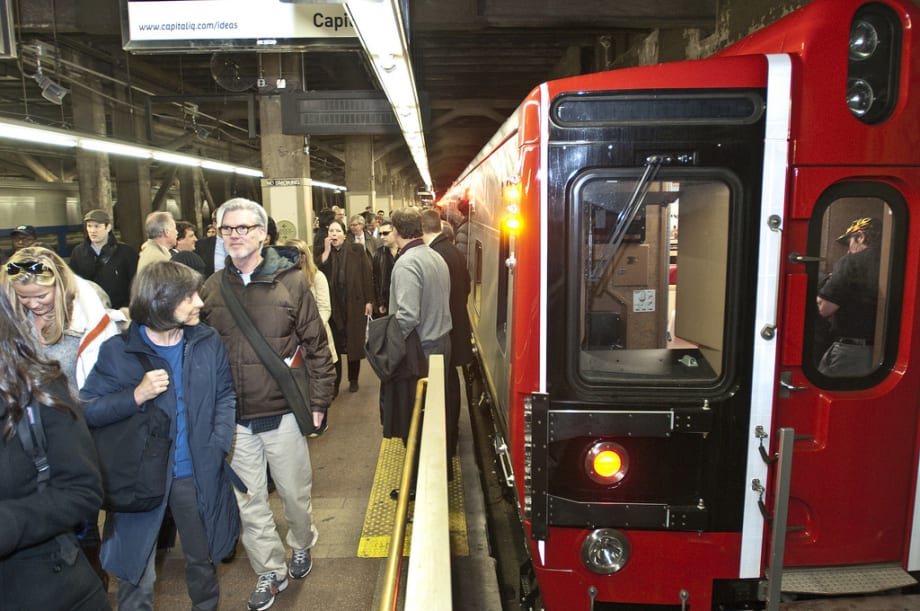
Photo: Metropolitan Transportation Authority/Patrick Cashin
3 min to read
Photo: Metropolitan Transportation Authority/Patrick Cashin
New York's Metropolitan Transportation Authority (MTA) Board approved an order for at least 60, and up to a total of 94, additional new M8 railcars, which provide train service on Metro-North Railroad’s New Haven Line.
The cars, the first of which are expected to enter service in three years, will allow the railroad to lengthen rush hour trains, retire its last 36 older M2 cars, increase safety, and have flexibility to increase train service in the years ahead to meet ridership increases. The cars, to be built by Kawasaki Rail Car Inc., will supplement the 405 M8 cars already in use on the New Haven Line and New Canaan Branch.
The order consists of a base order of 60 cars and an option for an additional 34 cars. The base order is expected to include the retrofit of 10 existing M8 cars into café cars.
The M8 cars have improved customer satisfaction levels and have achieved very high mechanical reliability, far in excess of expectations. Additionally, the new M8 are designed to be enabled with positive train control from the time they enter service. Through September, the cars are averaging 460,277 miles between mechanical breakdowns, the best rate for New Haven Line cars in decades and 53% above the railroad’s goal for the cars.
T
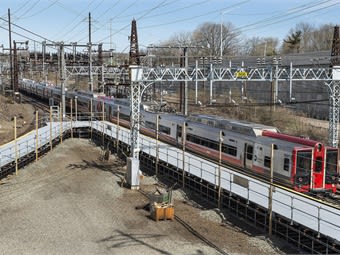
Photo: Metropolitan Transportation Authority / Patrick Cashin
he M8 cars are the most technologically sophisticated in Metro-North’s fleet. They have third rail shoes that can receive 700- to 750-volt direct current to power the trains between Pelham and Grand Central Terminal, and the capability to run under two types of alternating current from overhead wire, known as catenary. The New Haven Line and its New Canaan Branch use 60-cycle, 12.5-kilovolt power. The cars can also operate at the higher, 60-cycle, 25-kilovolt power, which is used on the Shore Line East route east of New Haven.
Three hundred eighty of the current cars are in permanently coupled pairs; each pair’s “A” car has 110 seats and each “B” car has 101 seats plus a handicapped-accessible, airline-style vacuum toilet and space for wheelchair seating or bicycles to be stored on wall-mounted hooks.
Each row of seats is outfitted with electrical outlets, grab bars, coat hooks, and overhead luggage racks. The color scheme is a vibrant red, the historical color of the New York, New Haven and Hartford Railroad, a predecessor to Metro-North. Outside, customers see prominent electronic destination signs and hear public address announcements from external speakers. Single-leaf doors provide high reliability and less susceptibility to snow intrusion.
The existing M8 cars, like the rest of Metro-North’s fleet, are being upgraded to enable them to operate with enhanced PTC. The existing cars are also being retrofitted to include security cameras in engineers’ cabs and in the customer areas of the trains. The new M8 cars will not need to be retrofitted, they will come enabled with cameras and PTC equipment when they are delivered to the railroad.
The M8 coach cars for use on the New Haven Line are funded 65% by the State of Connecticut and 35% by the MTA Capital Program. M8 café cars are funded entirely by the State of Connecticut.
More Rail
Amtrak, CN Reach Agreements to Strengthen Passenger Rail Service, Safety
The agreement resolves a more than decade-long proceeding before the Surface Transportation Board concerning the terms and conditions for Amtrak services, such as the City of New Orleans, Illini/Saluki, and Wolverine.
Read More →
New York MTA Advances Final Contract for Second Avenue Subway Expansion
Contract Four is the largest in the Second Avenue Subway Phase 2 project and includes construction of station infrastructure, tracks, and signals for the subway expansion, MTA officials said. Work on Contract Four will begin in 2027.
Read More →
San Diego MTS Breaks Monthly Trolley Ridership Record
Agency officials said July’s ridership indicates MTS’s continued recovery from the pandemic.
Read More →
Report Examines NJ TRANSIT Reliability, Funding Challenges
The Garden State Initiative analysis examines the roles of Amtrak infrastructure, fleet management, and agency operations while recommending a more performance-based approach to improving reliability.
Read More →
Stadler, CapMetro Sign Long-Term Rail Fleet Support Agreement
Beginning in 2027, Stadler will provide on-site technical expertise, spare parts support, training, and obsolescence management to help extend the reliability and longevity of CapMetro’s GTW fleet.
Read More →
Biz Briefs: Alstom Lands Canadian Contract, LYT to Supply California TSP, and More
In METRO's latest installment, we take a look at recent news from Complete Coach Works, Beep, FlixBus, and more partnerships making headlines across the transportation sector.
Read More →
CATS Gold Line Marks 5 Years of Service, 2.8M Passenger Trips
With a six-mile expansion planned, the Charlotte streetcar is positioned to connect more neighborhoods and major transit hubs across the region.
Read More →
Why Simulating Pedestrian Movement Has Become Essential for Modern Rail Stations
Pedestrian microsimulation is helping rail planners identify bottlenecks, test station designs, and prepare complex transit hubs for growing passenger volumes.
Read More →
Amtrak Begins Major Construction at New York’s Sunnyside Yard
The new maintenance facility will support Amtrak’s Airo trainsets while improving maintenance efficiency and turnaround times in New York.
Read More →
Chicago Leaders Unveil Plans for O’Hare Airport Express Train
The privately developed project would offer a 15-minute trip between downtown and O’Hare’s Terminal 2, with trains operating every 15 minutes on a dedicated track. The service would use battery-electric trains and three existing freight rail rights-of-way.
Read More →