



Milwaukee Launches Coach/Bus Operator and Mechanic Apprenticeships
The programs align with Gov. Tony Evers’ statewide recognition of apprenticeships as a cornerstone of Wisconsin’s workforce development strategy.

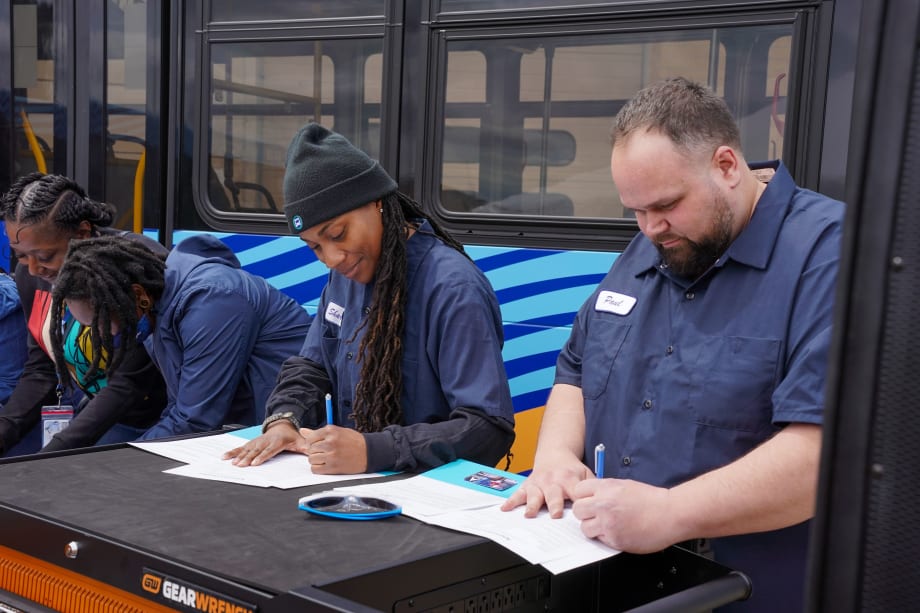
The apprenticeship event featured remarks from state and county leaders, a ceremonial apprenticeship signing, and a presentation of toolboxes and gear to the inaugural class of apprentices.
Photo: MCTS
The Milwaukee County Transit System (MCTS) launched new Coach/Bus Mechanic and Bus Operator Registered Apprenticeship programs, in partnership with the Wisconsin Department of Workforce Development (DWD) and the Amalgamated Transit Union (ATU).
The programs align with Gov. Tony Evers’ statewide recognition of apprenticeships as a cornerstone of Wisconsin’s workforce development strategy.
“We encourage other transit agencies across the state to start a similar workforce initiative to address the shortage of bus operators and mechanics,” said MCTS Interim President/CEO Julie Esch. “This shortage comes in the face of a growing trend of increased bus ridership in Wisconsin.”
MCTS’ Bus Mechanic Apprenticeship Program
MCTS is offering an 18-month Registered Apprenticeship program for mechanics, through the Wisconsin Department of Workforce Development Bureau of Apprenticeship Standards.
Once the apprentices fulfill program requirements, they can move into mechanic positions with MCTS.
The curriculum consists of hands-on learning and mentorship at MCTS.
Because the lack of a toolkit is often a barrier to moving up the career ladder into a mechanic position, MCTS will award each mechanic apprentice with a set of tools valued at $4,000 for their training, which will become the apprentice’s own when they complete the program.
Each apprentice will earn between $30 to $33 per hour (depending on their position prior to starting the program). Each trainer will receive an additional $4 per hour above their current wages for their time invested in the apprentices.
The apprentices will receive a Coach/Bus Mechanic Journey worker’s card issued by the State of Wisconsin upon completion of the program.
The goal is to begin each 18-month program with two mechanic apprentices.
About the Bus Operator Program
The agency is also offering a 12-month Registered Apprenticeship program for new bus operators, through the Wisconsin Department of Workforce Development Bureau of Apprenticeship Standards.
In addition to on-the-job learning, apprentices will also meet with a mentor who will provide additional guidance to ensure the long-term success of the apprentice.
The apprenticeship program is expected to improve the retention of new bus operators.
The operator apprentices are selected both internally and externally for the full-year program. Each candidate will have excellent customer service skills.
Each operator apprentice will be assigned to a mentor. The mentor will be a current employee who can coach the new employee and share experiences — all have been bus operators at Milwaukee County Transit System for at least three years.
Each apprentice will earn $24.54 per hour. Each mentor-trainer will receive an additional $2 per hour above their current wages for their time invested in the apprentices.
Apprentices will receive a Coach/Bus Operator Journey worker’s card issued by the State of Wisconsin upon completion of the program.
MCTS’s goal is to begin with an inaugural group of 25 operator apprentices and two mechanic apprentices, with the agency now accepting applications for the next class in the fall.
More Management

METRO Opens Submissions for 2026 Motorcoach Awards
Nominations are now being accepted for METRO Magazine’s Operator of the Year and Innovative Operator of the Year awards.
Read More →
New York MTA Advances Final Contract for Second Avenue Subway Expansion
Contract Four is the largest in the Second Avenue Subway Phase 2 project and includes construction of station infrastructure, tracks, and signals for the subway expansion, MTA officials said. Work on Contract Four will begin in 2027.
Read More →
Transit Agencies Highlight Safety Gains at National Summit
Leaders from 15 major transit systems shared crime-reduction results and safety initiatives while discussing the role of continued federal support.
Read More →

NITA Names New Leadership, Expands Reduced-Fare Program at First Board Meeting
The new regional transit authority appointed its first board chair and interim executive director while extending reduced fares across CTA, Metra, and Pace for eligible riders.
Read More →
Beyond the Checklist: A Structured Approach to Transit Maintenance
Reliability-Centered Maintenance helps transit agencies move beyond routine checklists to focus limited resources on the assets and failures that have the greatest impact on safety, reliability, and service.
Read More →
APTA 2026 Nominating Committee Selects Leadership Slate, Names Chair and Vice Chair Nominees
Leadership changes will help shape the association’s priorities and its representation of the transportation industry during the 2026–2027 term.
Read More →
DART Launches Major Security, Fare Enforcement Initiative
The 90-day demonstration will deploy coordinated security teams at five light rail stations while testing controlled access and gathering data to guide future investments.
Read More →
Advancing Fare Collection Through Technology and Innovation
Learn about delivering 1300 gates at 91 stations while managing fare evasion. Explore the large scale deployment, solution customization and real-world results that affect the region. Prepare for deployment in your region now.
Read More →
Game Day in Motion: Moving Millions During the 2026 World Cup
Between packed transit stations and team motorcoaches, see how agencies and operators across North America tackled the transportation demands of the 2026 FIFA World Cup.
Read More →
Surface Transportation Extension Averts Shutdown, Leaves Transit Funding Gap
The stopgap keeps federal transportation programs moving, but missing advance funding could complicate the transit and rail projects agencies are planning next.
Read More →