



MTA subway performance improving, officials call for congestion pricing
The MTA is in a dire financial position, officials say, with an operating budget deficit of approximately $500M as early as 2020.

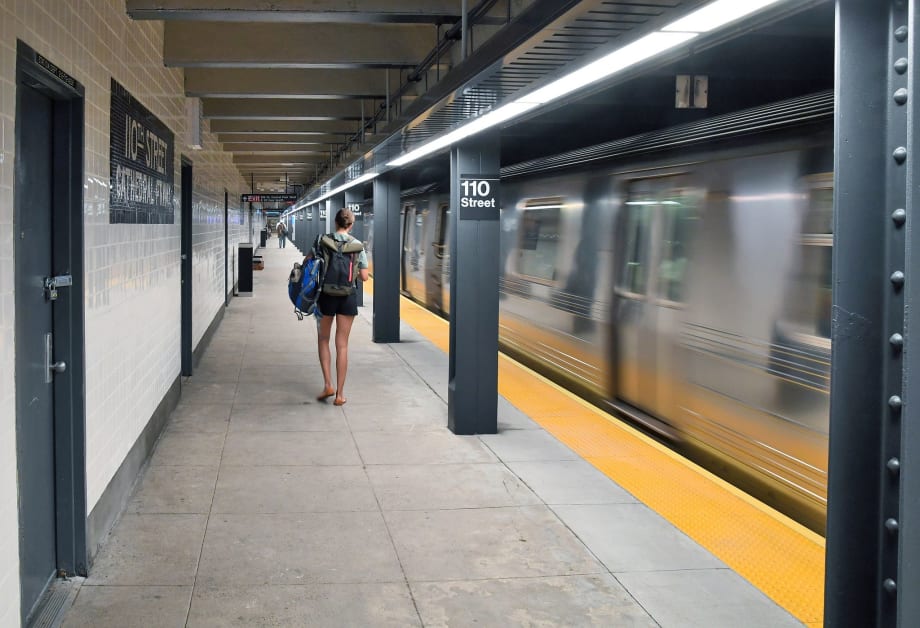
The Subway Action Plan was launched at the direction of Gov. Andrew Cuomo in July 2017
Marc A. Hermann
The Subway Action Plan was launched at the direction of Gov. Andrew Cuomo in July 2017
Marc A. Hermann
Metropolitan Transportation Authority (MTA) President Patrick Foye, Managing Director Ronnie Hakim, and New York City Transit President Andy Byford outlined new statistics showing the dramatic subway performance improvements that have been achieved since the launch of the Subway Action Plan. They pointed to a months-long trend of improvement, including the best on-time performance and the fewest number of delays that the system has seen in four years.
The Subway Action Plan was launched at the direction of Gov. Andrew Cuomo in July 2017, and funded by the governor, legislature, and city, with the goal of taking extraordinary measures to stabilize and improve the more than 100-year old subway system.
The officials also noted the MTA is in a dire financial position, with an operating budget deficit of approximately $500 million as early as next year, growing to nearly $1 billion by 2022. The agency also has zero funding allocated for its next capital plan (2020-2024). For progress to continue, they noted it is absolutely necessary to pass congestion pricing and secure additional and reoccurring revenue from city and state funding partners. Without additional revenue from congestion pricing, fares would increase by approximately 30%, over currently scheduled increases.
“Our concerted efforts are paying off in the form of fewer delays, less waiting, faster trips, and an overall better experience for our customers,” said MTA New York City Transit President Andy Byford. “These are sustainable improvements resulting from the Subway Action Plan, but we’re also limited by an aging infrastructure - in order to achieve the subway system that New Yorkers deserve and that Transit employees are capable of delivering, we need sustainable, adequate funding through means such as congestion pricing.”
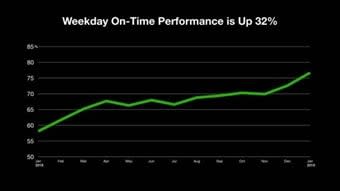
Weekday on-time performance is up 32% according to the MTA.
MTA
Weekday on-time performance in January was 76.7%, as opposed to 58.1% in January 2018, — an approximately 32% improvement. January also represents the fifth consecutive month that the Department of Subways exceeded its goal of reducing 10,000 delays each month. In January 2019, there were 42,348 weekday delays, compared to 76,287 in January 2018. Weekday major incidents — incidents causing 50 or more delays — are also drastically down in January, with 52 compared to 105 in January 2018.
Weekend on-time performance is also drastically improved. In January 2019 compared to January 2018, there were seven major incidents compared to 14; 83.1 percent on-time performance compared to 64.7%; and 8,180 delays compared to 18,931.
Delay-inducing track fires caused by debris are also significantly down — a direct result of aggressive debris cleanup under the Subway Action Plan. In January 2019, there were 23 track debris fires, compared to 42 in January 2018. In the 12 months leading up to January 2019, there were 322 track fires related to debris, compared to 452 the previous year.
Several other metrics also point to evidence of the Subway Action Plan's effectiveness. Additional unanticipated time spent waiting on platforms is down to one minute 11 seconds compared to one minute 35 seconds and additional unanticipated time spent on trains is down to 58 seconds compared to one minute 46 seconds.
More Management
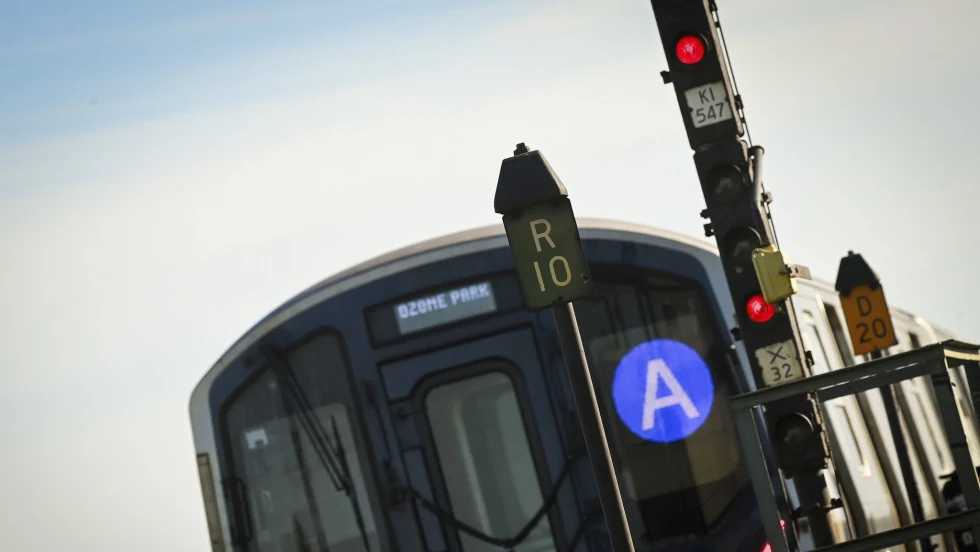
New York MTA Launches Historic $1.9B Signal, Track Modernization Project
Funded in part by congestion pricing revenue, the project will replace nearly century-old signals along the A and C lines in Brooklyn and Queens.
Read More →
Brian Dickson on Building Stronger, More Resilient Transportation Organizations
Bus Business Consultants Founder Brian Dickson discusses the leadership principles, operational discipline, and strategic planning that separate transportation companies positioned for long-term success from those stuck in survival mode.
Read More →
LA Metro Breaks Ground on Vermont BRT Project
The 12.4-mile corridor is projected to serve 66,200 daily riders, reduce travel times by up to 24%, and create the nation's busiest bus rapid transit corridor.
Read More →
Building Stronger Leaders, More Resilient Transit Teams
Dr. Carol Parker Walsh discusses leadership development, employee retention, workplace culture, and preparing transit’s workforce for AI and automation.
Read More →
Roman Cornell on ABC Companies’ Evolution and the Future of Passenger Transportation
The company’s CEO discusses carrying forward a third-generation family legacy, ABC’s continued evolution in passenger transportation, support for increasingly complex fleets, and how technology and continued investment could help operators improve uptime.
Read More →
CATS Launches West Charlotte Microtransit Zone, Expands Transit Services
The new microtransit zone connects residents to key destinations as Charlotte Area Transit System rolls out the first phase of its 2055 Transit System Plan.
Read More →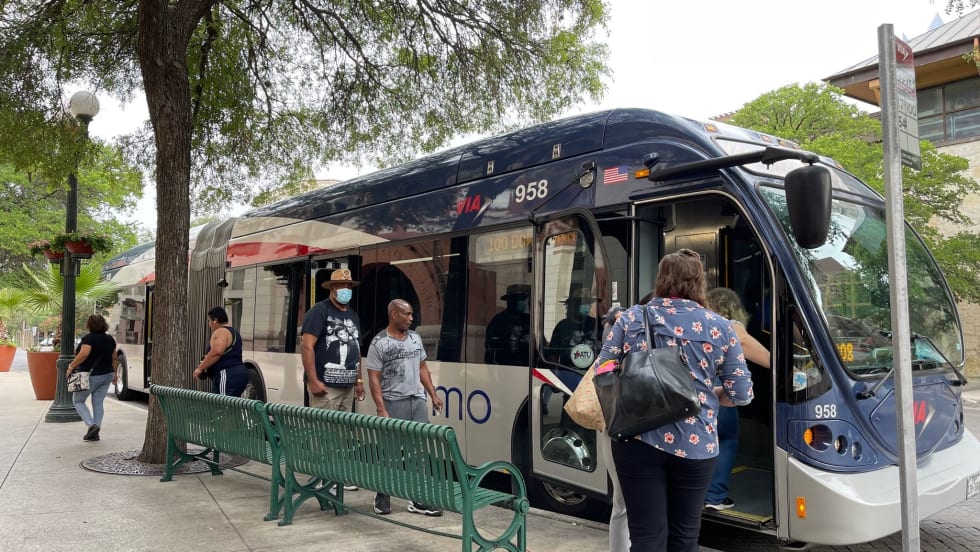
VIA Bus Ridership Grows 10.1% Through August 2026
San Antonio's VIA Metropolitan Transit reported the highest bus ridership growth among major Texas transit systems. Federal Transit Administration data ranked it second among the nation's 50 largest transit systems.
Read More →
CSA Group Releases Climate Resilience Standard for Transit, Passenger Rail
Developed with support from the Standards Council of Canada, CSA D700 guides assessing climate-related risks and planning adaptation measures for transit and passenger rail systems.
Read More →
ETA CEO John Maglio on Transit Technology, Innovation, and Building Agency Trust
ETA founder and CEO John Maglio explores the evolution of transit technology, the importance of reliable systems, and how stronger partnerships can help agencies improve operations and the passenger experience.
Read More →
COTA Launches First Customer Experience Action Plan to Improve Transit Service
The new plan outlines improvements to service reliability, accessibility, communication, and the overall rider experience across Central Ohio's transit system.
Read More →