



MTA to Commence Environmental Assessment of Interborough Express Project
The commencement of environmental review marks the first significant milestone reached for the IBX, following Gov. Hochul’s announcement in August that the project had entered the preliminary engineering and design phase.

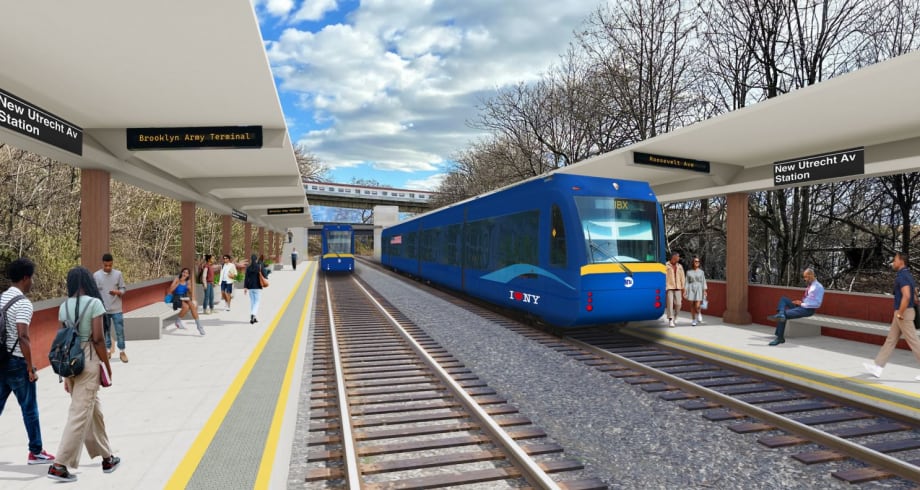
The Interborough Express is a generational transit investment that will connect nearly 900,000 New Yorkers in underserved areas of Brooklyn and Queens to the subway, bus, and Long Island Rail Road.
Photo: NY MTA
The New York Metropolitan Transportation Authority (MTA) is beginning the environmental review process for the forthcoming Interborough Express (IBX) under the New York State Environmental Quality Review Act.
The commencement of environmental review marks the first significant milestone reached for the IBX, following Gov. Hochul’s announcement in August that the project had entered the preliminary engineering and design phase.
“The IBX will dramatically improve the commutes of over 160,000 daily riders, and we are moving full-speed ahead to keep this transformational project on track,” Gov. Hochul said. “Beginning environmental review is yet another statement of intent that in New York, we don’t just talk about major infrastructure projects, we build them.”
Opening Feedback
To initiate the environmental review, a series of three public meetings will be held to outline the project's scope and the review process.
The environmental review process will run concurrently with the ongoing preliminary design and engineering phase of the project, which commenced in August.
Following public outreach, the SEQRA process will produce a Draft Scoping Document and, ultimately, a draft Environmental Impact Statement on the project. This process will assess the potential significant environmental benefits and impacts of the IBX project.
“900,000 New Yorkers live along the proposed IBX route, and we’re not going to waste any time advancing this project for them,” said MTA Chair/CEO Janno Lieber. “Launching the State environmental review process gives us the momentum we need to move this transformational effort toward construction."
The IBX Project
The Interborough Express is a generational transit investment that will connect nearly 900,000 New Yorkers in underserved areas of Brooklyn and Queens to the subway, bus, and Long Island Rail Road.
The project will also significantly reduce travel times between the two boroughs, with an end-to-end run time of 32 minutes along an existing 14-mile freight line owned by the MTA and CSX Corp.
In August, the MTA’s board authorized the selection of a joint venture between Jacobs and HDR, which will oversee the design and engineering phase of the IBX.
The project design, which commenced this summer, focuses on the design of a light rail system. This was determined to offer the best service to riders at the best value to the MTA, with about 70% of projected IBX riders expected to transfer within the MTA system.
The project design work encompasses communications and signal design, vehicle design, track design, station design, and other key components.
Once the design process is completed, the next step will ultimately create 19 stations that connect with 17 different subway lines, 50 bus routes, and two LIRR stations. The IBX will be the first new end-to-end rapid transit system built entirely within New York City since the IND Crosstown Line, now called the Crosstown Line, which fully opened in 1937.
IBX stations in Queens will be the first new transit stations built since the Archer Avenue extension of the E, J, and Z lines to Jamaica in 1988.
Funding for the Project
The current project design phase is funded mainly through $45 million secured by Gov. Hochul in New York State’s 2025 budget and the MTA’s 2025-2029 Capital Plan. The total estimated cost of the IBX project is $5.5 billion, with 50% of the total funding for the project secured by Gov. Hochul in the MTA’s 2025-2029 Capital Plan.
Since 2023, the MTA has hosted 10 open houses attended by nearly 1,000 community members along the route to raise awareness and gather feedback.
The MTA also held pop-up outreach at 10 locations across the IBX corridor, speaking with 1,300 members of the public and over 250 businesses. Every quarter, the MTA hosts a virtual community council meeting on the project, featuring elected officials, community groups, and community boards.
More Rail

New York MTA Advances Final Contract for Second Avenue Subway Expansion
Contract Four is the largest in the Second Avenue Subway Phase 2 project and includes construction of station infrastructure, tracks, and signals for the subway expansion, MTA officials said. Work on Contract Four will begin in 2027.
Read More →
San Diego MTS Breaks Monthly Trolley Ridership Record
Agency officials said July’s ridership indicates MTS’s continued recovery from the pandemic.
Read More →
Report Examines NJ TRANSIT Reliability, Funding Challenges
The Garden State Initiative analysis examines the roles of Amtrak infrastructure, fleet management, and agency operations while recommending a more performance-based approach to improving reliability.
Read More →
Stadler, CapMetro Sign Long-Term Rail Fleet Support Agreement
Beginning in 2027, Stadler will provide on-site technical expertise, spare parts support, training, and obsolescence management to help extend the reliability and longevity of CapMetro’s GTW fleet.
Read More →
Biz Briefs: Alstom Lands Canadian Contract, LYT to Supply California TSP, and More
In METRO's latest installment, we take a look at recent news from Complete Coach Works, Beep, FlixBus, and more partnerships making headlines across the transportation sector.
Read More →
CATS Gold Line Marks 5 Years of Service, 2.8M Passenger Trips
With a six-mile expansion planned, the Charlotte streetcar is positioned to connect more neighborhoods and major transit hubs across the region.
Read More →
Why Simulating Pedestrian Movement Has Become Essential for Modern Rail Stations
Pedestrian microsimulation is helping rail planners identify bottlenecks, test station designs, and prepare complex transit hubs for growing passenger volumes.
Read More →
Amtrak Begins Major Construction at New York’s Sunnyside Yard
The new maintenance facility will support Amtrak’s Airo trainsets while improving maintenance efficiency and turnaround times in New York.
Read More →
Chicago Leaders Unveil Plans for O’Hare Airport Express Train
The privately developed project would offer a 15-minute trip between downtown and O’Hare’s Terminal 2, with trains operating every 15 minutes on a dedicated track. The service would use battery-electric trains and three existing freight rail rights-of-way.
Read More →
OCTA Maps Out 30-Year Strategy to Protect Coastal Rail Corridor
The draft feasibility report identifies strategies to protect the coastal rail line for decades as the agency continues near-term stabilization and sand placement efforts.
Read More →