



MTI Report: Majority of Americans Back Gas Tax Hike for Road Maintenance
Support increases significantly when proposed measures are tied to specific outcomes, particularly roadway safety and infrastructure maintenance.

New MTI survey questions added this year explored which type of public or private organization respondents would prefer to verify the number of miles a vehicle drives, and whether a mileage fee should be adopted.
Credit: METRO
The Mineta Transportation Institute (MTI) has released findings from its 16th annual survey on public attitudes toward federal transportation funding. The results reveal that Americans are open to paying more — through higher gas taxes or a mileage-based fee — when they understand how the revenue will be used.
Support increases significantly when proposed measures are tied to specific outcomes, particularly roadway safety and infrastructure maintenance.
“An astounding 75% of Americans told us they would support paying an extra 10 cents per gallon in federal gas taxes if the revenue raised were dedicated to maintaining the transportation system,” explains study co-author Asha Weinstein Agrawal, PhD. “And almost as many (72%) would support that same increase if the revenue were dedicated to improving safety.”
She went on to explain that committing the new revenue to specific purposes that the public values is key to support for the tax increase. The survey found that support for the rate increase was only half as high if the revenue were dedicated to “transportation” in general (38%).
Rising Support
The survey series finds that support for increasing the federal gas tax rate has risen steadily since 2010. The figure below shows support for six options for raising the tax rate that differ only in the purposes for which the new revenue would be spent. Maintenance and safety improvements have always been the most popular options.
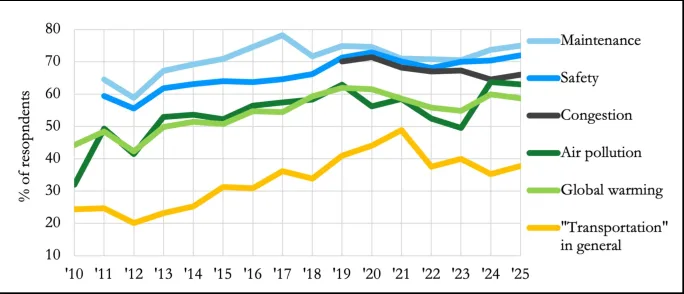
Trends in Support for Raising the Federal Gas Tax Rate to Support Different Types of Improvements (2010 – 2025).
Credit: MTI
Co-author Hilary Nixon, PhD, notes that the public also supports raising the tax rate to fund environmental objectives. “For more than 10 years, since 2013, at least half of the respondents have supported tax increases to pay for reducing air pollution and greenhouse gas emissions.”
Support for the different mileage fee options presented in the survey varied depending on the details of the tax option.
A majority of respondents (51%) supported replacing the gas tax with a green-rate mileage fee if the rate were set at an average of 3 cents per mile. Still, it varied according to the vehicle’s pollution emissions — more polluting vehicles would be charged a higher rate, and less polluting vehicles would pay a lower rate. By contrast, only 44% supported a flat-rate mileage fee of 3 cents per mile for all drivers.
The 2026 Survey
New survey questions added this year explored which type of public or private organization respondents would prefer to verify the number of miles a vehicle drives, and whether a mileage fee should be adopted.
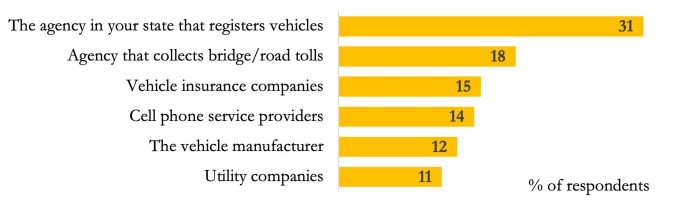
Preferred entity to collect mileage data (2025).
Credit: MTI
The most popular options among those tested were two government entities: state agencies responsible for vehicle registration or tolling. Fewer people opted for private companies, like vehicle insurance companies or vehicle manufacturers.
The survey also found that the majority of respondents supported lower mileage-fee rates for low-income drivers: almost two-thirds (63%) supported this option.
Other survey findings include:
If the federal government adopted a mileage fee, almost two-thirds of respondents would support charging a lower rate to low-income drivers.
82% of respondents want the federal government to prioritize spending federal revenue to improve how transportation agencies respond to disasters like wildfires, floods, and blizzards.
72% of respondents want the federal government to prioritize spending revenue to install cameras to enforce stricter rules against reckless driving, such as speeding or running red lights.
The survey data for this study were collected from a nationally representative sample of 2,539 adults living in the U.S. Respondents completed the online survey in February 2025.
More Management

METRO Opens Submissions for 2026 Motorcoach Awards
Nominations are now being accepted for METRO Magazine’s Operator of the Year and Innovative Operator of the Year awards.
Read More →
New York MTA Advances Final Contract for Second Avenue Subway Expansion
Contract Four is the largest in the Second Avenue Subway Phase 2 project and includes construction of station infrastructure, tracks, and signals for the subway expansion, MTA officials said. Work on Contract Four will begin in 2027.
Read More →
Transit Agencies Highlight Safety Gains at National Summit
Leaders from 15 major transit systems shared crime-reduction results and safety initiatives while discussing the role of continued federal support.
Read More →

NITA Names New Leadership, Expands Reduced-Fare Program at First Board Meeting
The new regional transit authority appointed its first board chair and interim executive director while extending reduced fares across CTA, Metra, and Pace for eligible riders.
Read More →
Beyond the Checklist: A Structured Approach to Transit Maintenance
Reliability-Centered Maintenance helps transit agencies move beyond routine checklists to focus limited resources on the assets and failures that have the greatest impact on safety, reliability, and service.
Read More →
APTA 2026 Nominating Committee Selects Leadership Slate, Names Chair and Vice Chair Nominees
Leadership changes will help shape the association’s priorities and its representation of the transportation industry during the 2026–2027 term.
Read More →
DART Launches Major Security, Fare Enforcement Initiative
The 90-day demonstration will deploy coordinated security teams at five light rail stations while testing controlled access and gathering data to guide future investments.
Read More →
Advancing Fare Collection Through Technology and Innovation
Learn about delivering 1300 gates at 91 stations while managing fare evasion. Explore the large scale deployment, solution customization and real-world results that affect the region. Prepare for deployment in your region now.
Read More →
Game Day in Motion: Moving Millions During the 2026 World Cup
Between packed transit stations and team motorcoaches, see how agencies and operators across North America tackled the transportation demands of the 2026 FIFA World Cup.
Read More →
Surface Transportation Extension Averts Shutdown, Leaves Transit Funding Gap
The stopgap keeps federal transportation programs moving, but missing advance funding could complicate the transit and rail projects agencies are planning next.
Read More →